
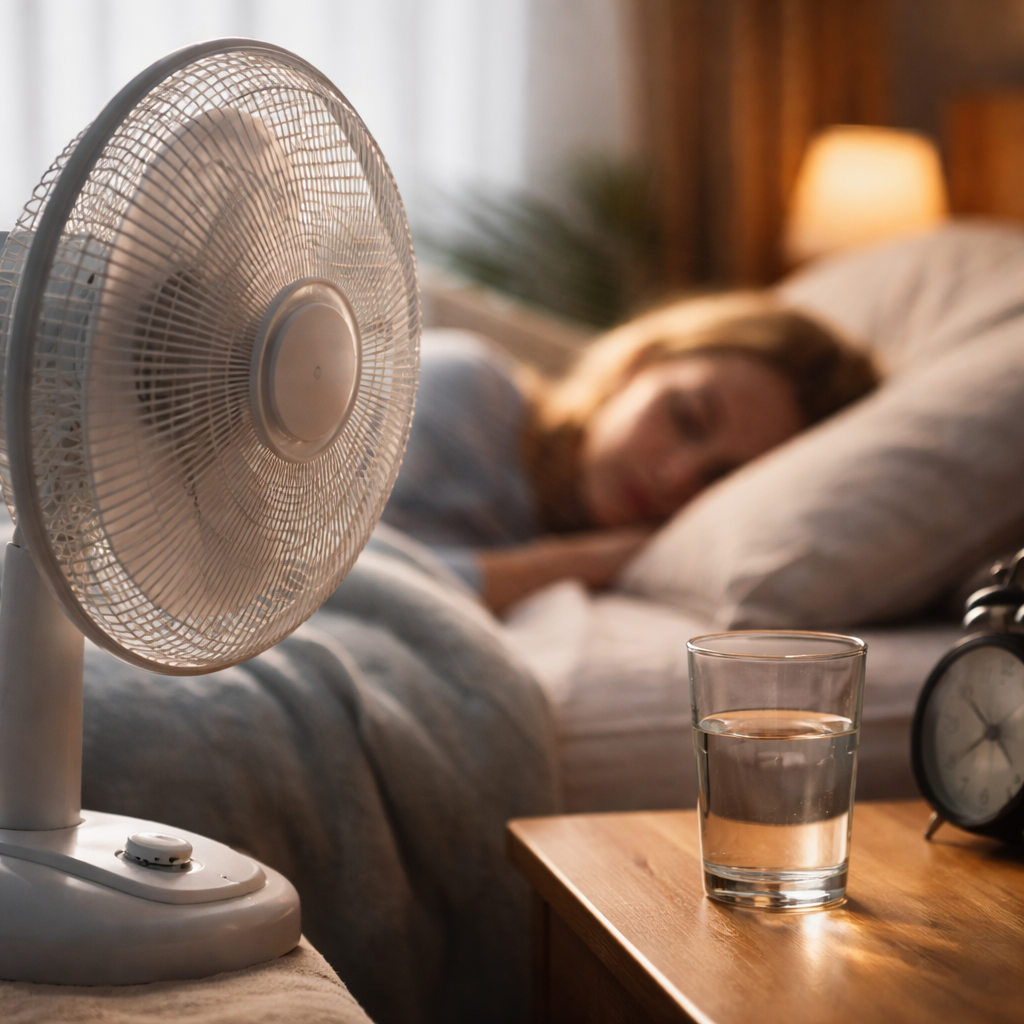
Millions of people sleep with a fan on every night, yet the question of whether is it safe to sleep with a fan blowing on you rarely gets a straight, science-backed answer — just vague warnings or blanket reassurances that don’t actually help you make an informed decision.
What actually happens to your body when a fan runs all night
A fan doesn’t cool the air — it moves it. That distinction matters more than most people realize. When airflow passes over your skin, it accelerates the evaporation of moisture, which creates a perception of coolness. For most healthy adults, this is completely harmless. Your body thermoregulates efficiently during sleep, and a gentle breeze doesn’t disrupt that process in any meaningful way.
Where things get more nuanced is around the airways. Continuous airflow throughout the night can dry out the mucous membranes in your nose and throat. These membranes serve as a first line of defense against airborne particles and pathogens. When they dry out, they become less effective at trapping dust and bacteria, which can leave some people waking up with a scratchy throat, mild congestion, or a stuffy nose — not because they’re sick, but because their nasal passages are simply irritated.
The real risks — and who should actually pay attention
For most people, sleeping with a fan is a non-issue. But for certain groups, the nightly airflow can genuinely aggravate existing conditions.
- People with asthma or allergies may find that a fan circulates dust, pet dander, and mold spores more actively around the room, triggering symptoms overnight.
- Those prone to dry eyes — especially contact lens wearers who fall asleep without removing lenses — may experience increased irritation if the fan is aimed at their face.
- Individuals with chronic sinusitis often report that direct airflow worsens congestion rather than relieving it, as dried-out passages can become more inflamed.
- People with muscle tension issues sometimes wake with stiffness in the neck or shoulders if cool air is directed at a specific part of the body for hours at a time.
If none of the above applies to you, the likelihood of any real harm from a fan is quite low. The key variable isn’t whether you use a fan — it’s how you use it.
Direct vs. indirect airflow: a difference worth knowing
There’s a meaningful difference between a fan pointed directly at your face and one that circulates air around the room. Direct airflow concentrates all the drying and cooling effects on one area of your body, which is where most of the complaints come from. Indirect airflow — a fan angled toward a wall or ceiling, or set to oscillate — keeps air moving without the same intensity of exposure.
Sleep specialists generally don’t flag fan use as a health concern for healthy adults. The more relevant question is air quality in the room itself — if the fan is stirring up dust from neglected surfaces or a dirty filter, that’s where the problem lies.
This is why regular cleaning matters more than most fan users acknowledge. Dust accumulates on fan blades quickly, and every rotation sends those particles back into the breathing zone. A fan cleaned every one to two weeks dramatically reduces this factor.
Practical setup guide for safer, better sleep with a fan
Getting the benefits of a fan without the downsides mostly comes down to small adjustments that take almost no effort to implement.
| Adjustment | Why it helps |
|---|---|
| Point the fan away from your head and face | Reduces drying of nasal passages and eyes |
| Use the oscillation setting | Prevents concentrated cold airflow on one body area |
| Keep a glass of water nearby | Helps rehydrate if you wake with a dry throat |
| Clean fan blades weekly | Lowers the amount of circulated dust and allergens |
| Run an air purifier alongside the fan | Improves overall bedroom air quality |
| Use a humidifier in very dry climates | Counteracts moisture loss from continuous airflow |
None of these require buying new equipment or overhauling your bedroom setup. Most are simply a matter of repositioning or adding a small habit to your routine.
What about white noise — is that part of the benefit?
For a large number of fan users, the sound is just as important as the airflow. The consistent, low-frequency hum of a fan functions as white noise, masking sudden sounds — traffic, neighbors, a phone notification — that would otherwise interrupt sleep. Research into white noise and sleep quality consistently shows that steady ambient sound can reduce the number of nighttime awakenings, particularly in urban environments or shared living spaces.
This is worth keeping in mind when weighing the pros and cons. If you find the fan helpful for falling and staying asleep, a white noise machine can deliver the same acoustic effect without any airflow — a useful option for people who want the sound benefit but experience dryness or allergy symptoms from the air movement itself.
One more thing before you turn that fan on tonight
The honest answer for most people is that a fan is not only safe to sleep with — it actively improves sleep comfort by managing temperature and sound. The cases where it causes genuine problems are real but fairly specific, and they’re almost always manageable with minor adjustments rather than complete avoidance.
Pay attention to how you feel in the morning. A consistently dry throat, increased allergy symptoms, or recurring muscle stiffness in one area are signals worth acting on. But if you wake feeling rested and comfortable, there’s no reason to give it a second thought. Your body tends to tell you what it needs — you just have to listen to the right signals.