
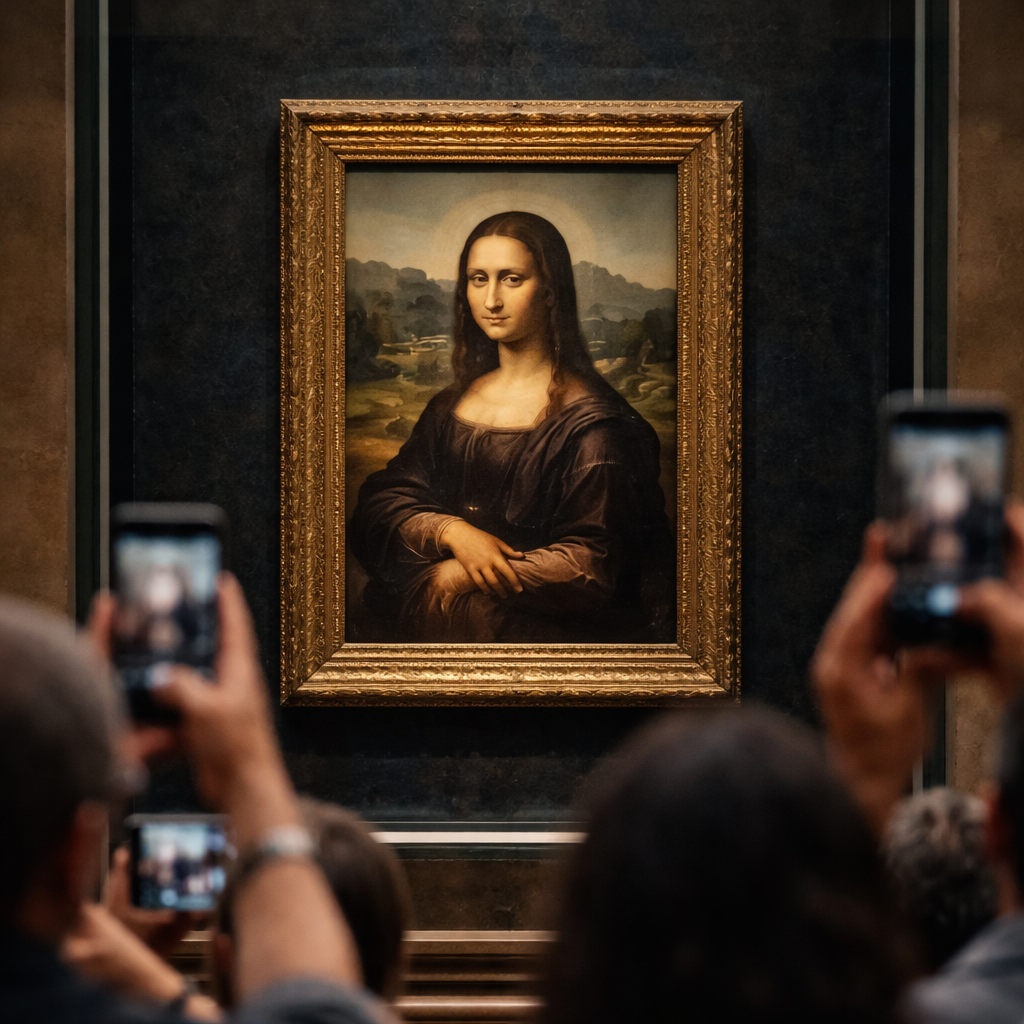
Most people recognize the painting instantly, yet the facts about the Mona Lisa continue to surprise even those who consider themselves art enthusiasts. Behind the calm expression and muted landscape lies a layered history of theft, scientific discovery, and centuries of debate that no museum label could ever fully capture.
She Is Smaller Than Most People Expect
One of the first things visitors notice when standing in front of the original at the Louvre is how compact the painting actually is. The Mona Lisa measures approximately 77 by 53 centimeters — closer to the size of a large hardcover book than the monumental canvas many imagine. Yet despite its modest dimensions, it draws larger crowds than almost any other artwork in the world, often surrounded by dozens of people holding up phones just to catch a glimpse.
The painting is displayed behind bulletproof glass in a climate-controlled environment, which means the viewing experience is more of a distant observation than an intimate encounter. That contrast — tiny painting, enormous reputation — is itself one of the most striking things about seeing it in person.
The Subject’s Identity Is Still Debated
The most widely accepted theory among art historians is that the woman depicted is Lisa Gherardini, the wife of a Florentine merchant named Francesco del Giocondo. This is why the painting is also known as La Gioconda in Italian and La Joconde in French. Leonardo da Vinci is believed to have begun the work sometime in the early sixteenth century, though he reportedly never considered it finished and carried it with him until his death.
“Leonardo used a technique called sfumato — layers of translucent glaze applied so finely that no brushstroke is visible to the naked eye. This gives the face its uniquely soft and almost breathing quality.”
Despite the widespread acceptance of the Lisa Gherardini theory, alternative proposals have been put forward over the years, including the idea that the subject could be a male figure or even a self-portrait of Leonardo himself. None of these alternatives have gained strong scholarly consensus, but they reflect how much uncertainty still surrounds the painting’s origins.
What Makes the Smile So Difficult to Read
The ambiguity of the expression has fascinated researchers for generations. Studies using digital imaging and neuroscience have explored why the smile appears to change depending on where you look. When your gaze focuses on the eyes, the mouth seems to curve upward. When you look directly at the lips, the smile appears more neutral.
This effect is connected to how peripheral and direct vision process contrast and shadow differently in the human eye. Leonardo’s mastery of light and shadow — particularly around the corners of the mouth and the edges of the eyes — created an expression that cannot be pinned down. It does not read as purely happy, sad, or amused. That deliberate ambiguity is now understood to be intentional, not accidental.
A Theft That Made the Painting World-Famous
Before the twentieth century, the Mona Lisa was respected but not the global icon it is today. That changed dramatically when the painting was stolen from the Louvre in 1911 by Vincenzo Peruggia, an Italian handyman who had worked in the museum. He hid inside overnight, removed the painting from the wall, and walked out with it concealed under his coat.
The theft sparked an international sensation. Newspapers ran the story on front pages across Europe and beyond. The empty wall space where the painting once hung attracted more visitors than the painting itself had before the theft. It took two years before the work was recovered — Peruggia had been keeping it in a trunk in his apartment in Florence and was caught when he tried to sell it to an art dealer.
| Event | Detail |
|---|---|
| Painting begun | Early 16th century, likely between 1503 and 1519 |
| Leonardo’s death | 1519, with the painting still in his possession |
| Theft from the Louvre | August 21, 1911 |
| Recovery | December 1913, in Florence, Italy |
| Current location | Musée du Louvre, Paris, Room 711 |
What Modern Technology Has Revealed
In recent decades, researchers have used infrared reflectography, multispectral imaging, and X-ray fluorescence to examine layers beneath the visible surface. These techniques have uncovered earlier compositional sketches, changes in the positioning of the figure’s hands, and evidence of underdrawing that Leonardo later modified.
One particularly significant finding involves the landscape in the background. The two sides of the background appear to sit at different horizon levels — the left side is lower than the right. Some researchers believe this was intentional, designed to make the figure appear taller and more imposing than the setting behind her. Others interpret it as an unresolved asymmetry left because the painting was never completed.
Worth knowing: The poplar wood panel on which the Mona Lisa is painted has developed a slight warp over the centuries. Conservators monitor it continuously, and the climate-controlled case at the Louvre is partly designed to prevent further warping that could eventually damage the paint layer.
Its Value, Its Copies, and Why It Cannot Be Sold
The Mona Lisa has no official market price and cannot legally be sold. Under French law, it is classified as property of the French Republic and is considered part of the national heritage. This makes any discussion of its monetary value purely theoretical, though estimates have ranged into the billions when adjusted for inflation and cultural significance.
There are hundreds of known copies of the painting produced across several centuries, many of them made by students or assistants working in Leonardo’s studio. One copy held at the Prado Museum in Madrid has attracted significant academic attention because it appears to have been painted simultaneously with the original, possibly by a student working alongside Leonardo. This copy offers a rare view of the Mona Lisa before much of the original’s varnish darkened the colors — the Prado version shows a brighter, lighter palette that may be closer to what Leonardo’s painting looked like when it was first completed.
- The painting has survived a flood, two world wars, and multiple vandalism attempts.
- It was once hung in the bedroom of Napoleon Bonaparte at the Tuileries Palace.
- The eyebrows and eyelashes are absent — likely lost to past restoration efforts or left unfinished.
- No single letter or diary entry by Leonardo explicitly mentions the Mona Lisa by name.
The Painting That Refuses to Be Fully Explained
After more than five centuries, the Mona Lisa remains a subject of active research, public fascination, and genuine scholarly disagreement. New imaging technologies continue to reveal details that previous generations could not see, while questions about the subject’s identity and Leonardo’s original intentions remain open. That combination of extraordinary craftsmanship and persistent mystery is probably the most honest explanation for why this relatively small panel painting has never lost its hold on the world’s attention.
What makes it enduringly interesting is not mysticism or legend but the very real complexity of how it was made, who it depicts, and how it found its way from a Renaissance workshop to a bulletproof case in one of the most visited buildings on earth. Each of those chapters is worth knowing — and most people who think they know the painting are surprised by how much more there is to discover.