
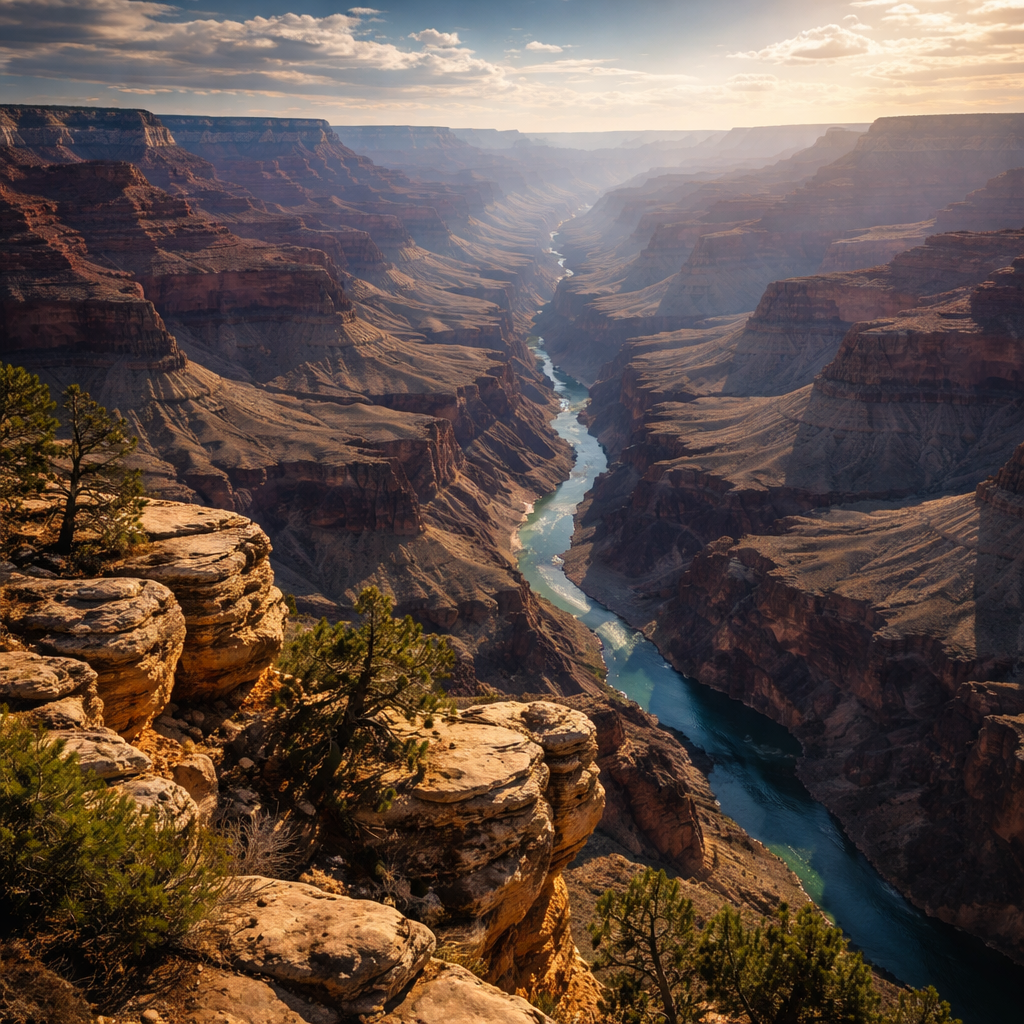
How deep can a river carve into solid rock over millions of years? The Grand Canyon answers that question better than any textbook ever could. The facts about the Grand Canyon read less like geography and more like a story that started long before humans walked the Earth — and understanding them changes the way you look at the landscape entirely.
The numbers that make your head spin
The Grand Canyon stretches approximately 277 miles along the Colorado River in Arizona. Its width varies dramatically — from 4 to 18 miles across — while its depth plunges over a mile straight down in places. That vertical distance is roughly the height of four Empire State Buildings stacked on top of each other.
But raw dimensions only tell part of the story. The canyon walls expose rock layers that date back nearly two billion years, making it one of the most complete geological records on Earth. Walking from the rim to the Colorado River at the bottom is, in a very real sense, walking backward through time.
| Feature | Measurement |
|---|---|
| Length | ~277 miles (446 km) |
| Maximum width | ~18 miles (29 km) |
| Maximum depth | ~6,093 feet (1,857 m) |
| Age of oldest exposed rock | ~1.8 billion years |
| Area of the national park | ~1,902 square miles |
What actually carved this place
The Colorado River is the primary force behind the canyon’s creation, but the process was never simple or linear. Geologists believe the river began cutting through the Colorado Plateau somewhere between 5 and 6 million years ago, though some research points to sections of the canyon being significantly older. The debate among scientists is still ongoing, which makes this landscape even more fascinating.
Water alone didn’t do all the work. Freezing and thawing cycles, rockfalls, wind erosion, and smaller tributary streams all contributed to widening and shaping the canyon walls. Each rainstorm continues this process today — the Grand Canyon is, technically speaking, still being formed.
“The Grand Canyon is not a static monument. It’s an active geological system, and every year erosion adds another chapter to its story.”
Life inside the canyon — more diverse than most expect
One of the least appreciated aspects of the canyon is its biodiversity. Because the elevation changes so dramatically from rim to river, the canyon essentially contains several distinct ecosystems layered on top of each other. The South Rim sits at around 7,000 feet and supports pine forests, while the canyon floor near the river bakes in a desert climate that can exceed 110°F in summer.
- Over 1,500 plant species have been recorded in the Grand Canyon region
- More than 370 bird species use the canyon as habitat or migration corridor
- At least 90 species of mammals live within the national park boundaries
- The endangered California condor was reintroduced here and can now be spotted soaring above the rims
- The Humpback chub, a native fish of the Colorado River, has survived in these waters for millions of years
This layering of habitats in one location is scientifically rare and makes the Grand Canyon a living laboratory as much as a scenic destination.
Human history carved into the walls
People have lived in and around the Grand Canyon for at least 12,000 years. Archaeological evidence shows that ancient Pueblo peoples built dwellings along the canyon walls, some of which are still visible today. The Havasupai people have lived continuously in the canyon for centuries and continue to maintain a reservation within its boundaries.
European explorers first reached the South Rim in 1540, when a Spanish expedition led by García López de Cárdenas arrived — but couldn’t figure out how to descend to the river. It took over three centuries before a successful descent was documented. The canyon became a U.S. national monument in 1908 and a national park in 1919.
- The South Rim is open year-round and receives the majority of visitors
- The North Rim sits about 1,000 feet higher and is typically closed from mid-autumn through spring due to snow
- Inner canyon trails like Bright Angel and South Kaibab are strenuous — rangers advise against attempting a rim-to-river-and-back hike in a single day
- Permits are required for overnight backcountry camping and are in high demand
The canyon at night — a dimension most visitors miss
Grand Canyon National Park is designated as an International Dark Sky Park, which means light pollution is actively controlled to protect nighttime visibility. On a clear night away from the developed rim areas, the Milky Way is visible to the naked eye with striking clarity. Stargazing programs are offered by park rangers during certain seasons, and the experience of standing at the canyon’s edge under a fully dark sky is something that tends to stay with people for a long time.
Sound is equally unusual here. The canyon’s shape creates acoustic effects that carry voices and sounds across distances in unexpected ways — another reminder that this place operates by its own rules.
The scale still surprises people who have seen it before
Photographs — even very good ones — consistently fail to convey what the Grand Canyon actually looks like in person. Depth perception breaks down when there’s nothing familiar to anchor it, and the brain initially struggles to process what it’s seeing. Many repeat visitors describe the same disorienting experience on their second or third trip as on their first.
That might be the most honest fact about the Grand Canyon: no amount of reading, viewing, or preparing fully substitutes for standing at the rim and looking out. The geology, the wildlife, the human history, the sheer scale — they all exist in that single view, layered and patient, waiting for anyone curious enough to come and see.