
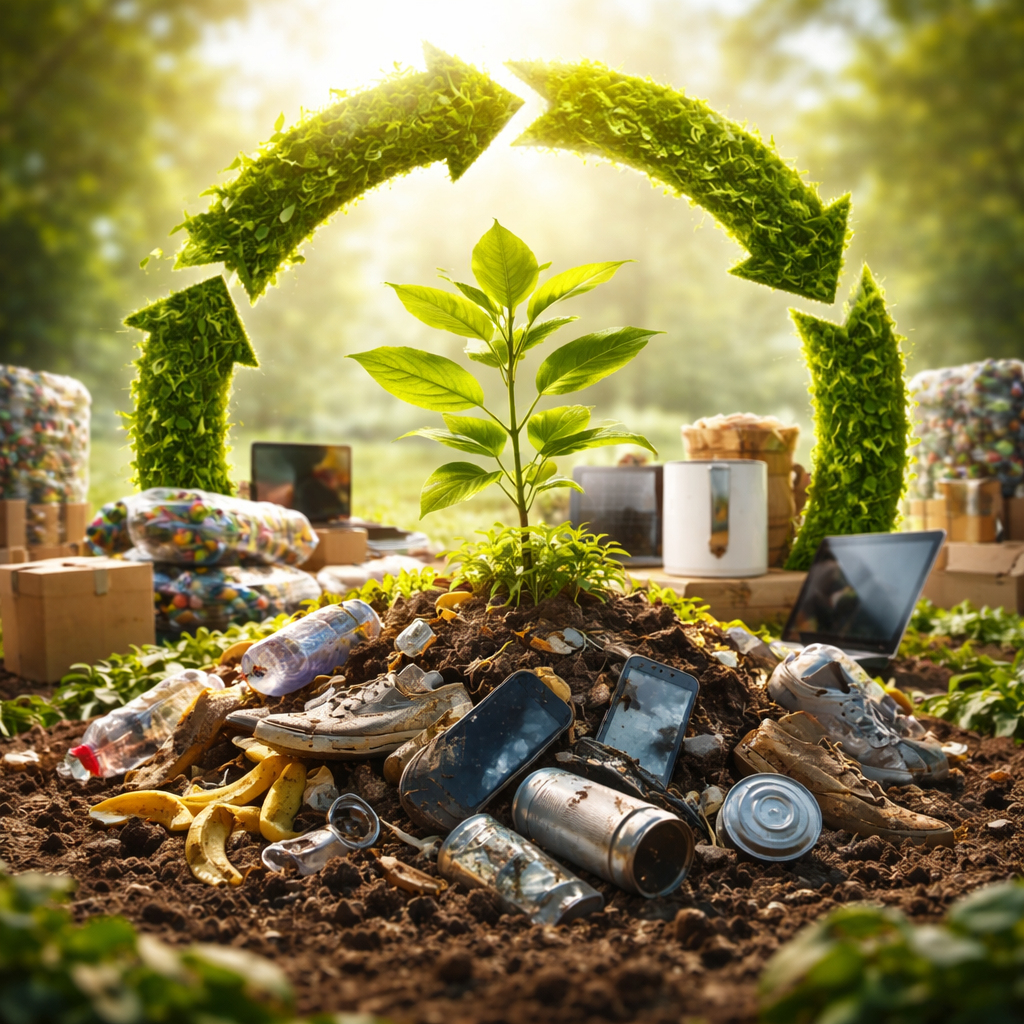
Most products you use today will end up in a landfill within a few years — and that path is completely avoidable. The advantages of circular economy go far beyond recycling bins and eco-friendly packaging. This model fundamentally changes how resources move through society, turning waste into input and extending the life of materials that would otherwise disappear from the supply chain forever.
Why the linear model is quietly draining resources
The traditional take-make-dispose approach has worked well for industrial growth, but it comes at a steep cost. Raw materials are extracted, processed into products, used briefly, and discarded. This model assumes that resources are infinite and that waste is an acceptable byproduct of consumption — both assumptions that have proven dangerously wrong.
Consider that a significant share of food produced globally never reaches a consumer, and that electronic devices are often discarded while still functional. These aren’t edge cases — they reflect structural inefficiencies baked into the linear system. The circular economy offers a different architecture, one built on resource loops rather than one-way flows.
What actually changes in a circular system
At its core, circular economy thinking is about designing out waste from the beginning — not managing it at the end. This shifts responsibility upstream, to manufacturers, designers, and supply chain managers who determine how long a product lasts and what happens to it afterward.
Three core principles guide this approach:
- Eliminate waste and pollution by design, not as an afterthought
- Keep products and materials in use for as long as possible through repair, reuse, and remanufacturing
- Regenerate natural systems by returning biological materials safely to the environment
These principles are not abstract ideals. They translate directly into business models: product-as-a-service, lease and return programs, modular product design, and industrial symbiosis where one company’s waste becomes another’s raw material.
Economic benefits that go beyond cost savings
One of the most compelling arguments for circular systems is economic resilience. Companies that depend heavily on virgin raw materials are vulnerable to price volatility and supply disruptions. Shifting toward material recovery and reuse reduces that exposure significantly.
Research from the Ellen MacArthur Foundation suggests that a circular economy could generate significant net material cost savings across key sectors, along with broader economic benefits through new employment and innovation opportunities.
There is also a strong employment dimension. Repair, refurbishment, and remanufacturing are labor-intensive activities that tend to be local and harder to offshore. This creates jobs that are more geographically distributed and more resistant to automation pressures than many manufacturing roles.
| Activity | Linear Economy | Circular Economy |
|---|---|---|
| Product end-of-life | Landfill or incineration | Repair, resale, recycling |
| Material sourcing | Primarily virgin resources | Recovered and recycled materials |
| Business model | Sell and replace | Lease, service, return |
| Value retention | Value lost at disposal | Value preserved through loops |
Environmental gains that compound over time
Reducing dependence on virgin material extraction lowers energy consumption, greenhouse gas emissions, and habitat disruption simultaneously. These environmental benefits are interconnected — when you reduce mining, you also reduce water contamination, land degradation, and carbon output from extraction and transportation.
Biodegradable and biological materials that are properly returned to natural cycles help restore soil health and reduce pressure on ecosystems. Industrial agriculture, for instance, can benefit when organic waste is composted and returned to farmland rather than treated as municipal waste.
The cumulative effect matters here. Each loop that keeps a material in use delays or eliminates the energy cost of producing a replacement. Over large scales and long time horizons, this compounding effect becomes substantial.
How individuals and businesses can engage practically
Circular economy participation isn’t limited to policymakers or large corporations. There are real entry points at every level.
- Choose products designed for longevity and repairability over disposable alternatives
- Participate in take-back programs offered by electronics and clothing brands
- For businesses: audit material flows and identify where waste could become input
- Explore product-as-a-service models that shift ownership incentives toward durability
- Support or establish local repair initiatives, tool libraries, and sharing networks
For businesses specifically, the shift often begins with a material flow audit — mapping where resources enter and leave the organization. This simple exercise frequently reveals overlooked opportunities for cost reduction and new revenue streams through material recovery or service-based offerings.
Sectors already demonstrating what’s possible
Several industries have moved beyond pilot projects and are embedding circular practices at scale. The construction sector is experimenting with building design that allows materials to be disassembled and reused rather than demolished. Textile companies are developing fiber-to-fiber recycling systems. The automotive industry has long used remanufactured parts, and some manufacturers are now designing entire vehicles for end-of-life material recovery.
Consumer electronics remains one of the most challenging sectors due to complex material compositions, but companies are increasingly offering modular devices where individual components can be replaced rather than discarding the entire product. This is not just environmentally meaningful — it also gives consumers a longer-lasting product at lower total cost.
The shift is already underway — and picking up pace
What makes the circular economy genuinely compelling is that it doesn’t ask for sacrifice — it proposes a better-designed system. Materials stay valuable longer. Companies build more stable supply chains. Consumers get more durable, repairable products. And environmental pressure eases as extraction and waste both decline.
The transition requires investment in infrastructure, policy support, and shifts in design culture. But the direction is clear, and the momentum — driven by both economic logic and environmental urgency — is increasingly difficult to ignore. Whether you’re a product designer, a business owner, or a consumer making everyday choices, understanding how circular systems work puts you in a better position to participate in what is becoming one of the defining shifts in how economies function.