
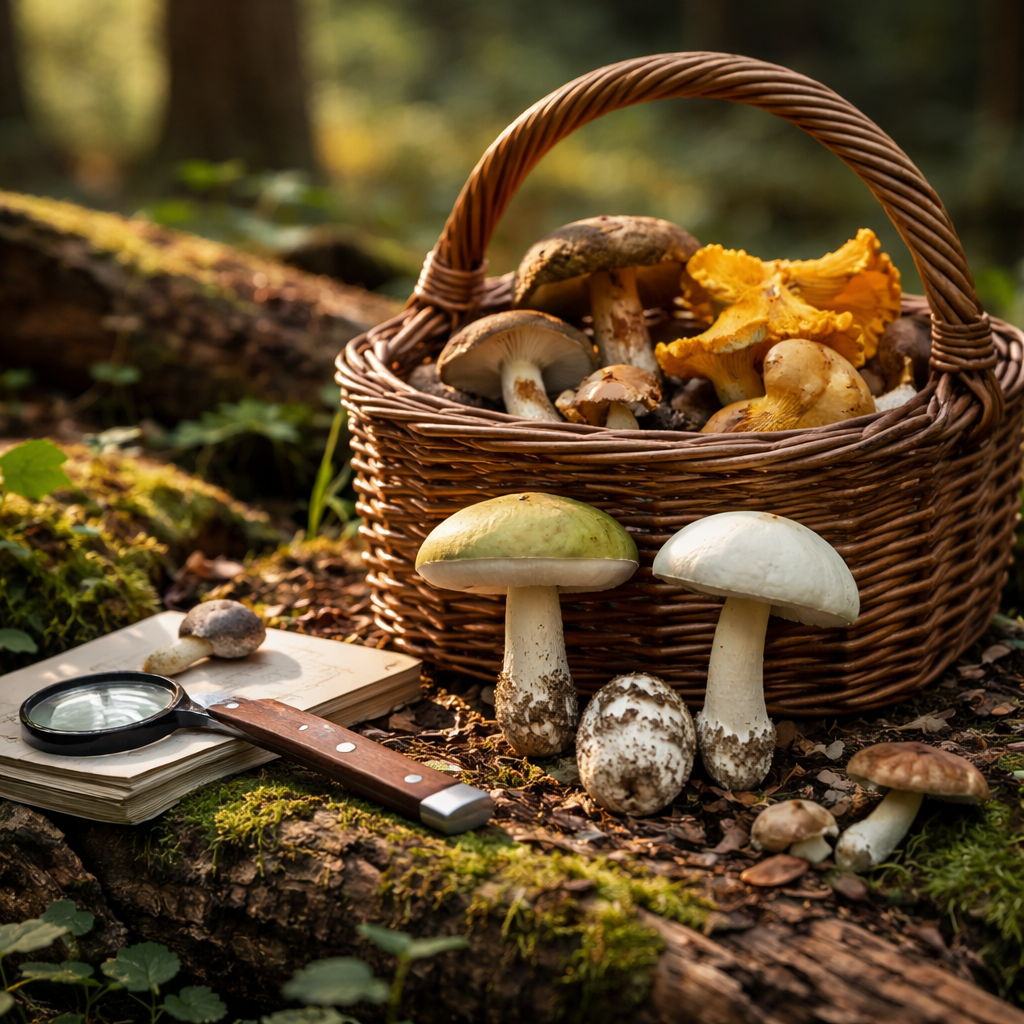
Every year, thousands of foragers — from curious beginners to seasoned hikers — ask the same critical question: is it safe to eat wild mushrooms? The honest answer is: it depends entirely on your knowledge, preparation, and willingness to be absolutely certain before anything goes on your plate. Wild mushrooms are not inherently dangerous, but the margin for error is razor-thin, and a single misidentification can have severe or even fatal consequences.
Why wild mushroom foraging carries real risk
The forest floor is full of species that look deceptively similar to one another. The death cap mushroom (Amanita phalloides), responsible for the majority of fatal mushroom poisonings worldwide, closely resembles several edible species. The destroying angel (Amanita bisporigera) looks almost innocent — clean, white, and unremarkable — yet a single cap contains enough amatoxin to cause acute liver failure.
What makes this especially tricky is that toxic mushrooms don’t taste or smell “wrong.” Many poisoning cases happen precisely because people trusted their senses when only scientific identification would have saved them.
The most dangerous wild mushrooms to know
| Mushroom | Toxin | Symptoms onset | Severity |
|---|---|---|---|
| Amanita phalloides (Death Cap) | Amatoxins | 6–24 hours | Potentially fatal |
| Amanita bisporigera (Destroying Angel) | Amatoxins | 6–24 hours | Potentially fatal |
| Galerina marginata | Amatoxins | 6–24 hours | Potentially fatal |
| Gyromitra esculenta (False Morel) | Gyromitrin | 2–12 hours | Serious, can be fatal |
| Clitocybe dealbata | Muscarine | 15–30 minutes | Serious |
Understanding which species pose the greatest threat is not about fear — it’s about building a baseline of knowledge that every forager should have before stepping into the woods with a basket.
Safe foraging starts long before you enter the woods
Experienced mycologists consistently emphasize that preparation is 90% of safe foraging. This means studying local species in depth, not just browsing a general mushroom app. Regional field guides written by professional mycologists are far more reliable than crowd-sourced identification platforms, which have documented error rates that can be genuinely dangerous.
“When in doubt, throw it out. No meal is worth a trip to the emergency room — or worse.” — A widely repeated principle among professional foragers and toxicologists alike.
Before you ever pick a mushroom to eat, consider investing time in the following:
- Join a local mycological society — hands-on identification walks with experts are invaluable
- Study at least three to five “foolproof four” beginner-safe species in your specific region
- Learn the toxic lookalikes for every edible species you plan to harvest
- Use multiple physical field guides, not just one app or one source
- Practice identifying without picking first — observe, photograph, and confirm
Species considered relatively safe for beginners — with conditions
There are several wild mushrooms that experienced foragers consider low-risk for beginners, largely because their edible forms have no truly dangerous lookalikes in most regions. However, “low-risk” never means “zero risk,” and geographic variation matters enormously.
Giant puffballs (Calvatia gigantea) are often cited as beginner-friendly because of their distinctive size and appearance — but only when the interior flesh is completely white and solid throughout, ruling out any developing Amanita buttons hidden inside. Chicken of the woods (Laetiporus sulphureus) is another commonly recommended starter species due to its bold coloring and bracket-like form, though some individuals do experience gastrointestinal reactions, particularly when the mushroom grows on certain host trees like locust or eucalyptus.
Chanterelles (Cantharellus cibarius) are beloved across European and North American foraging communities, but they have a lookalike — the jack-o’-lantern mushroom (Omphalotus olearius) — that causes significant gastrointestinal distress. Knowing the difference between true forked ridges and true gills is essential before harvesting.
What to do if you suspect mushroom poisoning
Symptoms of wild mushroom poisoning vary widely depending on the species involved. Some toxins act within minutes; others — particularly amatoxins — have a deceptive latency period where the person feels fine for hours before organ damage begins. This delayed onset is one of the main reasons mushroom poisonings are often diagnosed late.
If you or someone with you develops any of the following after consuming wild mushrooms, seek emergency medical care immediately — do not wait to see if symptoms resolve on their own:
- Nausea, vomiting, or severe abdominal cramping
- Excessive sweating, salivation, or tearing
- Confusion, dizziness, or visual disturbances
- Jaundice or signs of liver distress appearing hours or days later
Bring a sample of the mushroom — or photos — to the emergency room. This can dramatically speed up diagnosis and guide the appropriate treatment protocol.
The real reward of getting it right
None of this is meant to scare anyone away from foraging — quite the opposite. Wild mushrooms offer an extraordinary connection to local ecosystems, a genuinely nutritious food source, and a deeply satisfying skill to develop over time. Species like morels, hen of the woods (Grifola frondosa), and black trumpets (Craterellus cornucopioides) are prized by professional chefs and home cooks alike for flavors that no cultivated substitute can replicate.
The foragers who enjoy this practice safely for decades are not the ones who got lucky — they are the ones who took identification seriously from the very beginning, kept learning, and never let enthusiasm outpace knowledge. That combination of curiosity and discipline is exactly what makes wild mushroom foraging a rewarding and sustainable practice rather than a gamble.