
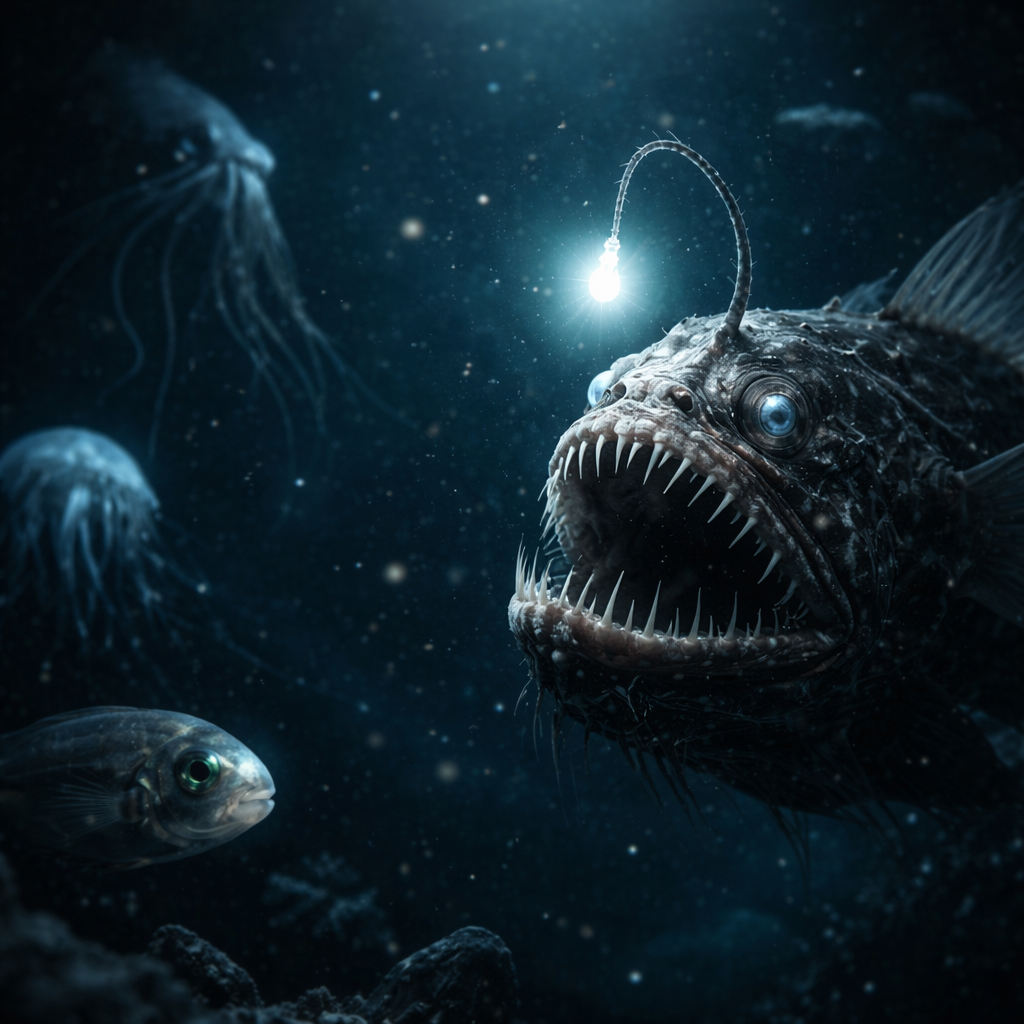
Most facts about the deep sea creatures sound too strange to be real — and yet every single one of them is backed by science. The ocean below 200 meters is not just “very deep water.” It is a world operating by completely different rules: no sunlight, crushing pressure, near-freezing temperatures, and organisms that have evolved solutions to survival that no surface-dwelling animal ever needed.
The abyss begins where sunlight ends
The ocean is divided into distinct depth zones, and each one hosts a different community of life. The mesopelagic zone stretches from 200 to 1,000 meters — this is where light fades into total darkness. Below that lies the bathypelagic zone, then the abyssal zone reaching down to 6,000 meters, and finally the hadal zone found in oceanic trenches, some of which plunge beyond 10,000 meters.
Scientists estimate that more than 80% of the ocean remains unexplored. Given that the ocean covers over 70% of Earth’s surface and has an average depth of around 3,700 meters, that figure becomes genuinely mind-bending. Deep-sea biology is still in its early chapters.
Built for pressure, darkness, and cold
Creatures living at extreme depths face pressure that would instantly crush a human body. At 1,000 meters, water pressure reaches approximately 100 atmospheres. At full ocean depth in the Mariana Trench, it exceeds 1,000 atmospheres. Deep-sea fish handle this through a combination of flexible skeletal structures, lack of gas-filled swim bladders in many species, and cell membranes rich in unsaturated fatty acids that remain fluid under compression.
The snailfish (Pseudoliparis swirei), discovered in the Mariana Trench at depths beyond 8,000 meters, holds the record as the deepest-living fish ever observed. Its body is semi-transparent, gelatinous, and surprisingly fragile-looking — yet it thrives where nothing seems like it should.
Temperature plays an equally decisive role. Much of the deep ocean hovers between 2°C and 4°C. Organisms here have evolved enzymes that function optimally at near-freezing temperatures — the same enzymes would become sluggish and ineffective at the warmer temperatures that surface animals consider normal.
Bioluminescence: the deep sea’s own light show
In the absence of sunlight, life created its own light. Bioluminescence — the biological production of light through chemical reactions — is extraordinarily common in the deep ocean. Estimates suggest that over 76% of deep-sea species produce some form of light.
The purposes vary widely. Some animals use bioluminescence to attract prey — the anglerfish being the most iconic example, dangling a glowing lure in front of its enormous jaws. Others use it for counter-illumination, producing light on their undersides to match the faint downwelling light from above and avoid casting a silhouette visible to predators below. Some squid species use bioluminescent signals for communication and mating.
| Species | Bioluminescence use | Depth range |
|---|---|---|
| Anglerfish | Luring prey | 200–2,000 m |
| Firefly squid | Counter-illumination, mating | 200–600 m |
| Viperfish | Attracting prey, camouflage | 250–1,500 m |
| Dinoflagellates | Defense (startle response) | Surface to 200 m |
Food in the dark: strategies that defy logic
Food is scarce in the deep sea. The primary source of nutrition for many deep-sea organisms is “marine snow” — a continuous slow drift of organic particles, dead organisms, fecal matter, and microscopic debris falling from the surface layers above. It can take weeks for a particle to drift from the surface to the seafloor.
This scarcity has driven some remarkable feeding adaptations. The black swallower fish can consume prey more than twice its own size, stretching its stomach to accommodate meals that would seem physically impossible. Gulper eels have jaws that unhinge to engulf much larger animals. Many deep-sea fish have rows of needle-like teeth angled inward — once prey is caught, escape becomes impossible.
Hydrothermal vents and a world without photosynthesis
One of the most significant discoveries in marine biology was the identification of hydrothermal vent ecosystems in the late 1970s. These vents, found along mid-ocean ridges, release superheated, mineral-rich water from the seafloor. Temperatures near the vent openings can exceed 400°C, though the surrounding water remains cold.
Around these vents, entire ecosystems thrive — not on sunlight, but on chemosynthesis. Specialized bacteria convert hydrogen sulfide released by the vents into energy, forming the base of a food chain that includes giant tube worms reaching over two meters in length, yeti crabs, eyeless shrimp, and unique species of clams and mussels. This was the first known ecosystem on Earth entirely independent of solar energy.
Strange bodies, stranger biology
Physical adaptations in deep-sea animals go far beyond the expected. Many species have developed enormous eyes to capture every available photon of light — the giant squid has eyes up to 30 centimeters in diameter, the largest of any living animal. Others have evolved in the opposite direction, losing eyes entirely in environments where vision offers no advantage at all.
- The barreleye fish has transparent fluid-filled domes on its head housing tubular eyes that rotate to look upward, forward, or sideways.
- The vampire squid is neither a true squid nor an octopus — it represents its own separate order, Vampyromorphida, and feeds on marine snow rather than live prey.
- Some species of deep-sea anglerfish fuse males permanently to females during mating — the male becomes a parasitic organ, sharing her bloodstream and contributing sperm when needed.
- The comb jelly, or ctenophore, is considered one of the oldest animal lineages on Earth, with fossil evidence dating back over 500 million years.
These are not evolutionary oddities — each adaptation is a precise, efficient solution to the specific pressures of life in the deep. Evolution in the abyss operates under constraints that simply do not exist anywhere else on the planet.
The deep ocean is not a wasteland — it is a frontier
There is a common assumption that the deep sea is empty, featureless, and largely irrelevant to everyday life. The opposite is true. Deep-sea organisms have contributed to medical research — heat-stable enzymes from hydrothermal vent bacteria are used in PCR testing, the same technology central to modern diagnostics. Compounds from marine invertebrates have shown promise in cancer research and antibiotic development.
The deep ocean also plays a critical role in regulating Earth’s climate by absorbing carbon dioxide and redistributing heat through deep ocean currents. Disruptions to this system — through warming, acidification, or deep-sea mining — carry consequences far beyond the seafloor itself.
Understanding what lives down there, how it survives, and what roles these organisms play in the broader planetary system is not a niche academic interest. It is one of the more urgent areas of scientific inquiry humans are currently pursuing — and with each new deep-sea expedition, the list of what we do not yet know grows longer, not shorter.