
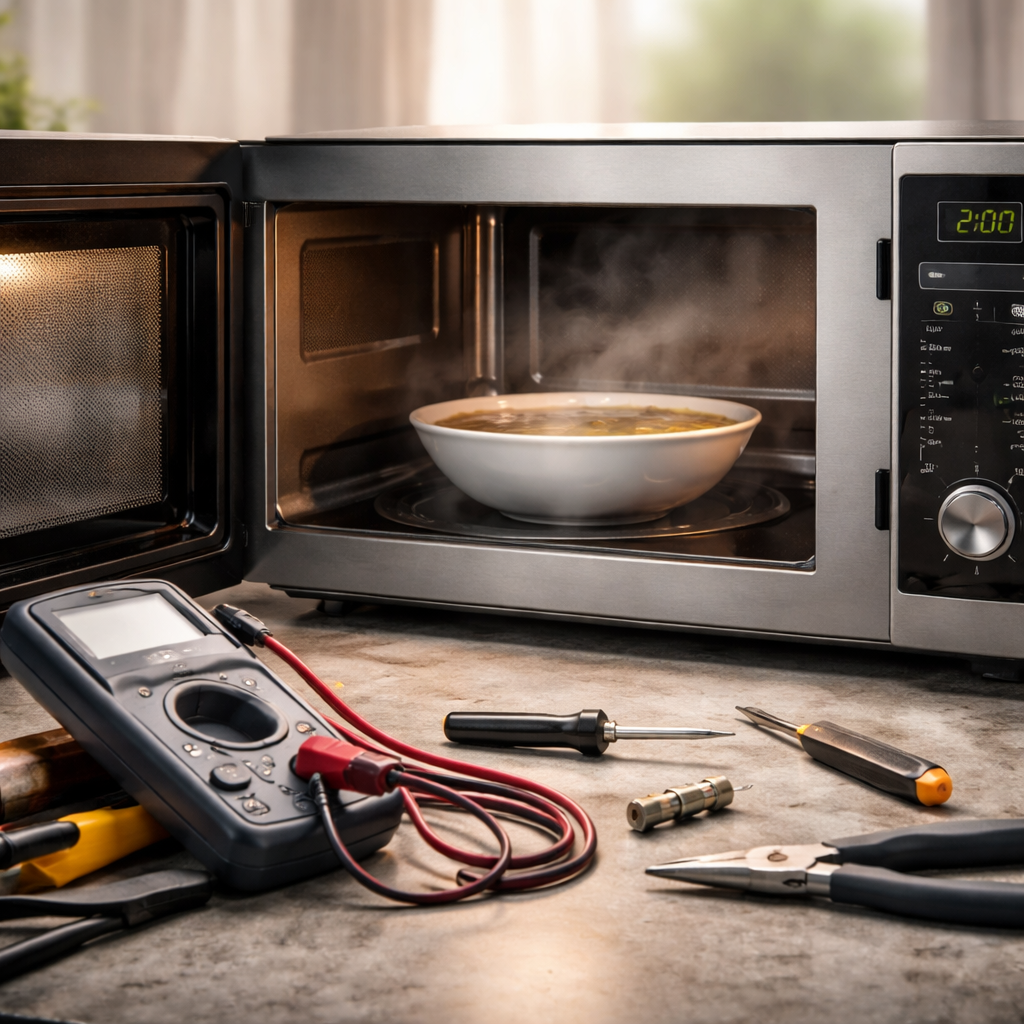
You open the microwave, press start, and two minutes later your food is still cold. Before you call a repair technician or start shopping for a new appliance, there’s a real chance you can figure out how to fix a microwave that won’t heat on your own — without any special tools or engineering background. Many of the most common causes behind this problem are surprisingly straightforward once you know where to look.
Why microwaves stop heating: the short version
Microwaves generate heat through a component called the magnetron, which converts electrical energy into microwave radiation. This radiation agitates water molecules in food, producing heat. When the magnetron fails — or when any part of the circuit that powers it breaks down — the microwave runs normally in every other way, but produces no heat at all. That’s why the light turns on, the turntable spins, and the timer counts down, yet your soup stays cold.
Understanding this helps you approach the problem logically rather than blindly replacing parts. Let’s go through the most likely culprits in order of how easy they are to check.
Start with the basics before touching anything inside
Some no-heat situations have nothing to do with internal components at all. Before assuming the worst, run through this checklist:
- Make sure the microwave is set to a power level above zero. Many models default back to a low or demo mode after a power outage.
- Check whether the door latches fully. Microwaves have safety interlock switches that prevent heating if the door isn’t properly closed.
- Test the outlet by plugging in another device. A faulty outlet can cause partial power delivery — enough to run the display but not the magnetron.
- Look at your home’s circuit breaker. A partially tripped breaker can produce exactly this kind of symptom.
- Reset the microwave by unplugging it for 60 seconds, then plugging it back in.
A microwave that heats on high but not on lower power settings often points to a faulty triac or control board, not the magnetron itself. This distinction saves a lot of unnecessary part replacements.
The door interlock switches: small parts, big impact
Door interlock switches are among the most common reasons a microwave won’t heat. Most microwaves have two or three of these switches, and if even one fails, the unit cuts power to the magnetron as a safety measure. A failed switch often blows the internal fuse at the same time, so you may need to replace both.
Signs of a faulty door switch include a microwave that stops heating suddenly after a door slam, or one where you can hear a slight difference in the sound when the door clicks shut. Replacement switches are inexpensive and widely available for most microwave models. However, replacing them requires disassembling the outer cabinet and working near the capacitor — which brings us to an important safety point.
Internal components most likely to cause a no-heat situation
Once you’ve ruled out the simple stuff and the door switches, the issue likely lies deeper. Here’s a breakdown of the internal components that most often fail in microwaves that run but don’t heat:
| Component | What it does | Typical symptoms when faulty | DIY-friendly? |
|---|---|---|---|
| Magnetron | Generates microwave energy | No heat, buzzing noise, burning smell | Possible but requires caution |
| High-voltage diode | Converts AC to DC for the magnetron | No heat, loud humming | Yes, relatively easy |
| High-voltage capacitor | Stores and releases electrical energy | No heat, burning smell, tripped breaker | Only for experienced users |
| Thermal cutout / thermoprotector | Shuts down heating if overheated | Intermittent heating loss | Yes, with proper discharge |
| Main control board | Controls all functions | Erratic behavior, no heating response | Moderate difficulty |
Of these, the high-voltage diode is the most frequently replaced part in a microwave that hums but won’t heat. It’s also one of the safer components to swap out, as long as the capacitor has been properly discharged beforehand. A failed diode typically costs very little and can be ordered by model number from appliance parts suppliers.
How to test the diode and magnetron without professional equipment
A basic multimeter is enough to test several key components. Here’s a simplified approach:
- To test the diode: set your multimeter to the diode setting. A working diode allows current in one direction only. If it shows continuity in both directions or no continuity at all, replace it.
- To test the magnetron: check for continuity between the terminals (should show low resistance) and between each terminal and the chassis (should show no continuity). Any deviation from this pattern suggests magnetron failure.
- To test the thermal cutout: it should show continuity when at room temperature. No continuity means it’s burned out and needs replacement.
Keep in mind that these tests only confirm whether a component has failed outright. A magnetron that shows normal resistance on a multimeter can still perform poorly under load. If you’ve replaced the diode and the fuse and the microwave still won’t heat, the magnetron is the next logical suspect.
When the repair cost stops making sense
Magnetron replacement is where the math gets tricky. Depending on the brand and model, a genuine magnetron can cost anywhere from a third to more than half the price of a new microwave. Add labor if you’re not doing it yourself, and the repair bill can easily exceed the appliance’s value.
A reasonable rule of thumb used by appliance repair professionals is this: if the repair cost exceeds 50% of the replacement cost for a comparable new unit, replacement is the smarter financial choice. This is especially true for older or budget-tier microwaves where parts availability is also declining.
That said, repairing a higher-end or over-the-range microwave often makes strong economic sense, especially when the unit is relatively new and the failing part is anything other than the magnetron itself.
What actually determines whether your microwave is worth fixing
Beyond the numbers, a few practical questions can guide your decision. How old is the unit? Microwaves typically last between seven and ten years with regular use. If yours is approaching that range and the magnetron has failed, replacement is almost always the better call. On the other hand, if the problem turns out to be a blown fuse, a failed diode, or a faulty door switch — all of which cost under twenty dollars in parts — there’s no good reason not to fix it.
The process of diagnosing a microwave that won’t heat is also genuinely educational. Even if you ultimately decide to replace the unit, understanding what went wrong gives you a much clearer picture of how to choose and maintain the next one. Look for models with accessible parts, available service manuals, and good parts availability from third-party suppliers — these factors make a real difference in the long-term value of any appliance you bring into your kitchen.