
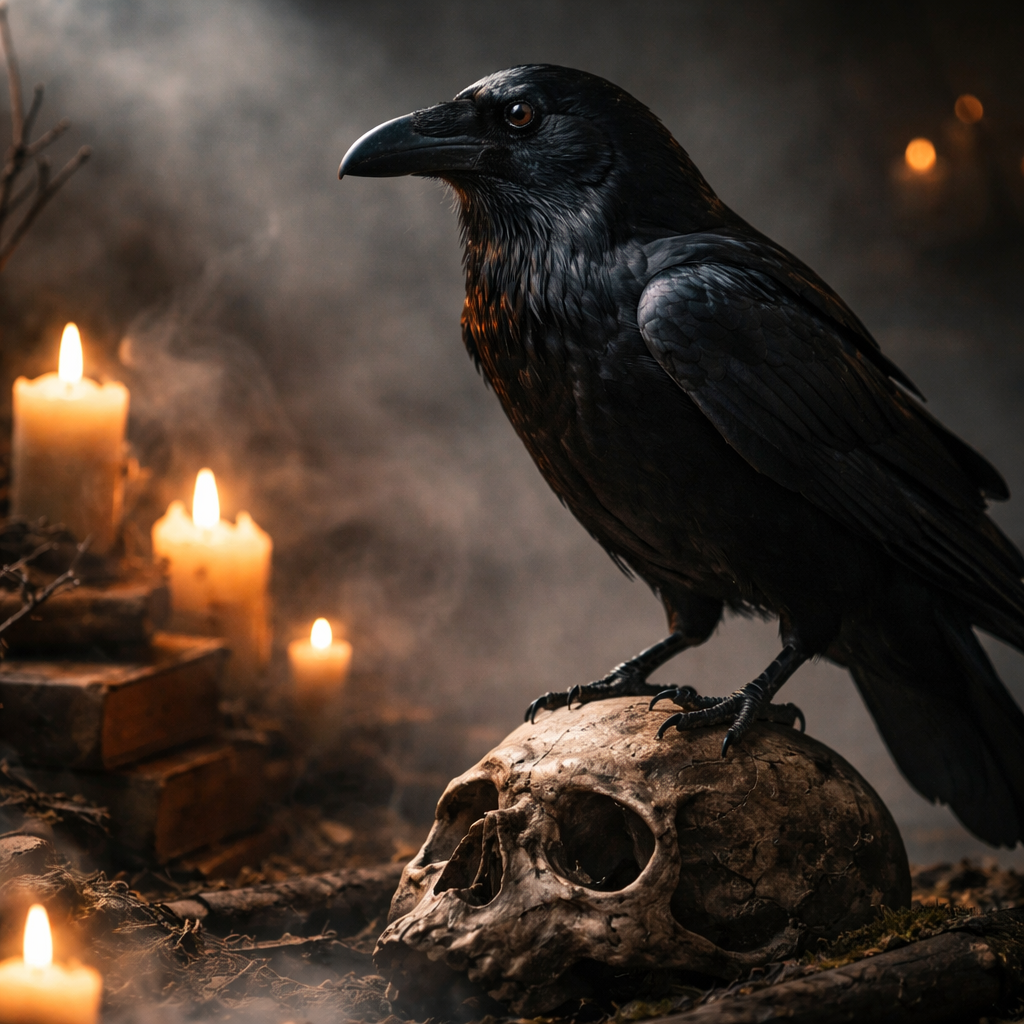
Few creatures have inspired as much literary fascination as the raven — and understanding the meaning of raven symbolism in literature reveals just how deeply this bird has shaped the way writers across centuries have explored death, wisdom, prophecy, and the darker corridors of human consciousness. What makes the raven so uniquely compelling is not just its black plumage or its unsettling call, but the way it sits at the intersection of the real and the symbolic, the natural and the supernatural.
Why the raven became a literary archetype
Long before Edgar Allan Poe immortalized the bird in verse, ravens appeared in Norse mythology, biblical texts, and ancient Celtic traditions as creatures with access to knowledge beyond human reach. In Norse legend, the god Odin kept two ravens named Huginn and Muninn — Thought and Memory — who flew across the world and returned to whisper what they had seen. This mythological background fed directly into literary tradition, giving writers a ready-made symbol loaded with intellectual and spiritual weight.
The raven’s ability to mimic human speech made it seem uncanny to early observers. Unlike most birds, it could approximate words — which writers naturally transformed into a metaphor for messages from another world, or truths too uncomfortable to be spoken by humans directly.
The raven as a symbol of death and grief
In Western literary tradition, no single work has done more to fix the raven’s symbolic identity than Poe’s 1845 poem “The Raven.” The bird arrives at midnight — itself a liminal hour — and plants itself above the narrator’s door, repeating its single, maddening word: “Nevermore.” The raven here is not simply a bird but an externalization of grief, an embodiment of the mind that cannot stop circling its own loss.
“Take thy beak from out my heart, and take thy form from off my door!” — Edgar Allan Poe, “The Raven” (1845)
This association with death was not Poe’s invention. Shakespeare referenced ravens as omens of ill fortune in works including Othello and Macbeth. Lady Macbeth famously invokes “the raven himself is hoarse / That croaks the fatal entrance of Duncan” — using the bird to signal impending murder before a word of violence has been spoken aloud.
Raven symbolism across different literary traditions
What makes raven symbolism genuinely rich is that it is far from uniform. Depending on the cultural and literary tradition, the raven can represent opposite qualities — sometimes within the same text.
| Literary / Cultural Tradition | Primary Symbolic Meaning |
|---|---|
| Norse mythology and literature | Wisdom, divine knowledge, cosmic awareness |
| Native American oral and written literature | The Trickster — a creator, transformer, and bringer of light |
| Gothic and Romantic literature (Western) | Death, grief, psychological torment, the unconscious |
| Medieval European literature | Bad omen, pestilence, battlefield death |
| Contemporary literary fiction | Ambiguity, liminality, intelligence on the margins of society |
In Indigenous North American storytelling traditions that have found their way into written literature, the Raven is a Trickster figure — mischievous, creative, and paradoxically life-giving. This is almost the mirror image of the European Gothic raven. Both traditions use the same bird, but the symbolic meaning shifts dramatically depending on the cultural lens applied.
What ravens represent beyond death
It would be a mistake to reduce raven symbolism in literary texts to a single, morbid interpretation. Writers have also used the raven to explore:
- Transformation and threshold-crossing — the raven as a guide between states of being
- Forbidden knowledge — the bird that sees what humans cannot or should not know
- Solitude and outsider identity — the raven as a companion to hermits, scholars, and those who live outside social norms
- Memory and the past — drawing on the Odin myth, the raven as the keeper of what should not be forgotten
- Intelligence as danger — the unsettling idea that to be too clever is to become something slightly inhuman
Contemporary authors continue to mine these veins. In George R.R. Martin’s “A Song of Ice and Fire” series, ravens serve as messengers — the primary communication system of a medieval world — while also retaining their ancient ominous quality. The three-eyed raven becomes a symbol of prophetic vision and the burden of knowing the future.
How authors use raven imagery technically
Understanding the symbolic role of ravens is one thing; recognizing how skilled writers deploy that symbolism is another. A few recurring techniques are worth noting:
Timing of appearance is almost always deliberate. Ravens tend to arrive at moments of transition — death, departure, a decision that cannot be undone. Their presence marks a threshold that the protagonist is about to cross, or has already crossed without knowing it.
Color functions as a continuous motif. The black of the raven’s feathers is rarely described neutrally in literary texts. It absorbs light rather than reflecting it — a quality writers use to suggest that the raven draws meaning inward rather than offering it outward.
Voice and silence create tension. In texts where ravens speak or seem to communicate, the contrast with their usual silence amplifies the moment. Poe’s genius was to give his raven only one word — making every question the narrator asks an exercise in self-torture.
Reading ravens in texts you encounter
If you are reading a text — a novel, a poem, a short story — and a raven appears, it is almost never decorative. Ask yourself three questions:
- What is the character doing or feeling at the moment the raven appears?
- Does the raven speak, act, or simply watch? What does its behavior suggest about the role of knowledge in the scene?
- What tradition is the author drawing from — the European omen tradition, the Norse wisdom figure, or the Trickster archetype?
These questions rarely produce simple answers, which is precisely why the raven has remained a productive literary symbol for so long. Its ambiguity is not a flaw — it is the point. The raven means something slightly different in every text it inhabits, shaped by the fears, losses, and questions of the author who placed it there.
The raven in the space between what is said and what is meant
What ultimately keeps the raven alive as a literary symbol is its resistance to a single, stable meaning. It is a bird that belongs to the in-between — between life and death, between speech and silence, between the known world and whatever lies outside it. Writers return to the raven not because it gives answers but because it holds the right kinds of questions. And in literature, as in life, the questions that refuse to resolve themselves are usually the ones that matter most.