
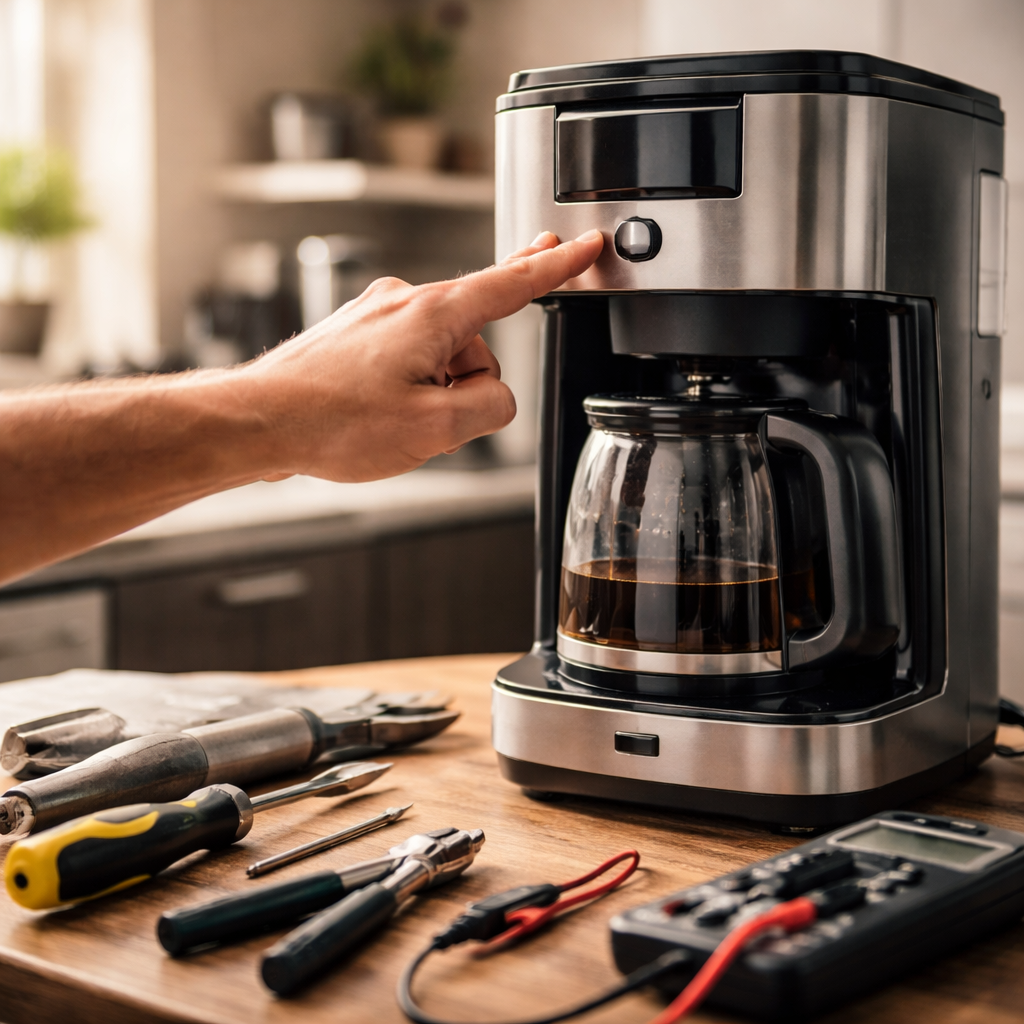
You press the button, nothing happens — and the coffee machine not working situation turns what should be a peaceful morning ritual into a minor crisis. Before you rush to a repair shop or start browsing for a replacement, it’s worth knowing that most coffee maker problems are surprisingly fixable at home, often in under ten minutes.
Why your machine suddenly stops — and what’s actually going on inside
Coffee machines fail for predictable reasons, and understanding the logic behind them saves both time and money. The majority of breakdowns come down to one of three categories: mineral buildup, power or connection issues, and blocked internal components. Knowing which category your problem belongs to is half the solution.
Hard water is the silent enemy of every coffee maker. Over time, calcium and magnesium deposits accumulate inside the boiler, heating element, and tubes. This restricts water flow, forces the machine to work harder, and eventually causes it to shut down or produce weak, lukewarm coffee. If you live in an area with hard tap water and haven’t descaled your machine in months, this is almost certainly where the problem starts.
Step-by-step: diagnosing the problem yourself
There’s no need to guess randomly. A structured approach will help you identify the fault quickly and avoid making things worse.
- Check the power cord and wall outlet first — plug in another device to confirm the socket is working.
- Inspect the water reservoir. Many machines have a safety mechanism that prevents operation when the tank is empty or not seated properly.
- Look at the drip tray. Some models won’t brew if the tray is full or missing.
- Check for any error codes or blinking indicator lights and cross-reference with the user manual.
- Listen when you switch the machine on — a faint hum suggests power is reaching the heating element, while complete silence points to an electrical issue.
Running through this checklist takes about three minutes and eliminates the most common causes before you go any further.
The most frequent faults — and how to address each one
| Symptom | Likely cause | What to do |
|---|---|---|
| Machine turns on but produces no water | Scale buildup or clogged pump | Run a descaling cycle with a citric acid solution |
| Coffee comes out cold or lukewarm | Faulty heating element or heavy scaling | Descale first; if the problem persists, heating element may need replacement |
| Machine leaks from the bottom | Worn seals or cracked internal tubing | Inspect the drip tray area and gaskets; contact a technician if tubing is damaged |
| Coffee tastes bitter or burnt | Dirty group head or incorrect grind size | Clean the group head and portafilter; adjust grind coarser |
| Machine won’t turn on at all | Blown fuse or failed thermal fuse | Check the power supply; a thermal fuse replacement is often straightforward |
Descaling: the one maintenance step most people skip
If there’s one habit that prevents the vast majority of espresso machine problems and drip coffee maker issues alike, it’s regular descaling. The process removes limescale deposits from internal components and restores normal water flow and temperature.
Manufacturers generally recommend descaling every one to three months depending on water hardness and how frequently the machine is used. Skipping this step voids the warranty on many models.
You don’t need a branded descaling product — food-grade citric acid dissolved in water works effectively and costs very little. Fill the tank with the solution, run it through a brew cycle without coffee, then repeat twice with clean water to rinse. That’s the entire process for most drip machines and pod coffee makers.
For espresso machines with a built-in grinder or steam wand, the cleaning routine is slightly more involved. The steam wand should be purged and wiped after every use to prevent milk residue from hardening inside the nozzle — a blocked steam wand is one of the most common complaints among espresso machine owners.
When a simple clean isn’t enough
Some faults genuinely require professional attention or replacement parts. Recognizing when to stop tinkering saves you from causing further damage.
A thermal fuse is a small safety component that cuts power to the heating element if the machine overheats. Once it blows, the machine appears completely dead even when plugged in. Replacing a thermal fuse is an inexpensive fix, but it requires opening the machine casing and working near electrical components — something best handled by someone comfortable with basic electronics repair, or a qualified technician.
Similarly, a failed pump in an espresso machine can’t be resolved through cleaning. The pump generates the pressure needed to push hot water through compacted coffee grounds, and when it fails, water either won’t flow at all or comes through with insufficient force. Pump replacement is possible for many popular models, with spare parts widely available online.
Practical tips to prevent future breakdowns
Consistent small habits make a bigger difference than any single repair. Here’s what actually works in the long run:
- Use filtered water instead of straight tap water — this dramatically slows limescale accumulation and improves coffee flavor at the same time.
- Empty and rinse the water tank daily rather than letting water sit for days, which encourages bacterial growth.
- Remove used coffee grounds or pods immediately after brewing to prevent moisture buildup and mold inside the brew chamber.
- Run a cleaning cycle with a machine-safe detergent tablet once a month if you use your espresso machine daily.
- Store the machine in a well-ventilated area and avoid pushing it flush against a wall, which can trap heat around the motor.
Making the call: repair or replace?
This is where people often hesitate, and understandably so. A rough guideline used by appliance repair professionals is the 50% rule: if the repair cost exceeds half the price of a new equivalent machine, replacement usually makes more financial sense.
That said, many quality machines — particularly manual espresso machines and high-end drip brewers — are designed to last well over a decade with proper maintenance. For these, investing in a pump replacement or new heating element is entirely reasonable. Cheaper pod machines, on the other hand, are often not worth repairing once the core components fail, simply because the parts can be difficult to source and the labor cost outweighs the machine’s value.
Before making any decision, search for your specific model number along with the fault you’re experiencing. A large community of coffee enthusiasts and appliance repair forums share detailed guides, video tutorials, and spare part recommendations for almost every major brand — from De’Longhi and Breville to Jura and Nespresso. Chances are someone has already solved exactly the problem you’re facing.