
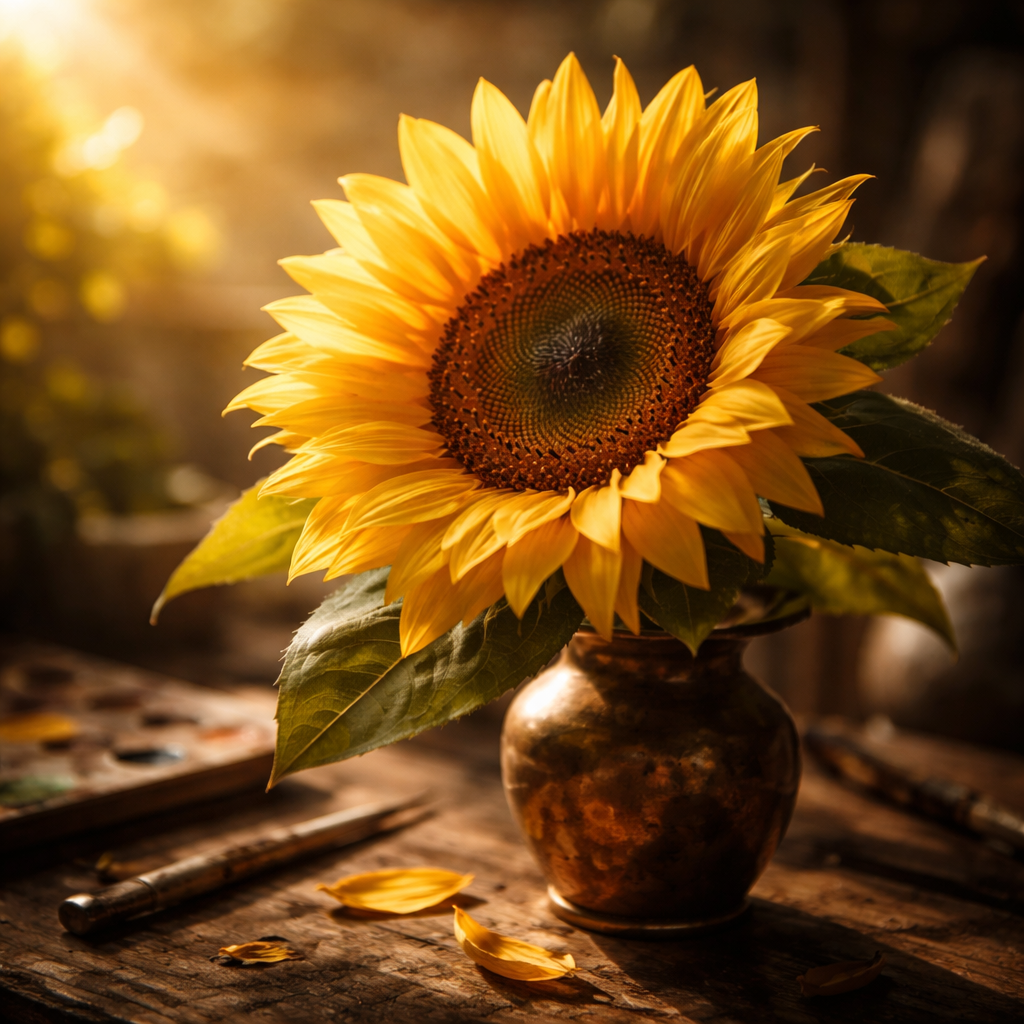
Few flowers have captured the imagination of artists across centuries quite like the sunflower — and understanding the meaning of sunflower symbolism in art reveals far more than a simple appreciation for a bright yellow bloom. Behind every painted petal lies a layered conversation about devotion, mortality, spiritual longing, and the human relationship with light itself.
Why artists kept returning to the same flower
The sunflower’s visual drama — its tall stance, its circular face, its habit of orienting toward the sun — made it almost irresistible as a subject. But artists weren’t simply drawing what they saw. They were borrowing the flower’s natural behavior to say something about human experience. The phenomenon of heliotropism, the plant’s movement in response to light, became a ready metaphor for spiritual aspiration, loyalty, and the soul’s pull toward the divine.
This symbolic weight accumulated gradually. When sunflowers arrived in Europe from the Americas in the sixteenth century, they were initially curiosities in botanical gardens. It didn’t take long before painters and poets recognized their expressive potential and began weaving them into allegorical compositions.
Solar symbolism and the language of light
The most persistent thread running through sunflower iconography is the connection to the sun itself. The flower’s golden petals radiating outward from a dark center mirrors the visual shorthand artists have always used to depict solar energy. In Baroque allegorical painting, the sunflower frequently appeared alongside figures representing Constancy or Faith precisely because of this solar association — the flower that follows the light was seen as a model of unwavering devotion.
“The sunflower is mine, in a way.” — Vincent van Gogh, in a letter to his brother Theo, 1888
Van Gogh’s relationship with sunflowers went far beyond aesthetic preference. He associated the flower with gratitude and warmth, and his famous series of sunflower paintings was intended to decorate the room of his friend Paul Gauguin. The works carry an emotional intensity that transforms a domestic subject into something almost devotional — a quality that perfectly illustrates how sunflower symbolism in Western art consistently blurs the line between the earthly and the sacred.
From allegory to personal expression: how the meaning shifted over time
In earlier European painting, sunflower symbolism was largely codified and shared — artists relied on the viewer recognizing established meanings. By the nineteenth and twentieth centuries, however, artists began using the flower in more personal and psychological ways.
| Period | Dominant symbolic meaning | Notable context |
|---|---|---|
| Baroque (17th c.) | Constancy, devotion, loyalty to the divine | Allegorical portraiture, vanitas still life |
| Romanticism (19th c.) | Longing, nature worship, spiritual aspiration | Landscape and symbolist painting |
| Post-Impressionism | Vitality, gratitude, emotional warmth | Van Gogh’s sunflower series |
| 20th–21st century | Hope, resilience, national identity | Political art, murals, contemporary painting |
One significant shift happened within the vanitas tradition — a genre of still life painting meant to remind viewers of life’s transience. Sunflowers appeared in these compositions not only as symbols of beauty and light but also as reminders of the cycle of growth and decay. A wilting sunflower carried the same memento mori weight as a skull or an hourglass. This duality — the flower as both vitality and impermanence — gave it unusual symbolic depth compared to simpler floral motifs.
Sunflowers in non-Western artistic traditions
While Western art history dominates most discussions of sunflower symbolism, it’s worth noting that after the flower’s spread across the globe, it acquired distinct meanings in other cultural contexts. In Chinese art and decorative tradition, the sunflower became associated with long life and good luck. In the folk art of several Latin American cultures, it retained connections to solar deities that predated European contact.
These cross-cultural resonances are not coincidental — they reflect the flower’s universal visual language. Something about its form simply reads as solar, vital, and life-affirming across vastly different cultural frameworks.
What contemporary artists do with sunflower imagery
Today’s artists approach sunflower symbolism with both awareness of its history and freedom to subvert it. The flower has appeared in street art as a symbol of hope in contexts of social struggle. It has been used in installation art to explore environmental themes, given the sunflower’s documented ability to absorb heavy metals from soil — a property that carries its own poetic charge when translated into visual art about ecological healing.
In fine art photography, the sunflower has become a study in texture and geometry — artists focusing on the Fibonacci spiral pattern of the seed head, exploring how mathematical order underlies natural beauty. This scientific angle has opened new conceptual territory for a symbol that might otherwise risk becoming visually clichéd through overuse.
Reading sunflowers when you encounter them in art
If you want to interpret a sunflower’s role in any artwork, context is everything. Here are the key questions worth asking:
- Is the flower depicted as healthy and vibrant, or wilting and decaying? The condition of the bloom fundamentally shifts the meaning toward vitality or transience.
- Does the sunflower appear alone or in combination with other symbolic objects? A sunflower placed beside a skull or an extinguished candle reads very differently from one placed in morning light.
- What is the flower’s orientation? A sunflower facing toward a light source carries aspirational symbolism; one turning away or drooping may suggest loss of faith or mourning.
- What period and cultural tradition does the work come from? Baroque allegory, Romantic landscape, and contemporary installation art each carry their own symbolic grammar.
These questions don’t produce single definitive answers — that’s precisely what makes sunflower imagery so durable as an artistic device. It accommodates contradiction: it can speak of joy and grief, of steadfastness and the inevitability of change, often within the same composition.
A symbol that keeps growing
What makes the sunflower genuinely remarkable as an art historical subject is how it has managed to remain meaningful without becoming rigid. Unlike some floral symbols whose meanings became so fixed they lost expressive power, the sunflower has remained flexible — absorbing new contexts, new political meanings, new scientific associations — while holding onto its core visual identity.
That core identity, rooted in the flower’s relationship with light and its dramatic, sun-like appearance, continues to give artists a reliable emotional shorthand. Whether the intent is spiritual, political, psychological, or simply aesthetic, the sunflower delivers — which is perhaps the most honest explanation for why it has never left the painter’s canvas for very long.