
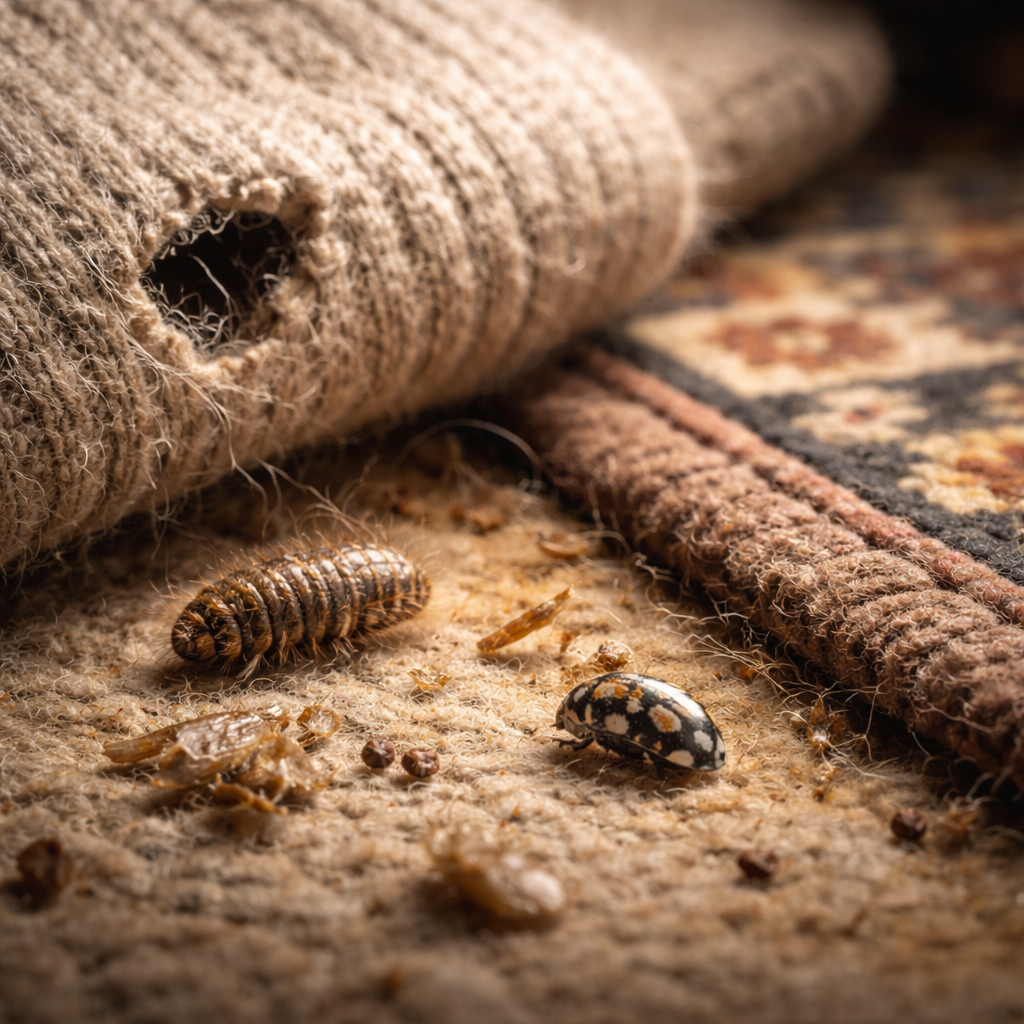
You notice a small hole in your favorite wool sweater, then another in the corner of the rug — and suddenly the pattern becomes clear. Knowing how to get rid of carpet beetles before the infestation spreads can save your wardrobe, furniture, and peace of mind. These tiny insects are surprisingly destructive, yet most people underestimate them until real damage is already done.
What you’re actually dealing with
Carpet beetles belong to the family Dermestidae. The adult beetles themselves rarely cause damage — it’s their larvae that feed voraciously on natural fibers, dried food, feathers, and even dead insects. The larvae look like tiny, bristly worms, often brownish or striped, and they tend to stay hidden in dark, undisturbed areas.
Common species you might encounter at home include the varied carpet beetle, the black carpet beetle, and the furniture carpet beetle. Each has slightly different habits, but the removal approach is essentially the same.
Signs the problem is already inside your home
Before jumping to treatment, it helps to confirm what you’re dealing with. Carpet beetle damage is sometimes mistaken for moth damage, but there are clear differences.
- Irregular holes in wool, silk, leather, or fur items
- Shed larval skins (tiny, hollow husks) near baseboards or in closets
- Small, slow-moving oval beetles near windows — adults are attracted to light
- Powdery fecal pellets near damaged materials
- Bare patches appearing in rugs or carpets, especially in low-traffic areas
Finding shed skins is often the most reliable sign. Larvae molt multiple times before becoming adults, and those skins accumulate in the places they spend the most time.
Step-by-step approach to eliminating carpet beetles
There’s no single magic solution here. Effective removal requires combining several methods that target different life stages of the beetle — eggs, larvae, and adults.
Start with a deep, thorough vacuum
Vacuuming is your first and most immediate weapon. Go beyond the obvious surfaces — vacuum along baseboards, under furniture, inside closets, under rugs, and in air vents. Pay close attention to dark corners where larvae hide and develop.
After vacuuming, remove the bag or empty the canister immediately into a sealed plastic bag and dispose of it outside. Larvae can survive inside the vacuum and crawl back out.
Wash and heat-treat infested fabrics
Carpet beetle larvae cannot survive high temperatures. Washing items in hot water (at least 50°C / 120°F) followed by a hot dryer cycle kills both larvae and eggs. For items that can’t be washed — like certain wool garments or decorative pieces — sealing them in bags and placing them in a freezer for at least two weeks is an effective alternative. Sustained cold kills all life stages.
Use boric acid on carpets and upholstery
Boric acid powder is a low-toxicity insecticide that works well against carpet beetle larvae when applied correctly. Lightly dust it into carpet fibers, along baseboards, and into cracks. Leave it for several hours, then vacuum thoroughly. It acts as a stomach poison and also damages the larval exoskeleton.
Keep pets and children away from treated areas during application and until the powder is fully vacuumed up.
Apply an insecticide spray for active infestations
For more severe cases, insecticide sprays containing permethrin, deltamethrin, or bifenthrin are commonly used against carpet beetles. These are contact insecticides — they kill on direct exposure but provide limited residual protection. Focus application on hidden spots: carpet edges, under furniture, inside wardrobes, and along wall-floor joints.
| Treatment method | Best used for | Effectiveness |
|---|---|---|
| Vacuuming | Immediate larvae and egg removal | High (when repeated) |
| Hot washing / drying | Clothing, bedding, soft furnishings | Very high |
| Freezing | Delicate items that can’t be washed | High (min. 2 weeks) |
| Boric acid | Carpets, floor cracks, baseboards | Moderate to high |
| Insecticide spray | Active infestations, hidden zones | High on contact |
Natural options worth considering
If you prefer to avoid chemical treatments, several natural approaches have shown real-world effectiveness against carpet beetles.
- Cedar — cedar blocks, chips, or cedar oil repel adult beetles and deter larvae. Place them in closets, drawers, and storage boxes. Note that cedar loses potency over time and needs refreshing with cedar oil.
- Diatomaceous earth — food-grade DE can be dusted into carpets and along baseboards. It damages the larval cuticle, causing dehydration. It’s non-toxic to humans and pets when used as directed.
- White vinegar — useful for wiping down hard surfaces, shelves, and the insides of drawers. It doesn’t kill eggs or larvae in fabric but disrupts pheromone trails and removes surface contamination.
Natural methods work best as part of a broader prevention and maintenance routine rather than as standalone treatments for an active infestation.
How carpet beetles get in — and how to block them
Adult carpet beetles fly and are commonly found outdoors on flowers. They enter homes through open windows, gaps around pipes, or even on cut flowers and second-hand clothing. Once inside, they lay eggs in undisturbed areas rich in natural materials.
One of the most overlooked entry points is a bird or rodent nest inside the walls or attic — these provide ideal food sources for carpet beetles to breed before spreading into living spaces.
Practical steps to reduce future risk include fitting window screens, sealing cracks and gaps around baseboards, inspecting second-hand furniture and clothing before bringing them inside, and storing natural fiber items in sealed containers or garment bags rather than open shelving.
When to bring in a professional
Most carpet beetle infestations can be managed without professional help if caught reasonably early. However, there are situations where calling a licensed pest control service makes practical sense.
- Damage is appearing in multiple rooms simultaneously
- You’ve treated twice or more with no visible reduction in larvae or damage
- There’s a suspected nest inside walls, attic, or crawl spaces
- You have a large collection of delicate or valuable textiles at risk
Professionals have access to stronger residual insecticides and can perform thermal treatments that penetrate furniture and wall cavities — areas that are simply not reachable with consumer products.
Keeping your home beetle-free going forward
Once you’ve dealt with an infestation, the goal shifts to making sure it doesn’t happen again. The most effective long-term strategy is removing the conditions that allow carpet beetles to thrive in the first place.
Vacuum regularly — at least once a week in carpeted areas and monthly in storage spaces. Rotate stored clothing and inspect it seasonally. Keep humidity levels moderate, since high humidity accelerates egg and larval development. If you own taxidermy, wool rugs, or large amounts of natural fiber textiles, inspect them a few times a year as a routine habit.
Carpet beetles thrive on neglect and undisturbed spaces. The more consistently you clean, inspect, and store items properly, the less hospitable your home becomes — and the less likely you are to find yourself dealing with this problem again.