
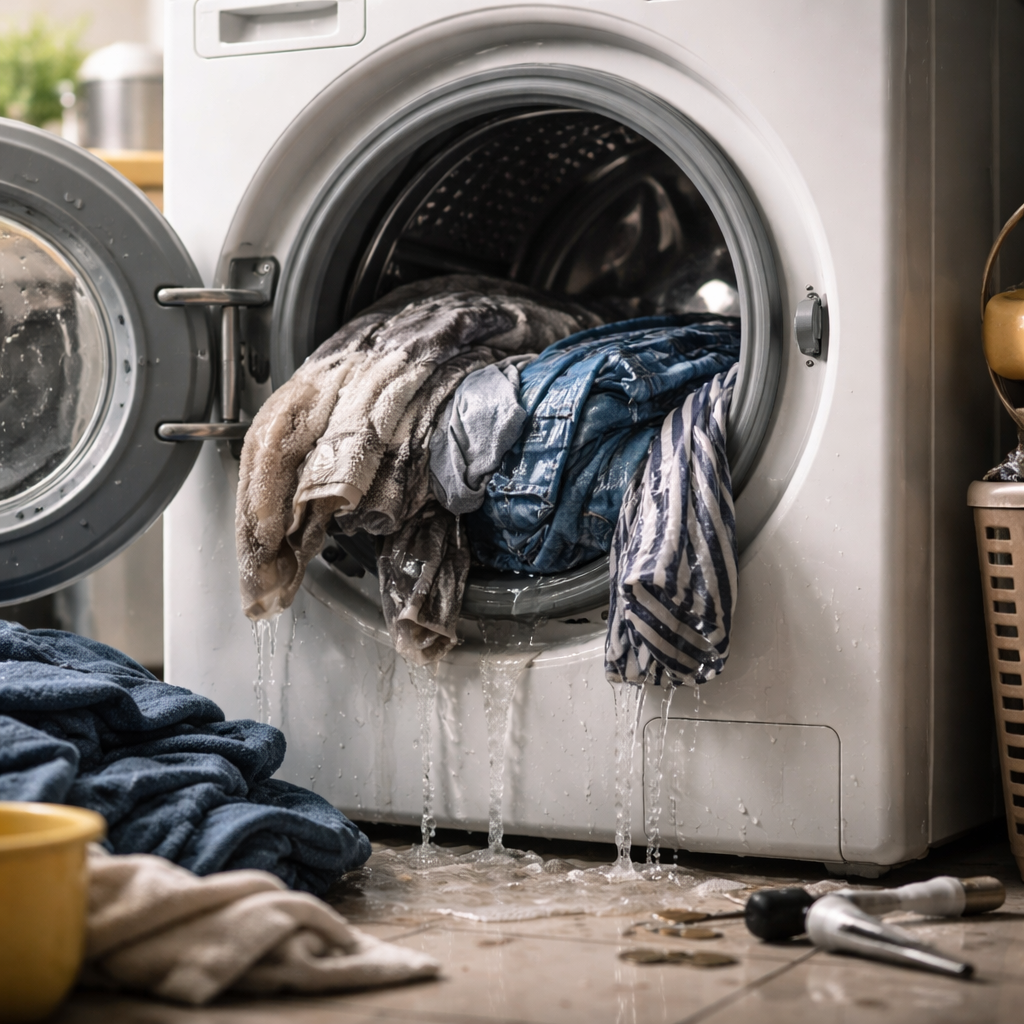
Your laundry is soaking wet, the drum has stopped, and the clothes are still dripping — a washing machine spin cycle not working is one of those household problems that disrupts your entire day without much warning. Before you call a repair technician or start budgeting for a new appliance, it’s worth knowing that most spin cycle failures come down to a handful of fixable causes — many of which you can diagnose and address yourself.
Why the spin cycle stops — understanding the basics
The spin cycle is the final phase of a wash program, designed to remove excess water by rotating the drum at high speed. When it fails or underperforms, the machine isn’t necessarily broken — it’s often responding to a specific condition that prevents safe or effective spinning. Modern washing machines are equipped with sensors and safety mechanisms that deliberately interrupt the spin cycle when something is off.
That’s actually good news. It means the machine is working as intended — protecting itself and your clothes. The challenge is figuring out what triggered that protective response.
The most common causes — and what to check first
Spin cycle problems rarely appear out of nowhere. Here are the most frequently reported causes, ranked from the simplest to more involved issues:
- Unbalanced or overloaded drum — one of the top reasons machines skip or interrupt the spin. Heavy items like duvets or jeans bunched on one side cause vibration the machine’s sensors detect as unsafe.
- Blocked or kinked drain hose — if water can’t drain properly, the machine won’t spin. Check whether the drain hose is pinched behind the appliance or clogged at the connection point.
- Clogged pump filter — most front-loading machines have a small filter at the bottom front panel. Lint, coins, and debris accumulate here and restrict water flow.
- Lid or door not fully latched — a safety interlock prevents spinning if the door sensor doesn’t register a secure close. Sometimes the latch wears out or the sensor becomes faulty.
- Faulty control board or motor brushes — these are less common but occur in older machines or after power surges. Motor brushes in particular wear down over time and reduce spinning power.
A machine that hums but doesn’t spin is often a motor or capacitor issue. A machine that’s completely silent usually points to a power supply or control board fault. These two symptoms lead you in very different directions.
Step-by-step: how to troubleshoot at home
You don’t need professional tools to work through the most likely causes. Here’s a practical sequence to follow before escalating to a repair call.
Start by redistributing the load. Open the drum and manually separate items that have clumped together. Close the door and run a short spin cycle on its own. This alone resolves the problem in a surprising number of cases.
If that doesn’t help, check the drain hose at the back of the machine. It should run downward without sharp bends and sit no more than 100cm above the floor if connected to a standpipe. A hose that’s pushed too far into the standpipe can create a siphoning effect that keeps the machine from draining fully.
Next, clean the pump filter. Place a towel on the floor, unscrew the filter cap slowly, and let the residual water drain into the towel. Remove any debris you find inside. Once replaced, run a rinse and spin cycle to test the result.
When error codes point the way
Many modern washing machines display error codes on their digital panel when the spin cycle fails. These codes are specific to each brand, but they often follow recognizable patterns. Codes beginning with “E3,” “F5,” or “UE” typically point to drainage issues, unbalanced loads, or motor faults depending on the manufacturer.
Consulting your appliance manual is the fastest way to decode these messages accurately. If you’ve lost the manual, the model number printed inside the door frame will help you find a digital version through the manufacturer’s website.
| Symptom | Likely Cause | DIY Fix? |
|---|---|---|
| Drum fills with water but won’t spin | Blocked drain / pump filter | Yes |
| Clothes still wet after full cycle | Unbalanced load or worn motor brushes | Partly |
| Machine stops mid-cycle | Overheating or faulty lid switch | Partly |
| Loud vibration during spin | Uneven load or worn drum bearings | Load: Yes / Bearings: No |
| No movement or sound at all | Control board or power supply fault | No |
What maintenance actually prevents spin problems
Reactive troubleshooting is useful, but a few simple habits significantly reduce how often spin cycle problems occur in the first place. Washing machines that receive basic regular attention consistently outperform neglected ones — and last considerably longer.
- Clean the pump filter every one to three months, depending on how frequently you use the machine.
- Avoid overloading. Most machines perform best at around 80% of their stated capacity, leaving the drum room to move the load freely.
- Run a hot maintenance wash monthly using a drum cleaner or a cup of white vinegar to prevent limescale and detergent residue from building up in the drum and hose.
- Check the door seal regularly for trapped items — socks and underwear caught in the seal can trigger the door sensor and prevent spin engagement.
- Inspect the drain hose position whenever you move or rearrange the machine.
Knowing when to stop and call a professional
Some repairs are genuinely worth attempting yourself. Others — particularly those involving the motor, bearings, control board, or wiring — carry a real risk of making the problem worse or creating a safety hazard. If you’ve worked through the basic checks and the spin cycle still isn’t functioning, and especially if you notice any burning smell, unusual electrical sounds, or water leaking from underneath the machine, it’s time to stop and contact a qualified appliance repair technician.
Drum bearings in particular are a boundary case. Replacing them is technically possible without professional help, but it requires disassembling much of the machine and takes several hours even for experienced people. Weigh the repair cost against the machine’s age — if the appliance is already over ten years old and bearings have failed, replacement may be more cost-effective than repair.
Getting your laundry routine back on track
Spin cycle failures feel dramatic in the moment, but the majority of them have straightforward explanations. A blocked filter, an unbalanced load, or a partially open door accounts for a significant portion of all reported spin problems — and none of those require a technician. Working through the checks methodically, starting from the simplest possible cause, saves time, money, and the frustration of an unnecessary repair visit.
If the problem does turn out to be mechanical, having a clear understanding of what’s actually wrong puts you in a much stronger position when talking to a repair service — you’ll know what questions to ask and whether the quoted solution makes sense. That kind of informed approach to appliance maintenance is genuinely useful, not just in this situation, but every time something in your home stops working as expected.