
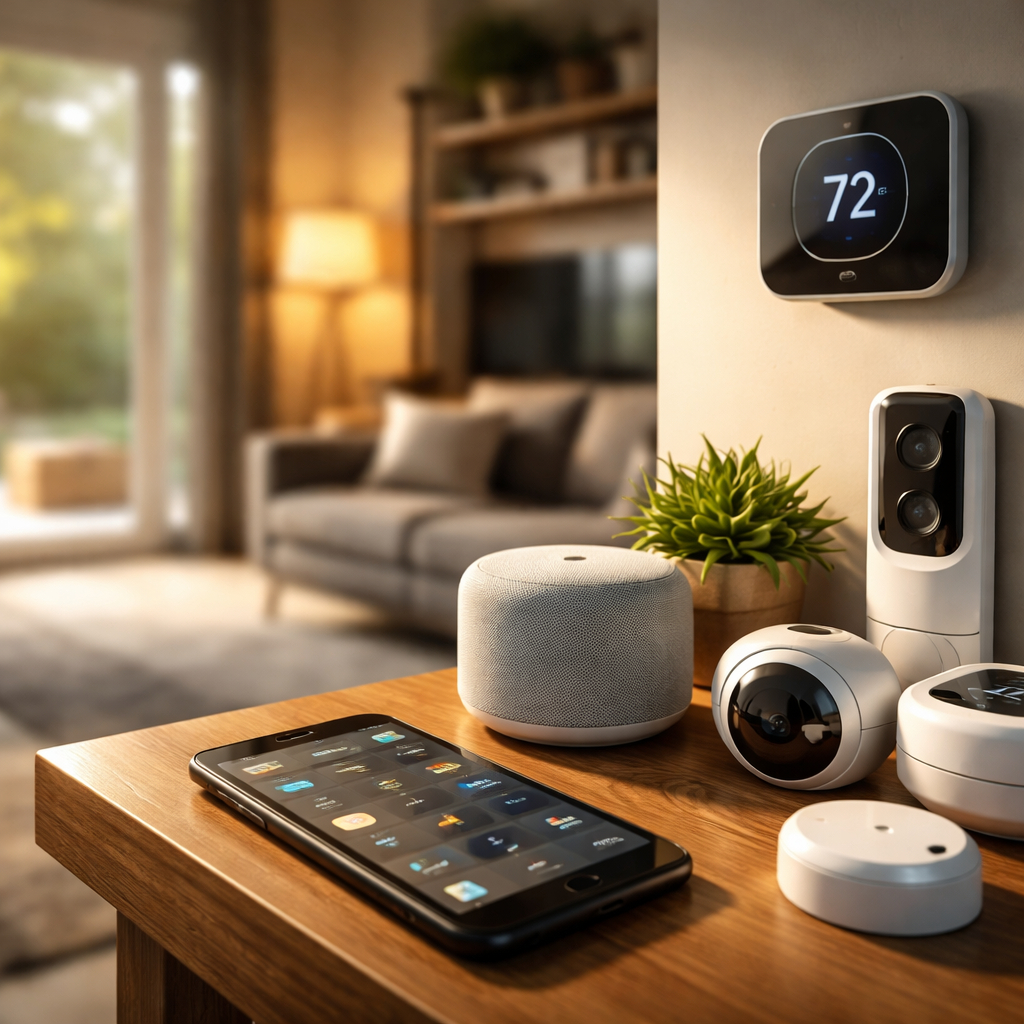
Most people don’t realize how much time they lose each day on tasks that could easily be automated — and that’s exactly where the advantages of smart home devices become impossible to ignore. From adjusting the thermostat before you walk through the door to receiving alerts when a package lands on your porch, these technologies are quietly reshaping what it means to live comfortably and efficiently.
What actually changes when your home gets smarter
There’s a common assumption that smart home technology is a luxury — something for tech enthusiasts or people with oversized budgets. But that framing misses the point entirely. The real value of connected home devices isn’t about novelty. It’s about gaining back control over your environment in a way that passive living simply doesn’t offer.
Consider how a smart lighting system works. It doesn’t just let you dim the lights from your phone. It learns your daily patterns, adjusts brightness based on natural light levels, and can even shift color temperature throughout the day to support your circadian rhythm. That’s not a gimmick — that’s applied science working quietly in your favor.
Energy efficiency that actually shows up on your bills
One of the most measurable benefits of smart home automation is energy management. Smart thermostats, for example, don’t just follow a schedule — they adapt to your behavior. If you leave work early, your heating or cooling system knows to adjust. If you forget to turn off the lights, motion sensors handle it automatically.
| Device | Primary function | Energy impact |
|---|---|---|
| Smart thermostat | Adaptive temperature control | Can reduce heating/cooling costs significantly |
| Smart plugs | Remote power management | Eliminates standby power waste |
| Smart lighting | Motion and schedule-based control | Reduces unnecessary electricity use |
| Smart appliances | Optimized operational cycles | Runs during off-peak energy hours |
These aren’t theoretical savings. Studies by organizations like the American Council for an Energy-Efficient Economy have consistently shown that smart thermostats alone can cut heating and cooling expenses in a meaningful way over time — without requiring any lifestyle changes from the user.
Home security that responds, not just records
Traditional security cameras capture footage. Smart security systems do something more valuable — they respond in real time. Motion-triggered alerts, facial recognition at the door, integration with door locks and lights: these features create a layered security environment that reacts before a situation escalates.
Smart doorbells, for instance, let you see and speak to whoever is at your entrance regardless of where you are in the world. For families, elderly residents, or anyone living alone, this kind of remote visibility isn’t a convenience — it’s a genuine safety net.
The shift from passive recording to active monitoring is what separates modern home security from the systems of a decade ago.
Accessibility and quality of life for every household
Smart home devices have opened up significant possibilities for people with mobility limitations, chronic conditions, or age-related challenges. Voice-controlled assistants allow users to manage lights, locks, thermostats, and entertainment without physical interaction. Automated routines can be set so that morning tasks — turning on the coffee maker, opening blinds, reading the day’s schedule — happen without a single manual step.
- Voice assistants integrated with smart devices offer hands-free control of the entire home environment
- Automated medication reminders help elderly users maintain routines independently
- Smart locks eliminate the need for physical keys, which is critical for users with limited dexterity
- Emergency alert systems can detect unusual inactivity and notify family members or emergency services
For caregivers managing the needs of family members from a distance, these tools provide both peace of mind and a meaningful layer of real-world support.
Practical tips before you start building your smart home
Getting started with home automation doesn’t require buying everything at once. In fact, the most sustainable approach is incremental — choosing devices that solve an actual problem you face, rather than building around what seems impressive.
Start with one room, one problem, one solution. Smart homes built piece by piece are far more coherent than systems assembled all at once without a clear plan.
- Check compatibility before purchasing — most devices align with either Google Home, Amazon Alexa, or Apple HomeKit ecosystems
- Prioritize devices with strong privacy policies and regular firmware updates
- Look for products that work locally (without requiring cloud connection) for greater reliability
- Consider your Wi-Fi infrastructure — smart devices perform best on a stable, dedicated network
It’s also worth noting that the resale value of properties with integrated smart home systems has been shown to be higher in several real estate markets, making these upgrades a practical investment rather than just a personal preference.
The gap between a connected home and a truly intelligent one
There’s an important distinction between a home that’s connected and one that’s genuinely intelligent. A connected home has devices that can be controlled remotely. An intelligent home learns, adapts, and anticipates. The gap between the two is closed through integration — when your thermostat, lighting, security system, and appliances communicate with each other through a unified platform, the result is an environment that responds to you rather than the other way around.
Platforms like Matter — a universal smart home standard developed collaboratively by major tech companies — are making cross-device compatibility significantly more achievable. This means the concern about locking yourself into one ecosystem is becoming less of a barrier for new buyers.
When smart technology stops being optional
There’s a tipping point in the adoption of any technology where it moves from being a choice to becoming a baseline expectation. Home internet was once optional. So was central heating. The trajectory of smart home adoption suggests a similar shift is underway — not as a matter of trend, but because the practical case for these systems is genuinely strong.
The conversation is no longer really about whether smart home devices are useful. It’s about which ones solve the right problems for your specific lifestyle, and how to integrate them in a way that adds clarity rather than complexity to daily life. That’s a far more interesting question — and one worth taking seriously.