
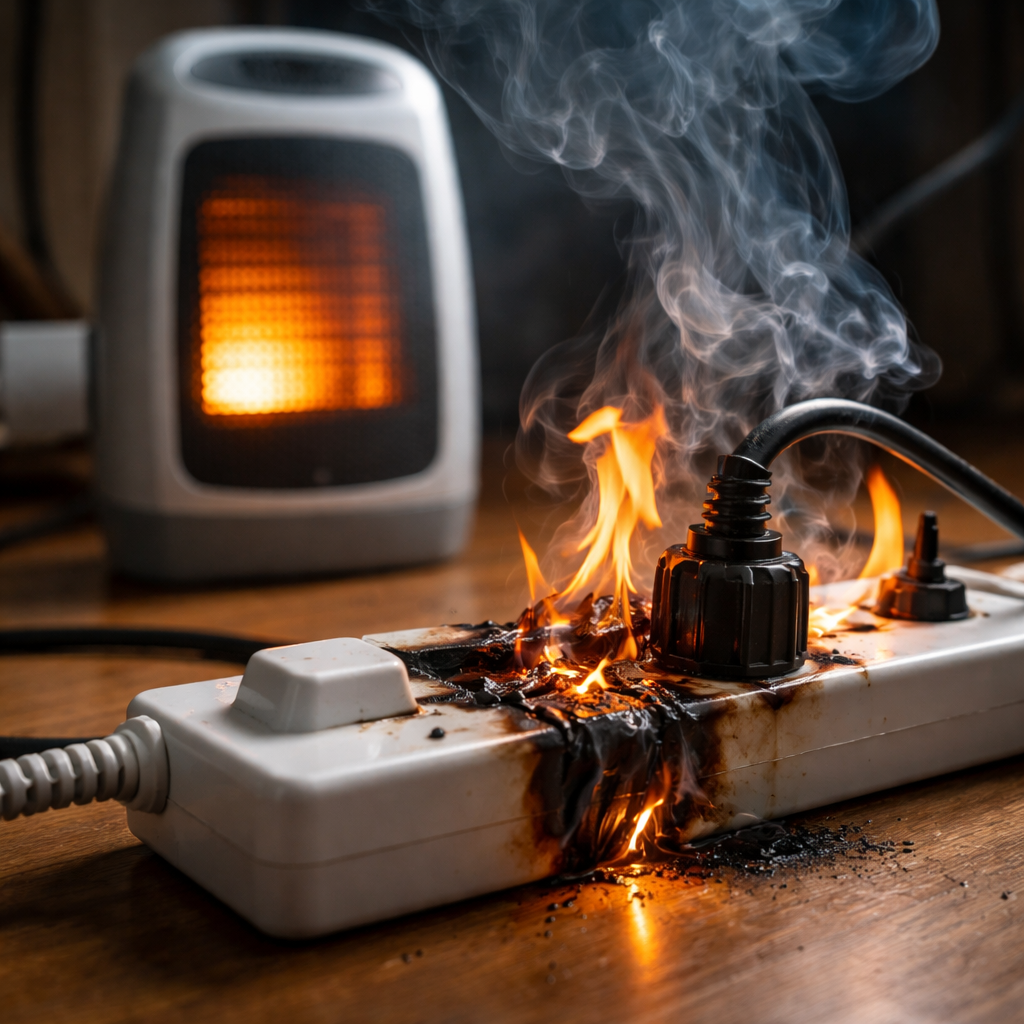
Every winter, the same question comes up in households across the country: is it safe to use a power strip for a space heater? The short answer is no — and the reasoning behind it matters more than the answer itself. Space heaters are among the leading causes of residential electrical fires, and a surprising number of those incidents trace directly back to how the heater was plugged in, not just where it was placed.
Why Space Heaters and Power Strips Are a Bad Combination
Space heaters draw a significant amount of electrical current — typically between 750 and 1500 watts, depending on the model and setting. That kind of power demand requires a direct, stable connection to a wall outlet. Power strips, on the other hand, are designed to distribute power across multiple low-draw devices: phone chargers, lamps, monitors. They are not built to sustain the continuous high-amperage load that a space heater demands.
When a space heater runs through a power strip, the internal wiring of that strip heats up. Over time — sometimes within a single session — this can cause the insulation to melt, the contacts to arc, or the strip itself to catch fire. The problem is not always visible. You might use it a dozen times without incident before something gives out at the worst possible moment.
What Electrical Safety Standards Actually Say
Organizations like the National Fire Protection Association (NFPA) and the U.S. Consumer Product Safety Commission (CPSC) have been consistent on this point for years. Their guidance is clear: space heaters should always be plugged directly into a properly rated wall outlet. Extension cords and power strips are explicitly listed as unsafe alternatives in product safety documentation and fire prevention guidelines.
“Space heaters need their own dedicated outlet. They should never share a circuit with other high-draw appliances or be connected through an extension cord or power strip.”
— U.S. Consumer Product Safety Commission guidance on portable heating safety
This is not a matter of being overly cautious. It reflects how residential wiring and consumer-grade power distribution equipment are actually rated. A standard power strip may be labeled for 15 amps, but continuous draw at or near that threshold degrades the internal components faster than most users realize.
Common Misconceptions Worth Clearing Up
A lot of people assume that a surge-protected power strip solves the problem. It does not. Surge protection guards against sudden voltage spikes — it does nothing to address sustained high-current draw. The surge protector will still overheat under the load of a space heater just as a basic power strip would.
Another common belief is that using a “heavy-duty” extension cord makes it acceptable. While heavy-gauge extension cords are safer than thin ones, they are still not a recommended solution for space heaters. Most space heater manufacturers explicitly void the warranty and flag it as a misuse if the heater is operated through any extension cord.
| Device | Typical Wattage | Safe via Power Strip? |
|---|---|---|
| Laptop charger | 45–100W | Yes |
| LED desk lamp | 5–15W | Yes |
| Space heater | 750–1500W | No |
| Electric kettle | 1000–1500W | No |
| Microwave | 900–1200W | No |
Signs Your Outlet or Wiring May Not Be Up to the Task Either
Even when plugged directly into a wall outlet, a space heater can reveal underlying electrical issues in older homes. Pay attention to these warning signs:
- The outlet feels warm or hot to the touch after the heater has been running
- Circuit breakers trip repeatedly when the heater is in use
- Lights in the room flicker or dim when the heater kicks on
- You notice a faint burning smell near the outlet or the heater itself
- The plug fits loosely in the outlet
Any of these signs point to a wiring issue that goes beyond the heater itself. In older homes with aluminum wiring or outdated panels, adding a high-draw appliance like a space heater to the mix can accelerate existing problems significantly. If any of these symptoms show up, stopping use and consulting a licensed electrician is the right move.
How to Use a Space Heater Without Increasing Your Risk
Using a space heater safely does not require giving it up — it requires a few consistent habits that most people skip simply because they were never told about them.
- Always plug directly into a grounded wall outlet — never into a power strip, extension cord, or adapter
- Make sure the outlet is rated for at least 15 amps on a dedicated circuit if possible
- Keep the heater at least three feet away from furniture, curtains, and bedding
- Turn the heater off when leaving the room or going to sleep
- Check the heater’s cord regularly for fraying, kinking, or discoloration
- Choose a model with automatic tip-over shutoff and overheat protection
One detail that often gets overlooked: avoid placing the heater’s cord under rugs or carpets to hide it. Covered cords trap heat and cannot dissipate it properly, which creates the same kind of risk as plugging into an overloaded power strip.
The Bottom Line Before You Plug Anything In
The convenience of a power strip makes it tempting to use it for everything within reach. But space heaters operate in a completely different category from the devices most strips are designed to handle. The risk is not theoretical — fire investigation reports consistently identify improper power connections as a primary factor in heating-related fires.
If your room lacks a conveniently placed outlet, the safer path is to rearrange your setup around the outlet rather than route power to where the heater happens to sit. A small inconvenience in placement is a far better outcome than the alternative. For anyone unsure about their home’s wiring capacity, having an electrician install an additional outlet in the right location is a worthwhile investment — one that costs far less than the damage a single electrical fire can cause.