
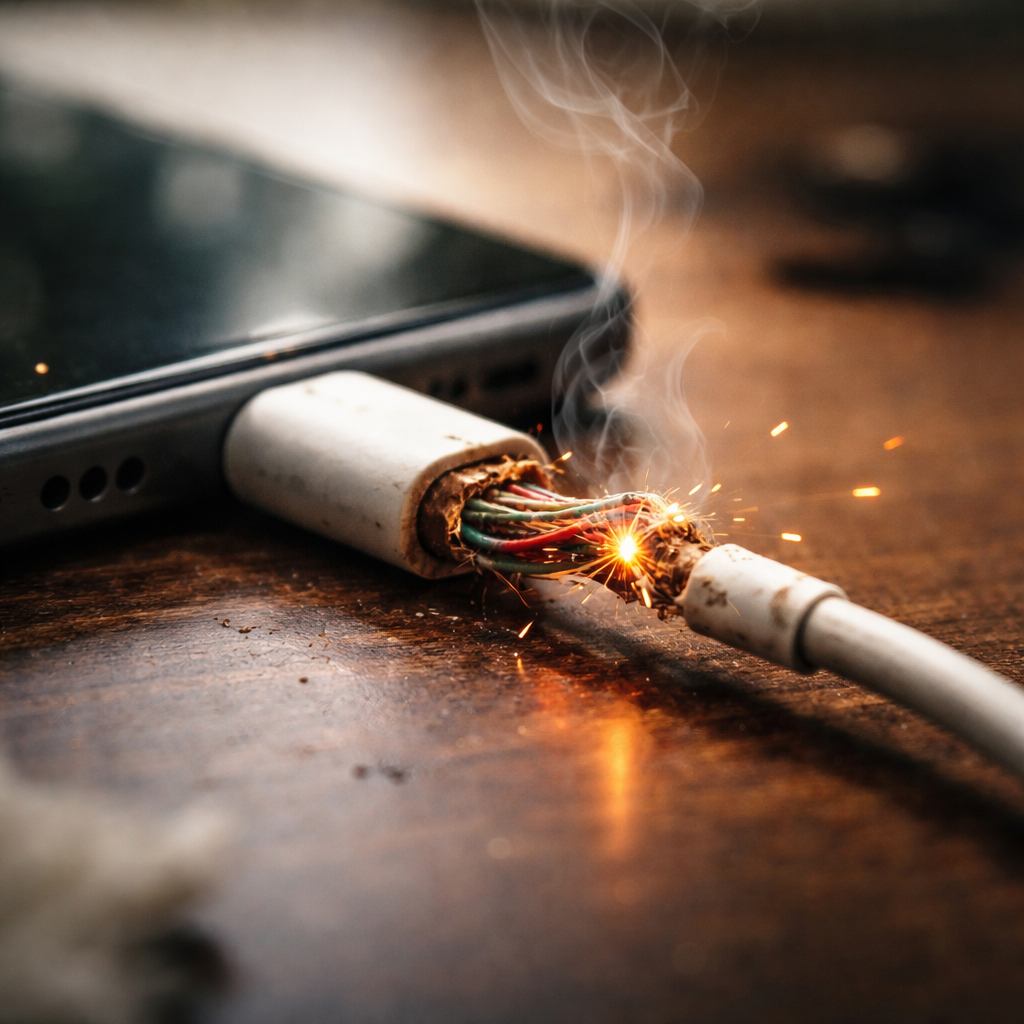
Most people have asked themselves at some point: is it safe to use a broken phone charger cable? The short answer is no — and the reasons go well beyond a simple “it might stop working.” A damaged cable can quietly become one of the more serious hazards in your home, especially if the damage is not immediately obvious.
What counts as a “broken” cable, exactly?
Not all cable damage looks the same. Some issues are visible right away — frayed insulation, exposed copper wires, or a bent connector. Others are harder to spot: internal wire breaks from repeated bending, weakened stress points near the plug, or subtle cracks in the outer jacket that let moisture in.
Understanding the type of damage matters because different faults carry different risks. A cable that charges slowly might just have a bent internal pin. A cable with exposed wiring near the USB end is a completely different situation — one that involves live electrical current close to your skin.
- Frayed or cracked outer insulation
- Exposed or bare copper wires
- Bent, corroded, or broken connector pins
- Burn marks or discoloration near the plug
- Intermittent charging that cuts in and out
- Unusually warm cable during use
Each of these signs points to a cable that has moved past the point of reliable use. Some of them point to something more urgent.
The real electrical risks you should know about
When insulation is compromised, the wires inside a charging cable can come into contact with each other, with conductive surfaces, or with your fingers. This creates conditions for a short circuit. A short circuit in a low-power USB cable will not necessarily electrocute you, but it can generate enough heat to ignite nearby materials — particularly fabric, paper, or a phone case left overnight on a bed.
Fire investigators have documented cases where phone charger cables were identified as ignition sources in residential fires. The combination of a damaged cable, a wall adapter running at full voltage, and a flammable surface is not theoretical — it has caused real damage in real homes.
According to electrical safety organizations, faulty charging equipment — including cables — is a recognized contributor to electrical fires in homes. Visible wire damage should be treated as an immediate replacement priority, not a “I’ll deal with it later” situation.
Beyond fire risk, a damaged cable can also affect your phone’s battery health over time. Inconsistent current delivery caused by a partially broken wire creates irregular charging cycles, which puts extra stress on lithium-ion batteries and can accelerate their degradation.
Can you use electrical tape as a fix?
This comes up constantly, and the honest answer is: it depends on the damage, and even then, it is a temporary workaround rather than a real solution.
Wrapping a small nick in the outer jacket with electrical tape can prevent it from getting worse in the short term. It does not restore the insulating properties of the original sheath, and it certainly does not fix internal wire damage. If the copper is exposed or the cable gets warm during use, no amount of tape will make it safe.
| Type of damage | Tape fix effective? | Recommended action |
|---|---|---|
| Small crack in outer jacket, no exposure | Marginally, short-term | Replace soon |
| Exposed copper wires | No | Stop using immediately |
| Burn marks near connector | No | Discard and replace |
| Intermittent connection | No | Replace cable |
| Bent but intact connector | Not applicable | Try carefully, monitor heat |
How cables get damaged — and how to slow it down
Most cable damage is gradual and entirely preventable. The stress points near the connector ends are the most vulnerable parts. Every time you yank a cable from a port by pulling the wire instead of the plug, you are weakening that joint. Rolling cables tightly or letting them dangle under tension from a high socket both accelerate wear on the internal wires.
A few habits that genuinely extend cable lifespan:
- Always grip the plug — not the cable — when disconnecting
- Avoid wrapping cables tightly around objects or your hand
- Use cable clips or organizers to prevent stress bending at ports
- Keep cables away from high-traffic areas where they get stepped on
- Store cables loosely coiled, not folded flat
Cable protectors — the small spring-loaded sleeves that attach near the connector — are also worth using. They reinforce the weakest point and genuinely reduce the rate at which cables develop stress fractures.
Choosing a replacement: what actually matters
Once a cable is genuinely damaged, replacing it promptly is the only sensible course of action. The replacement does not need to be expensive, but it does need to meet basic quality standards.
Cables certified by recognized standards bodies — such as those carrying USB-IF certification for USB-C — have been tested to handle the voltage and current they advertise. Uncertified cables from unknown manufacturers sometimes use undersized wiring that overheats under load, which recreates exactly the kind of risk you were trying to avoid.
A good rule of thumb: if a cable feels unusually light and thin for its length, or if the connectors have visible gaps or rough edges, it is worth spending a little more on something better-built.
For people who charge devices overnight regularly, investing in cables with reinforced braided nylon sleeves is a practical choice. These cables distribute bending stress across a wider area and typically last significantly longer than standard PVC-coated alternatives.
When the cable is not the only problem
It is worth checking the adapter too. A damaged cable paired with a faulty charger block compounds the risk. If your phone was charging erratically before the cable showed obvious damage, the wall adapter may also need to be inspected — look for discoloration, a burning smell, or a housing that feels unusually hot during use.
The charging port on the phone itself can also sustain damage if a broken cable is used repeatedly. Bent or broken connector pins inside a frayed cable can scratch or deform the port contacts, leading to charging issues that persist even after the cable is replaced.
The bottom line on broken cables
Using a visibly damaged charging cable is a gamble that rarely pays off. The downside scenarios range from a degraded battery and a ruined charging port to an electrical fire — none of which are worth the convenience of putting off a small purchase. The moment a cable shows exposed wiring, burn marks, or generates heat during normal use, it has crossed a clear line. Replace it, recycle the old one properly, and move on.
The cost of a quality replacement cable is trivial compared to the cost of any one of the problems a damaged cable can cause. That trade-off is about as straightforward as it gets.