
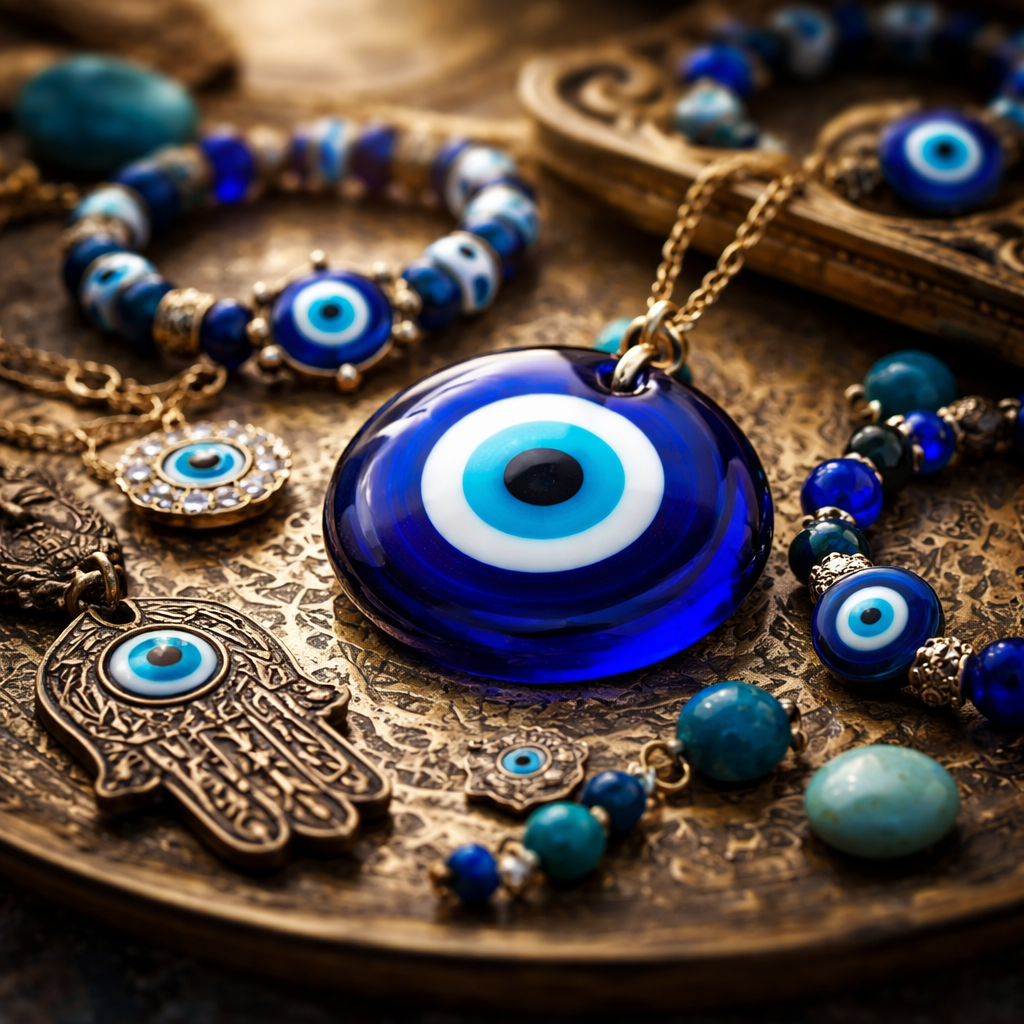
Across cultures separated by thousands of miles and centuries of history, one symbol keeps appearing on wrists, necklaces, and doorways alike — the blue eye. The meaning of evil eye jewelry runs far deeper than aesthetics, touching on ancient fears, communal protection, and a very human need to guard what matters most.
Where the symbol actually comes from
The concept of the evil eye — known in Arabic as “al-ayn,” in Greek as “mati,” and in Turkish as “nazar” — is one of the oldest recorded beliefs in human civilization. Archaeological evidence traces protective eye amulets back to ancient Mesopotamia, roughly 5,000 years ago. Ancient Egyptians painted the Eye of Horus on tombs and jewelry as a shield against harm. Romans wore bulla pendants to protect children from envious glances.
What’s striking is how independently these beliefs developed. Cultures that had no contact with each other arrived at the same conclusion: an envious or malicious gaze can cause real harm, and wearing a symbolic eye can deflect it. Whether you read that as spiritual truth or collective psychology, the staying power of this idea across millennia says something worth paying attention to.
What the evil eye charm is believed to do
The core idea behind evil eye protection jewelry is straightforward — the amulet absorbs or reflects negative energy directed toward the wearer, often unintentionally, through envy or admiration that carries a harmful charge. In many traditions, even a well-meaning compliment from a person with strong envy can cause misfortune, illness, or bad luck to the person being admired.
The protective charm acts as a kind of spiritual buffer. When the amulet cracks or breaks, it’s often interpreted not as a defect but as a sign it successfully absorbed a harmful gaze and protected its owner.
“In Turkey and Greece, it’s common practice to give a nazar boncuk — the blue glass bead — to newborns and hang it above a new business. The reasoning is consistent: new beginnings attract attention, and attention can carry envy.”
The symbolism behind colors and design
Not all evil eye jewelry looks the same, and the variations in color carry distinct meanings depending on the tradition you’re drawing from. The most iconic version — a concentric circle of dark blue, light blue, white, and black — comes from the Turkish nazar tradition, where the blue color is connected to the sky and water, both considered purifying forces.
| Color | Associated meaning |
|---|---|
| Dark blue | Karma, fate, protection from the evil eye |
| Light blue | General protection, broadening perspective |
| White | Purity, clarity, new beginnings |
| Green | Balance, growth, success |
| Red/orange | Energy, courage, protection from fears |
| Gold/yellow | Power, concentration, protection of health |
It’s worth noting that these color meanings are largely rooted in modern interpretations layered over traditional symbolism. The original nazar was always blue — the color associations for other shades have developed more recently within contemporary spiritual and fashion contexts.
How different cultures wear and use it
The way people incorporate evil eye symbolism into daily life varies considerably across regions. In Greece, the mati is a common gift for newborns and people entering significant life transitions. In Turkey, nazar beads are sewn into clothing, hung from rearview mirrors, and embedded in architecture. In South Asia, particularly in parts of India and Pakistan, the practice of “nazar utarna” involves specific rituals to remove the evil eye from a person, often using salt, chili peppers, or a flame.
In Jewish tradition, the “ayin hara” or evil eye is referenced in the Talmud, and the Hamsa hand — often worn alongside or incorporating an eye symbol — serves a similar protective function across Jewish and Islamic cultures.
- In Mediterranean countries, evil eye jewelry is gifted rather than purchased for oneself — the protective intention is thought to be stronger when given
- In parts of Latin America, the “mal de ojo” is taken seriously in folk medicine, and turquoise or red thread bracelets are used for protection
- In many Middle Eastern households, large blue eye plaques are hung near the entrance of a home
- In modern Western fashion, evil eye motifs appear on designer jewelry without religious context, though many wearers are aware of the cultural roots
Wearing it with awareness
As evil eye jewelry has moved into mainstream global fashion, questions about cultural sensitivity have come up more often. Wearing a symbol from a tradition that isn’t your own isn’t automatically disrespectful — but it becomes more meaningful when you understand what you’re actually wearing.
Many people from Greek, Turkish, Middle Eastern, and South Asian backgrounds welcome the global appreciation for their protective symbols. Others prefer that the symbols remain tied to their original spiritual context. The honest answer is that there’s no single consensus, and it’s worth being thoughtful rather than dismissive about the conversation.
What wearing one might mean for you personally
Even outside of religious or superstitious belief, there’s a psychological dimension to wearing a protective symbol. Research on symbolic self-completion and object attachment suggests that carrying a talisman can genuinely increase a person’s sense of confidence and security. Whether the protection is metaphysical or psychological, the effect on the wearer can be real.
Some people wear evil eye jewelry purely for its visual appeal. Others wear it as a connection to cultural heritage or as a spiritual practice. Many land somewhere in the middle — not fully committed to the belief but open to it, drawn to the idea that something beautiful can also carry intention. All of these are valid reasons, and none requires you to defend your choice.
If a piece of jewelry makes you feel protected, grounded, or simply more yourself when you put it on, that’s a meaning worth honoring — regardless of how it compares to what anyone else believes about the symbol.