
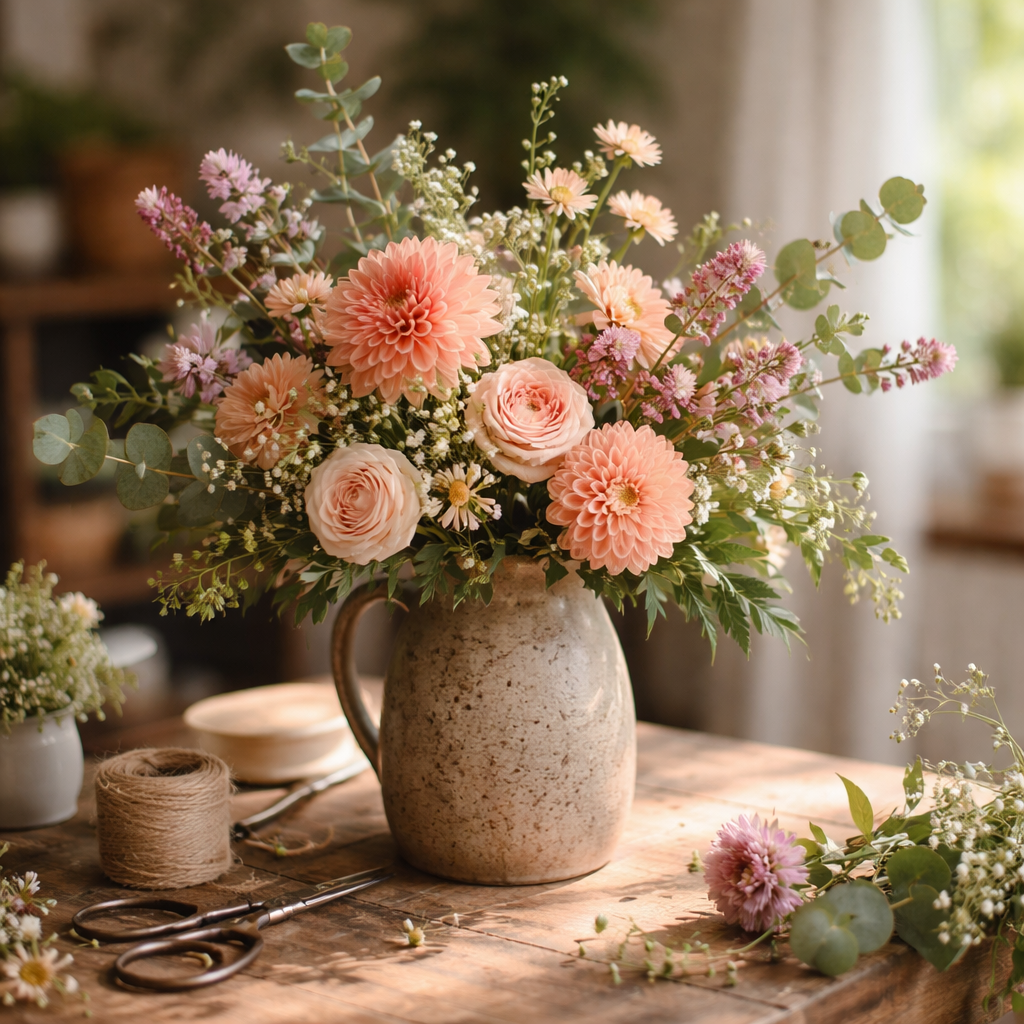
Most people walk past a bunch of grocery store flowers without a second thought — yet those same stems, arranged with a bit of intention, can completely change the atmosphere of a room. Whether you’re just starting to explore ideas for a flower arrangement at home or you’ve been doing it for years and want fresh inspiration, there’s always something new to try. The good news: you don’t need a florist’s training or expensive tools to make something genuinely beautiful.
Start with what you already have
Before buying anything new, take a look around your home. A tall glass bottle, a ceramic mug, a vintage tin — all of these can work as vases. One of the most underrated approaches to home floral design is using unexpected containers. The contrast between a rustic container and delicate blooms often creates far more visual interest than a standard vase would.
If you do have cut flowers on hand, check which stems are still sturdy and which are starting to wilt. Shorter stems actually open up more creative options — low, compact arrangements tend to look full and intentional rather than sparse.
Choosing flowers that work well together
Not every flower combination works visually. A reliable approach is to think in terms of three roles: a focal flower (the star of the arrangement), filler flowers (smaller blooms that fill gaps), and foliage or textural elements (leaves, branches, dried grasses). This structure works whether you’re arranging peonies with eucalyptus or wildflowers with herb sprigs.
- Focal flowers: roses, sunflowers, peonies, dahlias, orchids
- Filler blooms: baby’s breath, wax flower, statice, chamomile
- Textural elements: eucalyptus, ferns, olive branches, dried lavender, ruscus
Sticking to a limited color palette — two or three tones — usually produces a cleaner, more polished result than mixing many colors at once. Analogous colors (those close to each other on the color wheel, like peach, coral, and deep red) feel harmonious without being boring.
Arrangement styles worth trying at home
There’s no single “correct” way to arrange flowers. Different styles serve different spaces and moods.
| Style | Best for | Key characteristics |
|---|---|---|
| Round/dome | Dining tables, centerpieces | Symmetrical, full, viewed from all sides |
| Asymmetrical/natural | Shelves, windowsills | Loose, organic, mimics wildflowers |
| Single-stem | Bedside tables, desks | Minimalist, highlights one bloom |
| Cascading | Tall surfaces, entryways | Stems drape downward, dramatic effect |
| Ikebana-inspired | Any calm, quiet corner | Sparse, intentional, uses negative space |
If you’re new to arranging, the asymmetrical style is the most forgiving — it’s meant to look a little imperfect, which takes pressure off getting every stem exactly right.
A few practical techniques that actually make a difference
Even simple DIY floral arrangements benefit from a handful of technical habits. These aren’t complicated, but skipping them is usually why homemade arrangements look a bit “off.”
Always cut stems at a 45-degree angle under running water or while submerged — this prevents air bubbles from blocking water uptake and keeps flowers fresh significantly longer.
- Remove all leaves that would sit below the waterline to prevent bacterial growth
- Use clean, room-temperature water (not ice cold) for most flowers
- Recut stems every two to three days and change the water at the same time
- Keep arrangements away from direct sunlight and ripening fruit — ethylene gas from fruit shortens flower life
- For heavy-headed blooms like sunflowers or peonies, use floral tape across the vase opening as a grid to support stems
Working with dried and preserved flowers
Dried flower arrangements have become a genuinely popular choice for home décor — and for good reason. They last for months, require no maintenance, and have a texture that fresh flowers simply can’t replicate. Pampas grass, dried hydrangeas, bunny tail grass, and preserved eucalyptus are among the most versatile options.
One effective approach is to mix dried stems with fresh ones. A few sprigs of dried lavender or amaranth tucked into a fresh arrangement add depth and a slightly unexpected contrast. It also extends the life of the overall display — even after the fresh flowers fade, the dried elements remain.
Seasonal flowers and where to source them
Arranging with seasonal flowers isn’t just about following trends — it’s also more practical. Seasonal blooms are fresher because they haven’t been stored in cold transit for weeks, they’re often more affordable, and they tend to last longer once cut.
Beyond florists, consider local farmers’ markets for unusual varieties you won’t find at supermarkets. If you have outdoor space, growing cutting garden flowers — zinnias, cosmos, sweet peas, dahlias — gives you a supply of fresh material throughout the warmer months. Even a windowsill pot of herbs like rosemary or mint can serve as a fragrant filler in a small arrangement.
When the arrangement becomes part of the room
A flower arrangement doesn’t exist in isolation — it becomes part of the space around it. Thinking about placement as deliberately as you think about the flowers themselves changes the result. A tall, linear arrangement in a narrow hallway draws the eye upward and makes the space feel larger. A low, wide bowl of blooms on a coffee table invites people to sit and stay.
Color matters here too. Warm-toned flowers — yellows, oranges, deep reds — tend to feel energizing and work well in living areas and kitchens. Cooler tones — whites, soft purples, blues — feel calming and suit bedrooms or reading spaces. This isn’t a rigid rule, but it’s a useful starting point when you’re figuring out what to put where.
The best floral arrangement for your home is the one that fits the scale of the space, reflects what you actually like, and uses materials you can realistically maintain — not the most elaborate one you’ve seen online.
Let your home tell you what it needs
There’s no formula that works for everyone, and that’s genuinely the best part of working with flowers at home. A single stem in a small bottle can be more effective than an elaborate bouquet if it’s placed in the right spot. A cluster of mismatched vases with a few stems each can feel more lively than one formal centerpiece. The more you experiment — with scale, with texture, with color combinations — the faster your instincts develop.
Start with what’s accessible, pay attention to how the arrangement interacts with the light and the room, and adjust from there. That’s genuinely how most people who are good at this learned — not from a course, but from trying things and noticing what worked.