
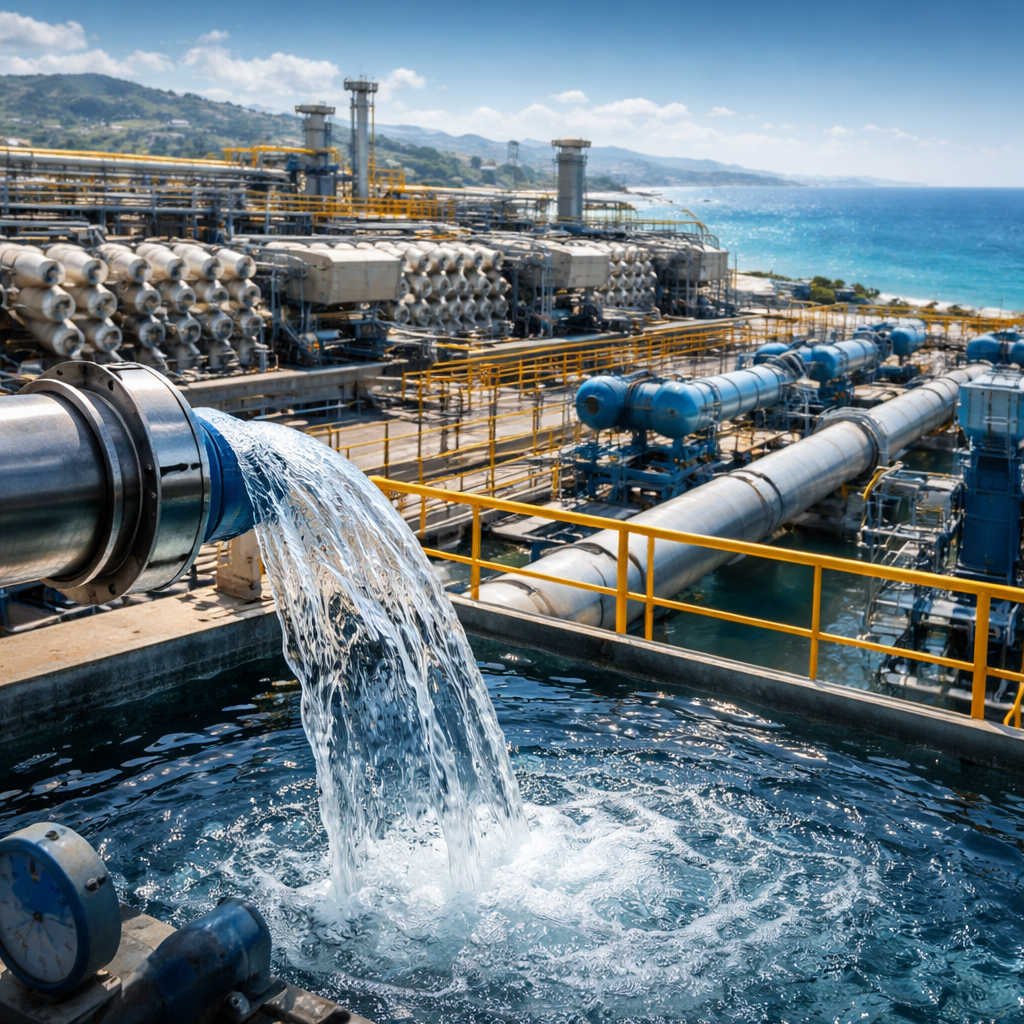
More than two billion people worldwide lack reliable access to clean drinking water — and desalination technology is increasingly stepping in where rivers, lakes, and rainfall simply cannot deliver enough. The advantages of desalination plants go well beyond just producing drinkable water; they reshape how cities plan for the future, how industries operate, and how coastal communities build resilience against drought.
Why the world is turning to desalination
Freshwater scarcity is not a distant problem — it is a present-day reality affecting agriculture, public health, and economic development across multiple continents. Traditional water sources such as rivers and underground aquifers are being depleted faster than they can naturally replenish. Desalination offers something that weather patterns and geography cannot always guarantee: a consistent, location-independent supply of clean water derived directly from the ocean or brackish inland sources.
Countries like Saudi Arabia, Israel, Australia, and Spain have already integrated large-scale desalination into their national water strategies — not as a backup plan, but as a primary infrastructure component. The technology has matured significantly over the past few decades, making it increasingly accessible and cost-effective for a wider range of regions.
The core benefits worth understanding
When evaluating desalination as a water solution, it helps to look at the actual, documented benefits rather than treating it as an abstract engineering concept. Here is what makes desalination plants genuinely valuable:
- They produce potable water independently of rainfall and seasonal changes, providing year-round supply stability.
- Seawater, which covers over 70% of the Earth’s surface, represents an effectively unlimited source of raw input material.
- Modern reverse osmosis plants can be scaled from small municipal installations to massive facilities serving millions of people.
- Desalinated water quality can be tightly controlled, often meeting or exceeding conventional drinking water standards.
- Plants can be built in coastal locations where land availability and proximity to the ocean align well with urban demand.
These are not theoretical advantages — they are operational realities in dozens of countries where desalination has become part of everyday water infrastructure.
Drought resistance as a strategic asset
One of the most compelling arguments for desalination is its independence from precipitation. Traditional water systems — reservoirs, rivers, snowmelt — are all tied to climate variability. A prolonged drought can cripple a region’s water supply within months. Desalination plants, by contrast, are essentially climate-neutral in terms of input: the ocean does not dry up.
Israel now produces over 85% of its domestic water through desalination, making it one of the most water-secure nations in a historically arid region — a transformation achieved over several decades of consistent investment in the technology.
This drought-proof quality makes desalination particularly attractive for regions experiencing increasingly erratic weather patterns. For urban planners and policymakers, having a water source that does not depend on annual rainfall is not a luxury — it is sound risk management.
Environmental considerations: a more nuanced picture
Critics often point to energy consumption and brine disposal as environmental drawbacks of desalination. These are legitimate concerns, but the industry has made measurable progress in addressing both. Energy recovery devices in modern reverse osmosis systems have dramatically reduced electricity use per cubic meter of water produced. When paired with renewable energy sources — particularly solar, which is abundant in the same sunny, arid regions that most need desalination — the carbon footprint can be reduced substantially.
Brine management is a real challenge, but newer approaches include diluting concentrate before discharge, using it in industrial processes, or extracting valuable minerals from it. The conversation around desalination and the environment is evolving rapidly, and it would be inaccurate to dismiss the technology based solely on older, less efficient plant designs.
| Aspect | Older Plants | Modern Plants |
|---|---|---|
| Energy use (kWh per m³) | 10–15 kWh | 3–4 kWh |
| Renewable energy integration | Rare | Increasingly common |
| Brine management | Direct ocean discharge | Dilution, mineral recovery |
| Water recovery rate | Around 35% | Up to 50–60% |
Supporting agriculture and food security
Agriculture accounts for roughly 70% of global freshwater withdrawals, and in water-stressed regions, this demand routinely outpaces natural supply. Desalination can help close this gap by providing water for irrigation, allowing food production to continue in areas that would otherwise face agricultural collapse during dry periods.
While desalinated water is more expensive than surface water for irrigation purposes, it becomes cost-justified in high-value crop production and in situations where the alternative is simply no water at all. In parts of the Middle East and North Africa, desalination already plays a direct role in sustaining agricultural output that would otherwise be impossible.
Economic ripple effects of desalination investment
Building and operating a desalination plant is a significant infrastructure investment, but it generates returns across multiple sectors. Reliable water supply attracts industrial development, supports tourism infrastructure, and reduces the economic losses associated with water shortages — whether in agriculture, manufacturing, or hospitality.
Regions that have invested in desalination often report lower vulnerability to water-related economic shocks. A city that cannot guarantee its water supply struggles to attract long-term business investment; one with a secure, diversified water infrastructure sends a very different signal to investors and developers.
What the technology means for everyday life
At its most human level, desalination is about access. It is about a household in a coastal city turning on a tap during a drought year and finding water. It is about a farmer in an arid region being able to plan a planting season without gambling entirely on rainfall. It is about municipal governments making long-term commitments to their residents instead of crisis-managing recurring shortages.
The technology is not perfect, and no single solution solves the global water crisis on its own. But among the tools currently available at scale, desalination stands out for its capacity to deliver reliable, high-quality water in places and circumstances where other options fall short. As energy costs continue to evolve and renewable integration deepens, the case for desalination only grows stronger — not as a futuristic concept, but as a working, proven part of the water infrastructure that millions of people already rely on every day.