
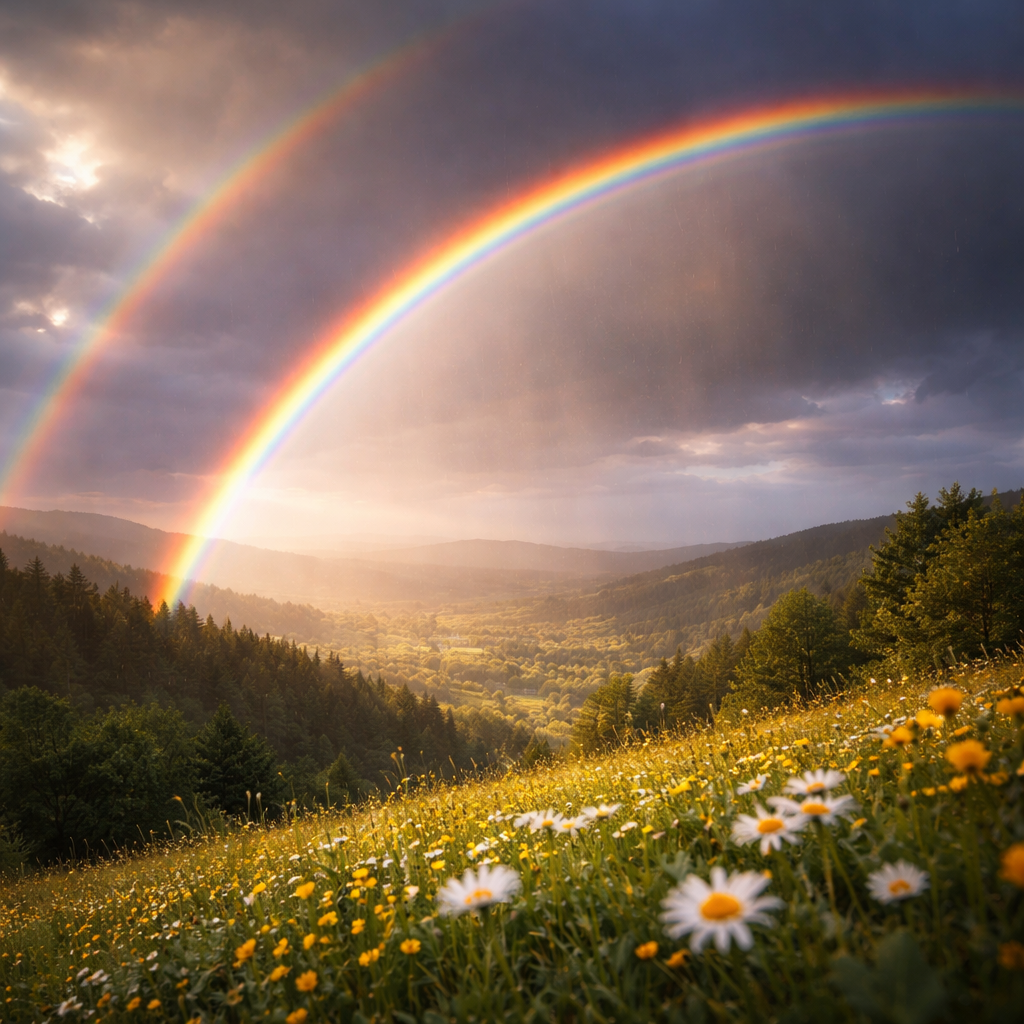
Spotting a double rainbow stops most people in their tracks — and for good reason. The meaning of a double rainbow has fascinated cultures, scientists, and casual sky-watchers alike for centuries, and the phenomenon manages to sit at a rare crossroads between physics, mythology, and personal reflection. Whether you just saw one outside your window or you’re simply curious about what makes it so special, there’s a lot more going on up there than meets the eye.
What actually causes a double rainbow
Before diving into symbolism and folklore, it helps to understand the science — because honestly, the physics alone is worth appreciating. A standard rainbow forms when sunlight enters water droplets in the atmosphere, bends (refracts), reflects once inside the droplet, and exits at an angle that splits light into its spectral colors. A double rainbow happens when light reflects twice inside each droplet before exiting.
That second reflection creates a few noticeable differences from the primary arc. The secondary rainbow appears outside the primary one, sits higher in the sky, and has its color order reversed — red appears on the inner edge rather than the outer. The sky between the two arcs also appears noticeably darker, a region called Alexander’s dark band, named after the ancient Greek philosopher Alexander of Aphrodisias who first described it.
| Feature | Primary Rainbow | Secondary Rainbow |
|---|---|---|
| Color order | Red outside, violet inside | Violet outside, red inside |
| Brightness | Brighter | Dimmer |
| Position in sky | Lower arc | Higher arc |
| Light reflections inside droplet | One | Two |
How different cultures have interpreted it
Long before anyone understood the optics behind it, people across the world were assigning meaning to this rare sky event. Interestingly, many traditions landed on similar themes — transition, duality, and messages from beyond the physical world.
- In Norse mythology, the rainbow (Bifrost) served as a bridge between the human world and the realm of the gods. A double rainbow was sometimes interpreted as that bridge being particularly active or significant.
- In Hawaiian culture, rainbows in general are considered sacred and connected to the presence of ancestors. A double rainbow carries an amplified sense of that connection.
- Some Native American traditions view double rainbows as a sign of renewal — a reminder that transformation comes in layers, not all at once.
- In Chinese symbolism, the two arcs have been associated with yin and yang — the primary and secondary rainbows representing complementary, balanced forces.
What’s striking across these traditions is that almost none of them treat the double rainbow as an ordinary event. The consensus, culturally speaking, tends to lean toward it being a marker of something meaningful — a turning point, a message, or an invitation to pay attention.
The emotional response people describe
There’s a reason the viral video of a man overcome with emotion at the sight of a double rainbow resonated with so many people. The reaction wasn’t just about internet humor — it captured something genuine. Psychologists who study awe as an emotion note that natural phenomena like double rainbows tend to trigger a specific kind of response: a sense of smallness combined with connection to something larger than oneself.
“Awe-inducing experiences — including rare natural events — have been linked to increased feelings of well-being, reduced stress, and a temporary shift away from self-focused thinking.” — findings consistent across multiple studies in positive psychology research.
This might explain why people instinctively pause, pull out their phones, or feel an urge to share the moment. It’s not superstition — it’s a deeply human response to something that briefly makes the world feel less mundane.
Spiritual and personal symbolism in modern context
For many people today, seeing a double rainbow doesn’t necessarily tie to a specific religious tradition. Instead, it tends to carry personal meaning shaped by whatever that individual is going through at the time. It’s a phenomenon that invites projection in the most natural way.
Some common personal interpretations people report include seeing a double rainbow as a sign of hope during a difficult period, a reminder of a loved one who has passed, or a sense that a decision they’re wrestling with might have a positive outcome. None of these interpretations are “correct” or “incorrect” — they reflect the very human tendency to find pattern and meaning in the world around us, especially during moments of beauty.
When two arcs tell a fuller story than one
What makes the double rainbow genuinely compelling — beyond any single interpretation — is that it naturally represents the idea of layers. The first rainbow is the obvious, the immediate. The second is fainter, reversed, and easy to miss if you’re not looking carefully. That structure maps onto a lot of human experience: the surface-level reading of a situation, and then the deeper, sometimes counterintuitive truth underneath it.
Whether you’re drawn to the atmospheric science, the cross-cultural symbolism, the psychological response it triggers, or simply the visual experience of watching two arcs stretch across a rain-cleared sky — the double rainbow earns its reputation. It’s one of those rare moments where nature and meaning seem to overlap without either side needing to explain itself.