
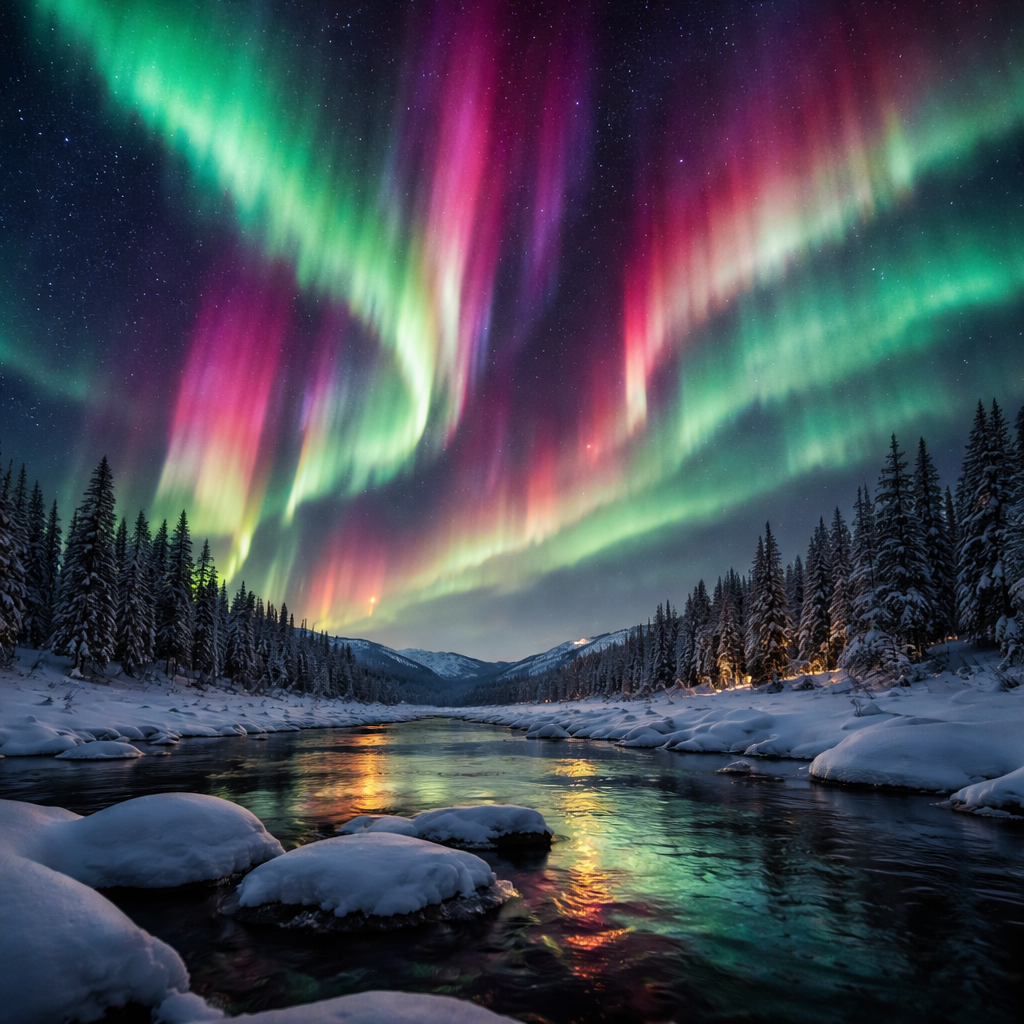
Few natural phenomena on Earth can match the sheer visual drama of the northern lights — and yet, many of the facts about the Aurora Borealis that make it truly extraordinary remain unknown to most people who dream of seeing it. Beyond the dancing curtains of green and violet light lies a story written in physics, solar wind, and Earth’s magnetic field.
What actually causes the aurora — and why it glows in different colors
At its core, the aurora is a collision event. Charged particles streaming from the Sun — primarily electrons and protons — travel across space as part of the solar wind. When they reach Earth, most are deflected by the planet’s magnetosphere. But near the poles, the magnetic field lines converge and dip toward the surface, creating a natural funnel that allows these particles to penetrate deep into the upper atmosphere.
Once inside, they collide with oxygen and nitrogen atoms. The energy from those collisions excites the atoms, which then release that energy as visible light. What color appears depends entirely on which gas is involved and at what altitude the collision occurs.
| Color | Cause | Altitude |
|---|---|---|
| Green | Oxygen atoms | Around 100–150 km |
| Red | High-altitude oxygen | Above 300 km |
| Blue / Purple | Nitrogen molecules | Below 100 km |
| Pink / Magenta | Nitrogen at lower altitudes | Roughly 90–100 km |
Green is by far the most common color seen from the ground — it’s the signature shade most people associate with aurora photos. Red auroras, while real, are often too faint for the naked eye and show up more clearly in long-exposure photography.
The aurora is not exclusive to the north
The Aurora Borealis has a southern counterpart: the Aurora Australis. Both phenomena happen simultaneously and are near-mirror images of each other, occurring over Antarctica and the southern ocean. The physics behind them is identical — only the geographic location differs.
Together, they’re referred to as the polar auroras. The reason we hear more about the northern version is largely practical — the Aurora Borealis is accessible to far more people, given that countries like Norway, Iceland, Finland, Canada, and northern Russia are inhabited and visited year-round.
The auroral oval — the ring-shaped zone where auroras are most frequently visible — sits at roughly 65–72 degrees latitude in both hemispheres. During strong geomagnetic storms, this oval expands dramatically, bringing the northern lights as far south as central Europe or even the northern United States.
Solar activity is the engine behind it all
The intensity of auroral displays is directly tied to the Sun’s activity cycle. The Sun operates on an approximately 11-year solar cycle, moving between periods of low activity (solar minimum) and high activity (solar maximum). During solar maximum, coronal mass ejections — massive bursts of magnetized plasma — are more frequent and more powerful.
When a particularly strong coronal mass ejection is directed toward Earth, it can trigger a geomagnetic storm measured on the Kp index, a scale from 0 to 9. A Kp of 5 or above is classified as a geomagnetic storm and typically produces visible aurora at mid-latitudes. Kp 9 events, though rare, can generate extraordinary displays across a wide geographic range.
Some aurora facts that tend to surprise people
Even those who have seen the northern lights in person often don’t know some of the less-publicized details about how the aurora behaves and where it appears.
- Auroras can occur during the day — they’re simply invisible because daylight drowns them out. The phenomenon is continuous, not limited to night hours.
- The aurora makes sound in rare cases. Though widely debated for decades, researchers in Finland have recorded faint crackling and clapping noises associated with strong auroral events. The sounds are thought to originate at altitudes far lower than the aurora itself.
- Astronauts aboard the International Space Station observe auroras from above — seeing them as glowing rings encircling the poles rather than overhead curtains.
- Jupiter, Saturn, Uranus, and Neptune all have their own auroras, generated by their powerful magnetic fields interacting with the solar wind or, in Jupiter’s case, also with its volcanic moon Io.
- The word “aurora” was chosen by French astronomer Pierre Gassendi in the 17th century, referencing the Roman goddess of dawn — a fitting name for a light that often appears just before sunrise.
Where and when you actually have the best chance of seeing it
Chasing the northern lights requires more than just booking a flight to Scandinavia. Timing, weather, and darkness all factor into whether you’ll witness a display or return home disappointed.
The best viewing window in the northern hemisphere runs from late September through late March. This isn’t because auroras are absent in summer — they absolutely occur — but because midsummer nights in the Arctic are too bright for the lights to be visible. You need true darkness, which the polar night season provides in abundance.
Clear skies are equally critical. Tromsø in Norway, Abisko in Sweden, and Rovaniemi in Finland are popular destinations partly because of their relatively stable weather patterns compared to Iceland’s notoriously unpredictable conditions. That said, Iceland offers the added draw of volcanic landscapes and geothermal pools as backdrop.
The aurora as a scientific tool, not just a spectacle
For space weather researchers, the aurora serves as a real-time visual indicator of what’s happening between the Sun and Earth. Monitoring auroral activity helps scientists understand geomagnetic disturbances that can affect satellite communications, GPS accuracy, and even power grid stability on the ground.
Strong geomagnetic storms — the same events that produce the most spectacular northern lights — have historically caused disruptions to electrical infrastructure. The 1989 Quebec blackout, which left millions without power for hours, was triggered by a powerful geomagnetic storm. Understanding and predicting these events is now an active area of space weather research with real-world implications.
The aurora is one of those rare phenomena that is simultaneously beautiful enough to stop you in your tracks and scientifically important enough to dedicate entire research programs to it. It exists at the intersection of astrophysics, atmospheric science, and human experience in a way few natural events do.
The northern lights have looked the same for a very long time
Cave paintings and ancient rock art found in parts of Europe and North America contain depictions that some researchers interpret as auroral displays, suggesting that humans have been watching — and trying to record — the northern lights for tens of thousands of years. Norse mythology described them as the glow from the shields of the Valkyries. Indigenous peoples across the Arctic developed rich oral traditions around the lights, often attributing them to spirits or ancestors.
What has changed is our understanding. We now know the lights are not supernatural — but knowing the mechanism doesn’t diminish the experience of watching charged particles from the Sun illuminate the sky above you in shifting waves of color. If anything, understanding what you’re looking at makes it more remarkable, not less.