
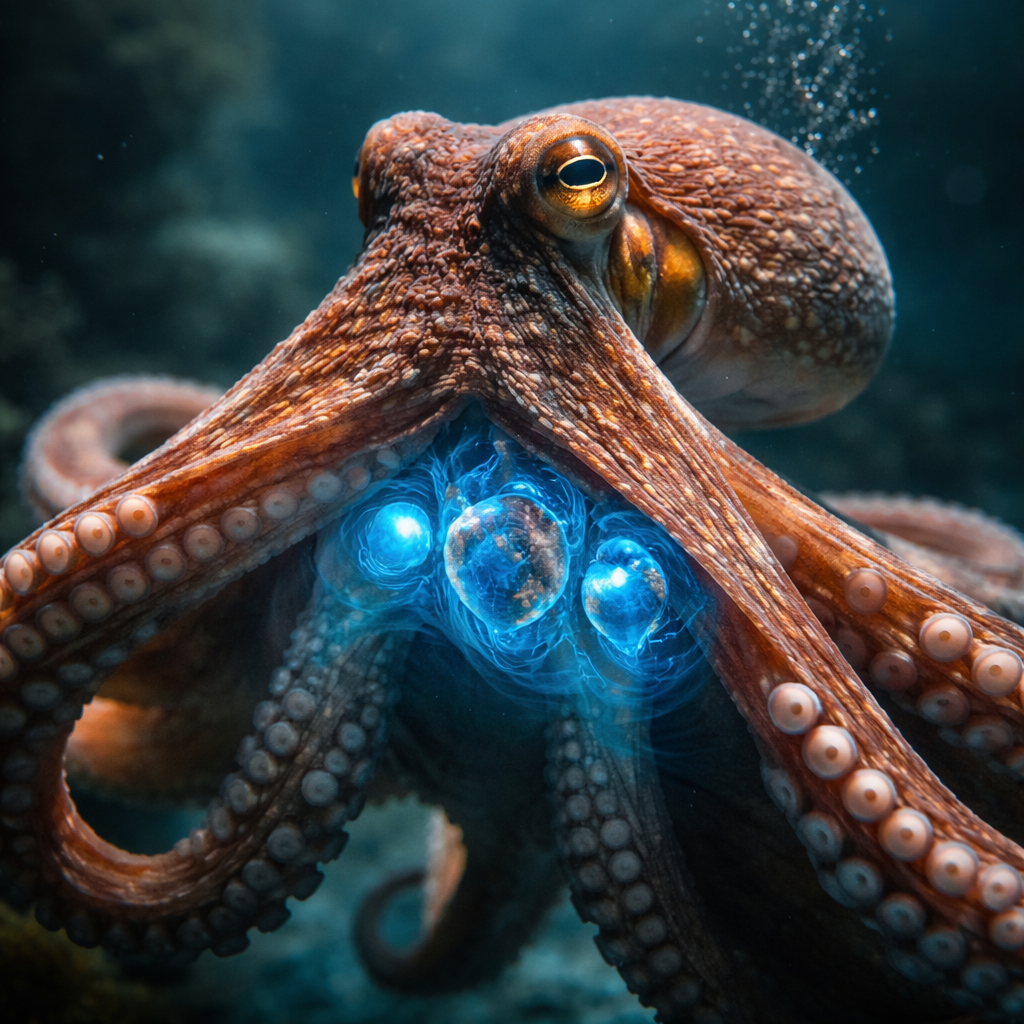
Most people know octopuses as strange, ink-squirting creatures from the deep — but the facts about octopuses and their three hearts reveal something far more astonishing than any sci-fi screenplay could invent. These animals don’t just look alien; their biology genuinely operates by a completely different rulebook than almost anything else on Earth.
Why three hearts — and what each one actually does
An octopus has three hearts working simultaneously, and each serves a distinct purpose. Two of them — called branchial hearts — are positioned near the gills. Their sole job is to pump deoxygenated blood through the gill tissue, where it picks up oxygen from the surrounding water. The third heart, known as the systemic heart, then takes that freshly oxygenated blood and pushes it out to the rest of the body: the muscles, the organs, the suckers, the skin.
What makes this especially interesting is that the systemic heart actually stops beating when an octopus swims. The act of swimming — which requires rhythmic muscular contractions — temporarily shuts down that central pump. This is why octopuses tend to crawl along the seafloor rather than swim long distances. Swimming, for them, is genuinely exhausting at a cardiovascular level.
The octopus systemic heart doesn’t just slow down during swimming — it stops entirely. This is one of the reasons these animals prefer to walk on eight arms rather than jet through open water.
Blue blood and copper: the chemistry behind octopus circulation
Here’s where it gets even more unusual. Octopus blood is blue — and that’s not a metaphor or an exaggeration. While human blood relies on iron-based hemoglobin to carry oxygen, octopuses use a copper-based molecule called hemocyanin. This compound turns blue when oxygenated and becomes nearly colorless when it releases oxygen to the tissues.
Hemocyanin is less efficient than hemoglobin at room temperature, but it performs significantly better in cold, low-oxygen environments — exactly the deep-sea conditions where many octopus species live. Evolution, in other words, gave them a circulatory system tailor-made for their habitat.
| Feature | Octopus | Human |
|---|---|---|
| Number of hearts | 3 | 1 |
| Oxygen-carrying molecule | Hemocyanin (copper-based) | Hemoglobin (iron-based) |
| Blood color | Blue | Red |
| Circulatory system type | Open (partially) | Closed |
| Heart stops during activity? | Yes (systemic heart during swimming) | No |
Nine brains, three hearts — the full picture of octopus neurology
The cardiovascular system doesn’t exist in isolation. To understand why three hearts make sense for an octopus, you also need to know about their nervous system. An octopus has a central brain, but about two-thirds of its neurons are distributed across its eight arms. Each arm can act semi-independently — tasting, gripping, and reacting to stimuli without waiting for instructions from the central brain.
This decentralized nervous system means the body has enormous metabolic demands spread across a large surface area. Three hearts — with two dedicated entirely to gill oxygenation — ensure that oxygen delivery keeps pace with the animal’s complex, distributed biology. It’s a system built for flexibility and redundancy, not simplicity.
Worth knowing: Each of the octopus’s eight arms contains roughly 50 million neurons. For comparison, a cat’s entire brain contains around 760 million. An octopus arm alone approaches roughly 6–7% of that total — which helps explain why those arms behave almost like independent creatures.
Short lives, intense biology
Despite all this biological sophistication, most octopus species live remarkably short lives — typically between one and two years. Some smaller species live only a few months. The common octopus (Octopus vulgaris) rarely survives beyond two years in the wild, and the giant Pacific octopus (Enteroctopus dofleini), the largest known octopus species, usually lives three to five years at most.
Reproduction plays a significant role in this short lifespan. Males typically die shortly after mating. Females stop eating entirely while guarding their eggs — sometimes for months — and die shortly after the eggs hatch. The three hearts, the blue blood, the distributed nervous system: all of it is packed into a lifespan shorter than many houseplants.
- Common octopus lifespan: 1–2 years
- Giant Pacific octopus lifespan: 3–5 years
- Females die after eggs hatch; males die shortly after mating
- Females stop feeding during the egg-guarding period
Camouflage, venom, and ink — the other tools in their arsenal
The circulatory system may be the most biologically radical feature of an octopus, but it’s surrounded by an equally impressive set of adaptations. Octopuses can change both the color and texture of their skin in milliseconds, thanks to specialized cells called chromatophores, iridophores, and papillae. This isn’t just camouflage — it’s also used for communication and to startle predators.
All octopus species are venomous, though the vast majority pose no serious danger to humans. The exception is the blue-ringed octopus (genus Hapalochlaena), found in the Pacific and Indian Oceans, whose venom contains tetrodotoxin — a neurotoxin with no known antidote that can cause paralysis and death in humans within minutes.
The ink octopuses release when threatened isn’t just a visual smokescreen. It contains tyrosinase, a compound that interferes with a predator’s sense of smell and taste, giving the octopus time to escape. The ink also temporarily blinds predators by irritating their eyes — a multi-layered defense delivered in a single squirt.
What makes octopuses worth paying attention to
Octopuses are increasingly studied not just by marine biologists but by neuroscientists, robotics engineers, and materials scientists. The way their arms move without rigid skeletal structure has inspired a new generation of soft robotics. Their skin’s ability to change texture has led researchers toward new materials that can alter their surface properties on demand. Their distributed nervous system challenges long-held assumptions about where intelligence can reside in a body.
Three hearts pumping blue blood through an animal that thinks with its arms and walks instead of swimming — it’s a reminder that nature doesn’t optimize toward familiarity. It optimizes toward survival, and sometimes the result looks nothing like what we’d expect.