
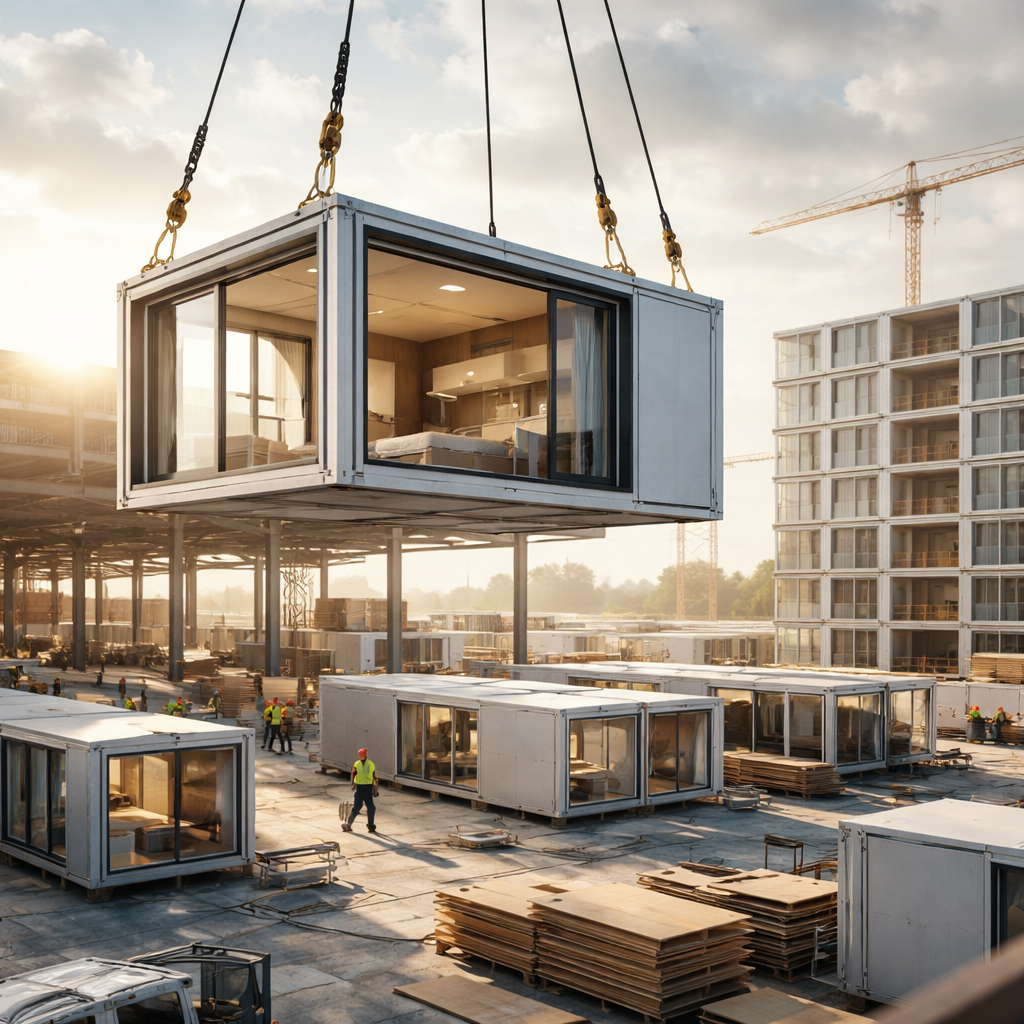
What if a building could be assembled the way a precision machine is built — in controlled conditions, with repeatable quality, and delivered to site ready to perform? That’s not a futuristic concept anymore. The advantages of modular construction have turned this approach into one of the most seriously discussed methods in architecture, engineering, and real estate development worldwide.
Speed that actually changes project economics
One of the most immediate differences between modular and traditional construction is the timeline. While site preparation and foundation work happen on location, the modules themselves are manufactured simultaneously in a factory. This parallel workflow can reduce overall construction time by 30–50% compared to conventional building methods.
For developers and property owners, this compression of the schedule isn’t just a convenience — it directly affects financing costs, time to occupancy, and return on investment. A hotel that opens four months earlier generates revenue that a traditionally built equivalent simply cannot.
Controlled environment, consistent results
Factory production removes one of the most unpredictable variables in construction: weather. Rain, frost, and humidity regularly delay site work and affect material quality. Inside a manufacturing facility, humidity, temperature, and processes are tightly managed.
This environment also allows for rigorous quality control at every stage. Inspections happen before modules leave the factory — not after installation when corrections are expensive and disruptive. The result is a more consistent final product, with fewer defects and less rework.
Factory-built modules typically undergo multiple inspection stages before delivery, compared to the episodic site inspections common in traditional construction.
Where the numbers actually land
Cost comparison between modular and site-built construction depends heavily on project type, location, and scale. But there are consistent patterns worth understanding:
| Factor | Traditional Construction | Modular Construction |
|---|---|---|
| Construction timeline | Standard duration | 30–50% faster |
| Weather disruptions | Frequent | Minimal |
| Material waste | 10–15% average | Up to 90% waste reduction possible |
| Labor efficiency | Variable by site | Optimized factory workflow |
| Quality inspections | Post-installation | Pre-delivery in facility |
Material procurement in bulk for factory production often reduces costs through economies of scale. Waste is also dramatically lower — factories can reuse offcuts and manage inventory precisely, unlike a construction site where overordering is a standard buffer strategy.
Sustainability isn’t a tagline here
Modular buildings genuinely perform better on several environmental metrics. The reduction in on-site construction activity means less noise, dust, and traffic in surrounding communities. This matters especially in dense urban areas where traditional construction can disrupt neighborhoods for years.
From a resource standpoint, factory precision cuts material waste significantly. Lumber, steel, and insulation are cut to exact specifications with minimal surplus. Some modular manufacturers have documented up to 90% reduction in construction waste compared to conventional building.
- Lower embodied carbon due to reduced waste and optimized logistics
- Modules can be designed for disassembly and relocation
- Factory processes support consistent energy-efficient detailing
- Fewer delivery trips to site compared to traditional material staging
The ability to relocate or reconfigure modules also gives buildings a longer functional life. Rather than demolition, a structure can be adapted — adding floors, changing layouts, or repurposing units entirely.
Flexibility that architects and developers appreciate
A common misconception is that modular automatically means boxy, repetitive, or aesthetically limited. In practice, modern modular design has produced multi-story residential towers, boutique hotels, healthcare facilities, and student housing that are architecturally indistinguishable from site-built equivalents.
The modularity itself introduces a kind of design flexibility that conventional construction struggles to match. Configurations can be adjusted, units stacked in varying arrangements, and finishes customized within the factory process. This is particularly useful for large-scale residential projects where the same floor plan repeats across dozens or hundreds of units — factory production thrives in exactly this scenario.
Safety and labor conditions that often go unmentioned
Construction sites carry inherent safety risks. Working at height, in variable weather, with heavy equipment and materials — the combination produces injury rates that the industry has struggled to reduce for decades. Factory environments offer fundamentally different conditions: stable footing, controlled lighting, ergonomic workflows, and predictable processes.
Workers in modular manufacturing facilities typically experience lower rates of on-the-job injury compared to site-based construction crews. This isn’t just a humanitarian benefit — it affects project continuity, insurance costs, and workforce retention.
The types of projects where modular performs strongest
Not every project is equally suited to modular methods, but the range of successful applications is broader than most people assume:
- Multi-unit residential housing — apartments, dormitories, affordable housing developments
- Hospitality — hotels where room configurations repeat across many floors
- Healthcare — clinics and patient rooms where identical layouts are required
- Remote or difficult-access sites — mining camps, research stations, disaster relief structures
- Urban infill projects where site disruption must be minimized
- Temporary or relocatable structures with planned future reuse
The pattern is clear: the more repetition in the design, the more constrained the site conditions, and the tighter the schedule — the more modular construction proves its value.
Building differently isn’t just a trend
The construction industry has faced persistent productivity challenges for decades. Unlike manufacturing and technology, output per worker in construction has remained relatively flat across many developed economies. Modular and prefabricated building methods represent one of the most credible structural responses to that problem.
What makes modular particularly compelling is that it doesn’t require a radical rethinking of what buildings are — it changes how they are made. The end result looks and functions like any other building, but the process behind it carries genuine advantages in speed, quality, cost predictability, and environmental performance. For anyone involved in real estate, architecture, or construction — these are not small distinctions.