
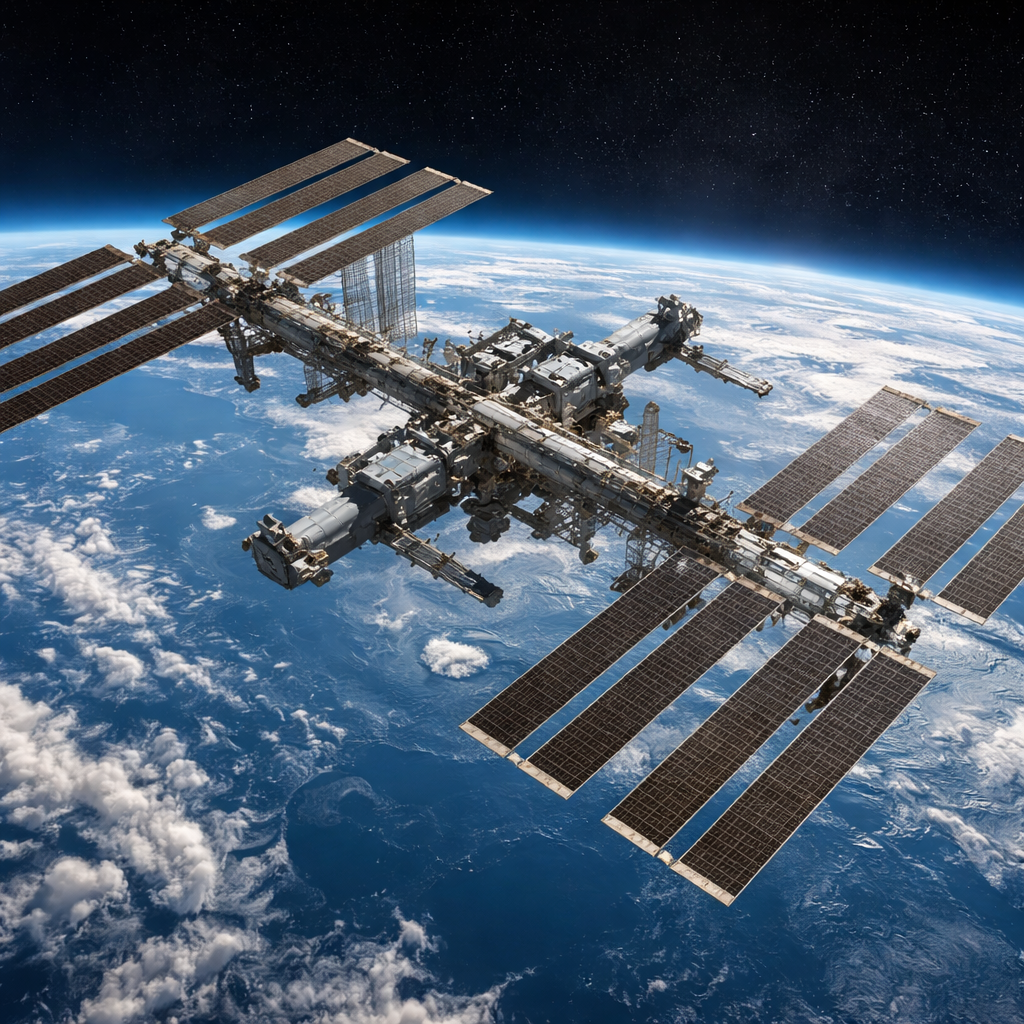
Orbiting roughly 400 kilometers above Earth, the International Space Station has been continuously inhabited longer than most people realize — and the facts about the International Space Station go far beyond what you typically see in a school textbook or a documentary clip. This structure is not just a lab floating in space. It is a living, breathing collaboration between nations, scientists, and engineers who made something genuinely extraordinary work in one of the most hostile environments imaginable.
A structure assembled piece by piece — in orbit
The station was not launched all at once. It was built module by module over more than a decade, with the first component — the Russian Zarya module — reaching orbit in late 1998. What followed was a construction effort unlike anything attempted before: dozens of assembly missions, hundreds of spacewalks, and components manufactured across multiple countries that had to fit together perfectly once in space.
Today the station stretches across an area roughly the size of an American football field, including its solar arrays. Its pressurized living and working volume is comparable to a six-bedroom house — compact by Earth standards, but remarkable for something traveling at 28,000 kilometers per hour.
| Key Specification | Value |
|---|---|
| Orbital altitude | ~400 km above Earth |
| Orbital speed | ~28,000 km/h |
| Mass | ~420,000 kg |
| Length (with arrays) | ~109 meters |
| Orbits per day | ~16 |
| Continuous human presence | Since November 2000 |
What actually happens on board
The ISS is primarily a research laboratory, but the scope of that research might surprise you. Crew members conduct experiments across fields including biology, physics, medicine, materials science, and Earth observation. The microgravity environment allows scientists to study processes that simply cannot be replicated on the ground — such as how flames behave without convection, how crystals grow in the absence of gravity, or how the human cardiovascular system adapts over long-duration spaceflight.
One of the station’s most consistent areas of research involves human physiology. Astronauts living there for six months or longer experience measurable bone density loss, muscle atrophy, and fluid shifts toward the upper body. Understanding these changes is directly relevant to future deep-space missions — and has also contributed to medical treatments used for people with osteoporosis and other conditions here on Earth.
“The station has been a platform for more than 3,000 research investigations involving researchers from over 100 countries.” — NASA
Daily life in microgravity — practical realities
Living on the ISS is not glamorous in the way science fiction portrays it. Every routine task requires adaptation. Sleeping is done in small cabins with sleeping bags attached to walls. Water does not flow — it floats in blobs and must be captured. Food comes in pouches or cans, and crumbs are a genuine hazard since they can float into equipment or airways.
Exercise is non-negotiable. Each crew member spends about two hours per day working out to counteract the physical effects of weightlessness. The station is equipped with a treadmill, a stationary bike, and a resistance machine — all modified to function without gravity.
International partnership — and the complexity behind it
The ISS is operated by five major space agencies: NASA (United States), Roscosmos (Russia), ESA (Europe), JAXA (Japan), and CSA (Canada). This partnership formed during a period of post-Cold War diplomacy and has outlasted significant geopolitical tension between the participating nations — which itself says something notable about the program.
The station’s systems are divided between American and Russian segments, each with its own life support, power, and propulsion components. This division means that, while collaboration is essential, neither side is entirely dependent on the other — a design that reflects both engineering pragmatism and political realism.
- The US segment generates the majority of electrical power through its solar arrays
- The Russian segment handles most of the orbital reboost maneuvers
- The European Columbus and Japanese Kibo modules each host dedicated research facilities
- Canada contributed the robotic arm system used for assembly and maintenance tasks
Visibility from Earth and the human connection to the station
One detail that many people find genuinely surprising: the ISS is visible to the naked eye. On a clear night, when the geometry is right, it appears as a steady, fast-moving bright point of light crossing the sky in just a few minutes. NASA and ESA both offer free tools that calculate when the station will be visible from your specific location.
There is something quietly affecting about watching it pass overhead, knowing there are people living and working inside that moving light. It brings what could easily feel like an abstract scientific project into something immediate and real.
What the station has already changed — and what comes next
The legacy of the ISS is not just in its research outputs, extensive as those are. It demonstrated that humans can live and work continuously in space for extended periods — a prerequisite for any future mission to the Moon or Mars. It proved that international cooperation on complex technical projects is achievable even under political pressure. And it created an entire ecosystem of private spaceflight companies, many of which developed cargo and crew transportation systems specifically to service the station.
Plans are already underway — from NASA, private companies, and international partners — to develop successor stations. Commercial space stations are in active development, and some are intended to be operational before the ISS is eventually deorbited. The knowledge gained from decades aboard the current station will be the foundation that makes those future platforms possible.
Whether you are drawn to space exploration for its scientific value, its engineering ambition, or simply the sheer audacity of what humans have managed to accomplish a few hundred kilometers above the planet — the International Space Station offers plenty of all three.