
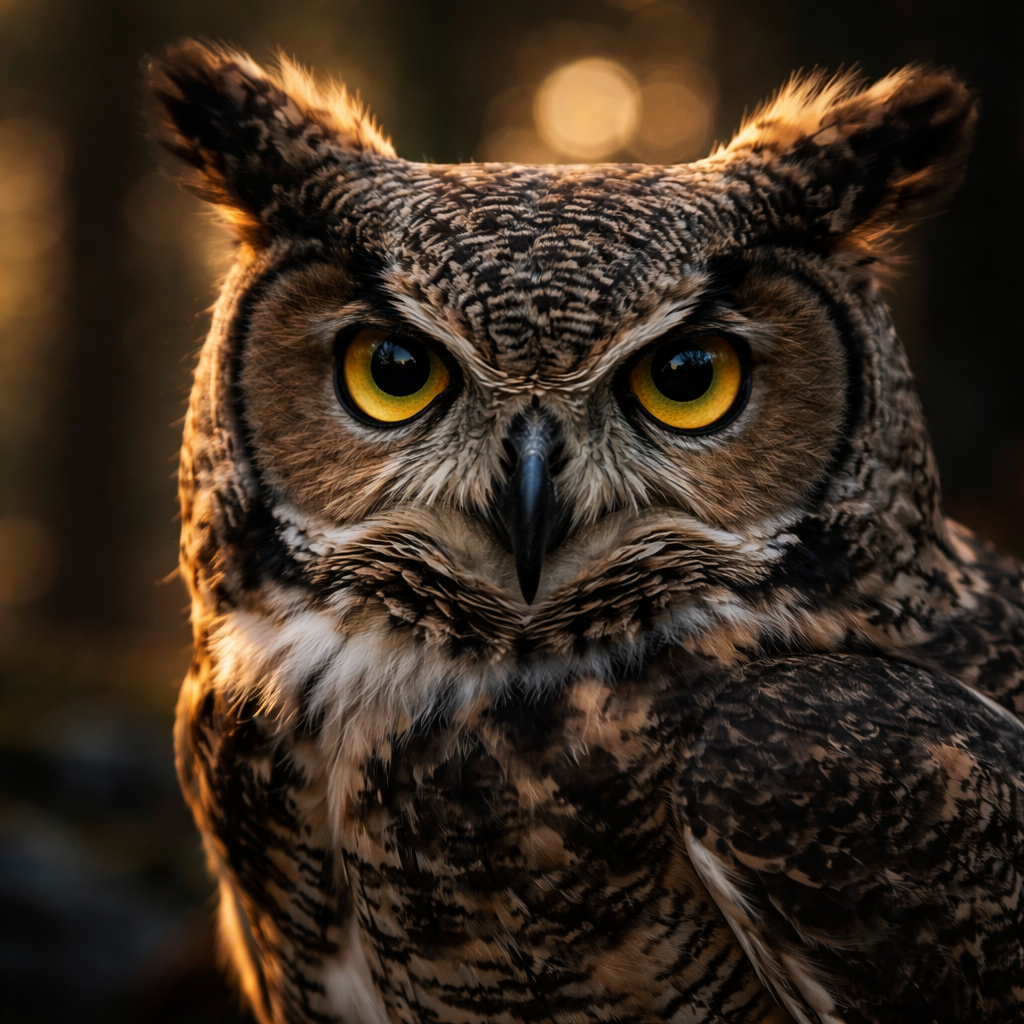
Most people assume owls see in complete darkness the way cats do — but the facts about owls and their vision tell a far more nuanced and fascinating story. Owl eyesight is one of the most specialized sensory systems in the entire animal kingdom, shaped by millions of years of nocturnal hunting and fine-tuned to a degree that still surprises researchers today.
Why owl eyes are built differently from almost any other bird
Unlike most birds whose eyes are positioned on the sides of their heads, owls have forward-facing eyes set close together on a flat face. This gives them a binocular field of view of roughly 70 degrees — much wider than other raptors — which allows for accurate depth perception. That ability to judge distance precisely is critical when diving toward prey in low light conditions.
But here is where it gets genuinely interesting. Owl eyes are not spherical like human eyes. They are tubular in shape, elongated toward the back of the skull. This shape maximizes the surface area of the retina while keeping the eye relatively lightweight. The tradeoff? Owls cannot move their eyes within the socket at all. Their eyes are essentially fixed in place.
To compensate for immobile eyes, owls can rotate their heads up to 270 degrees in either direction — not 360, as the popular myth suggests. This range is made possible by a unique arrangement of neck vertebrae: owls have 14 cervical vertebrae, compared to just 7 in humans.
The structure behind exceptional low-light vision
The owl retina is densely packed with rod photoreceptors — the cells responsible for detecting light rather than color. The ratio of rods to cones in owl eyes is dramatically higher than in humans, which is exactly what allows them to detect movement and shapes in near-darkness. Some species, like the barn owl, can locate prey in light conditions as low as 0.00000073 foot-candles.
Another structural advantage is the tapetum lucidum — a reflective layer behind the retina that bounces light back through the photoreceptors a second time, essentially doubling the eye’s sensitivity to available light. This is also what makes owl eyes appear to glow when caught in a beam of light at night.
| Feature | Owls | Humans |
|---|---|---|
| Eye shape | Tubular | Spherical |
| Eye movement | Fixed (no rotation) | Full rotation |
| Rod density | Extremely high | Moderate |
| Binocular field | ~70 degrees | ~120 degrees |
| Head rotation | Up to 270 degrees | ~180 degrees |
Can owls actually see color?
This is a question that comes up often, and the answer is more complex than a simple yes or no. Owls do have cone cells in their retinas, but in far smaller numbers than rod cells. This means they do perceive some color under brighter light conditions, but color discrimination is not their visual priority. During daylight, species like the burrowing owl are actually quite active and can use their limited color vision effectively. In low light, however, the rod-dominated visual system takes over entirely.
Interestingly, some owl species can detect ultraviolet light — a wavelength invisible to the human eye. Research has shown that certain owls may use UV sensitivity to track vole runways marked by urine trails, which glow under UV light. This gives them a hunting advantage that goes well beyond what we typically associate with “good night vision.”
How hearing works alongside vision in nocturnal hunting
It would be misleading to talk about owl vision without acknowledging how closely it works alongside hearing. Barn owls in particular can hunt in total darkness — not because their vision is superhuman, but because their facial disc acts as a parabolic reflector that channels sound toward their asymmetrically positioned ears. The two ears are set at slightly different heights on the skull, which allows the owl to triangulate sound in three dimensions with extraordinary precision.
Vision and hearing essentially cross-reference each other in real time. An owl will first detect a sound, orient its head toward it, and then visually lock onto the target as it comes within visual range. The two systems work as a single integrated tracking mechanism.
Species differences that matter
Not all owls are created equal when it comes to visual capability. There are over 200 known owl species, and their visual systems vary considerably based on habitat and hunting behavior.
- The great horned owl has eyes large enough that they account for roughly 5% of its total body weight — a remarkable proportion that underscores how central vision is to this species.
- The burrowing owl is diurnal or crepuscular, meaning it hunts during the day or at dawn and dusk, and has comparatively better color vision than purely nocturnal species.
- The snowy owl, adapted to the Arctic tundra, has evolved to function well both in polar night conditions and in the continuous daylight of Arctic summers.
- The elf owl — the world’s smallest owl — hunts primarily insects and relies more on hearing and short-range vision than on long-distance visual tracking.
Understanding these differences matters because it shifts the conversation away from a generic idea of “owl vision” toward something more ecologically meaningful. Each species has developed a sensory toolkit calibrated to its specific environment.
What makes owls genuinely worth understanding
Owls are often romanticized as symbols of wisdom, but the actual biology behind their perception is far more impressive than any mythology. Their tubular eyes, packed retinas, UV sensitivity, rotatable heads, and integrated auditory systems represent an evolutionary solution to a genuinely difficult problem: hunting fast-moving prey in near-zero light, often in complex terrain.
For anyone curious about animal senses, predator adaptations, or simply how different life on Earth can look through another creature’s eyes — owls offer one of the clearest and most studied examples available. The more closely you examine how they perceive the world, the more it challenges your assumptions about what vision actually is.