
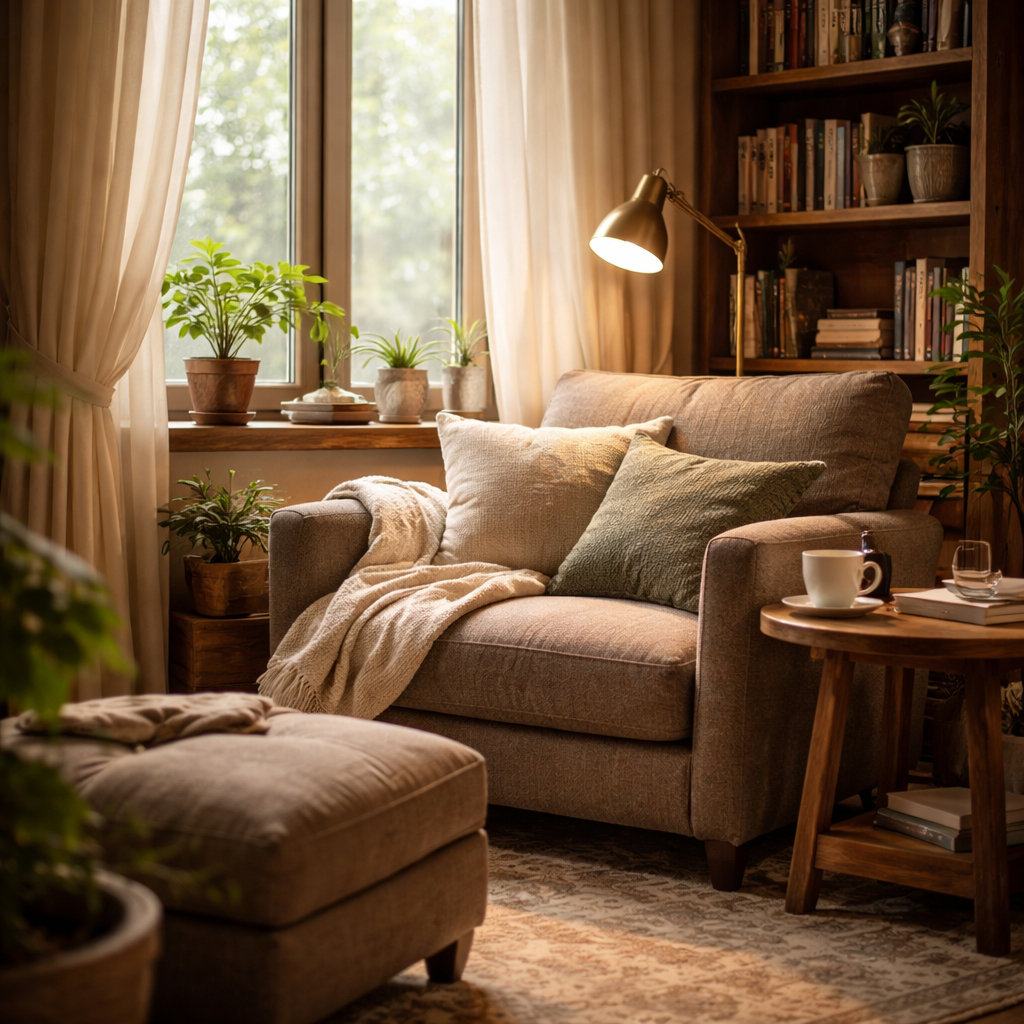
Most people underestimate how much a dedicated reading spot changes their relationship with books. When you’re serious about finding ideas for a cozy reading nook, the real challenge isn’t the budget or the square footage — it’s knowing which elements actually make a space feel inviting rather than just staged for a photo.
Why the location matters more than the furniture
Before you start browsing for cushions or bookshelves, pause and look at your home differently. A reading nook doesn’t need a dedicated room — it needs a corner with just enough separation from the rest of life. The key is finding a spot where natural light is soft and consistent throughout the day, background noise stays low, and you can actually settle in without feeling like you’re in the middle of something else.
North-facing windows tend to offer the most stable light for reading without harsh glare. A bay window recess, the space under a staircase, or even a wide hallway alcove can work beautifully if you approach it with a clear vision. The physical boundaries — even symbolic ones like a low bookshelf or a curtain — signal to your brain that this is a separate zone, and that psychological shift matters.
Seating that actually works for long reading sessions
The most common mistake people make when setting up a reading corner is choosing style over support. A velvet armchair might photograph beautifully, but if it doesn’t support your lower back after twenty minutes, you’ll drift back to the sofa every time. Here’s what to prioritize when selecting seating:
- Lumbar support — a chair with a slightly reclined back angle reduces strain during long sessions
- Seat depth — deep bucket seats invite slouching, while a medium-depth seat encourages better posture
- Armrests at the right height — they should let your shoulders stay relaxed, not raised
- Firm cushioning — plush foam compresses quickly and loses support; higher-density foam or layered cushions last longer
- Footrest or ottoman — keeping your feet elevated slightly reduces lower back pressure significantly
Window seats with built-in storage underneath are particularly practical because they solve two problems at once: comfortable seating with a view, and hidden space for blankets, notebooks, or book collections.
Lighting: the detail most guides get wrong
Natural light is wonderful, but it shifts throughout the day and disappears entirely by evening. A good reading nook needs layered lighting that you can adjust depending on the time and mood. The most functional setup typically combines an overhead ambient source with a dedicated task light positioned over your shoulder — not in front of you.
Reading lamp positioning matters more than wattage. A light source placed behind and slightly above your reading shoulder illuminates the page without creating shadows from your hands or causing glare.
Warm white bulbs in the 2700K–3000K range are consistently easier on the eyes than cool daylight bulbs during evening reading. Dimmer switches, even inexpensive ones, give you much more flexibility than fixed-brightness fixtures. If you’re using a floor lamp, look for one with a gooseneck or adjustable arm rather than a fixed shade.
Texture, warmth, and the sensory side of comfort
A reading space that works purely on a visual level often fails in practice because reading is a full-body experience. Physical warmth, soft textures underfoot, and gentle acoustic dampening all contribute to how long you’re actually willing to stay in the space.
| Element | Purpose | Practical choice |
|---|---|---|
| Area rug | Acoustic absorption, warmth underfoot | Wool or high-pile fabric, at least 120x180cm |
| Throw blanket | Temperature regulation, tactile comfort | Chunky knit or fleece, always within reach |
| Curtain or canopy | Visual separation, light control | Semi-sheer linen for daytime, blackout panel option for evenings |
| Cushions | Back and side support | Mix of firm bolster and softer accent cushions |
| Small side table | Surface for drinks, notes, bookmarks | Height level with armrest, stable base |
Don’t overlook sound. If your home tends to be noisy, heavy curtains, a bookshelf filled with books (which absorb sound), and a soft rug together can reduce ambient noise noticeably without any acoustic panels or technical solutions.
Small space? These approaches actually scale down well
Not every home has an alcove or a spare room to dedicate to reading. But even modest spaces can support a genuinely comfortable reading spot with the right approach.
A floor-level reading nook — essentially a low platform with cushions, a few pillows stacked for back support, and a low bookshelf nearby — works especially well in smaller rooms because it uses vertical wall space rather than floor area. This style is common in Scandinavian and Japanese interior traditions, and it genuinely delivers in terms of comfort when the cushioning is done right.
Corners of bedrooms are consistently underused. A single armchair angled toward a window with a small lamp on a floating shelf beside it takes up very little square footage but creates a meaningful separation between where you sleep and where you read — which also supports better sleep hygiene.
A reading nook starts to feel uncomfortable when it doubles as storage for everything else. Keep only what you’re currently reading, one or two items for comfort, and a single drink. The less visual noise, the easier it is to mentally switch into reading mode.
Personalization that makes the space yours
The reading spots people actually use consistently tend to have one thing in common: they reflect the person who uses them, not a design trend. That might sound abstract, but in practice it means surrounding yourself with things that have personal meaning — a shelf of favorite titles, a plant you enjoy tending to, a piece of artwork that doesn’t demand attention but quietly adds warmth.
Color psychology plays a genuine role here. Muted, earthy tones — dusty greens, warm terracottas, stone greys — tend to support focus better than bright or highly saturated colors, which can be stimulating in the wrong way for a reading environment. This doesn’t mean everything has to be neutral, but the dominant tones in a reading nook are worth choosing deliberately.
Finally, consider what you keep within reach. A small tray with a few bookmarks, a notebook for jotting down thoughts while you read, and a candle or diffuser with a scent you associate with calm — these small details build a ritual around the space. And once the space has a ritual attached to it, sitting down there naturally signals to your mind that it’s time to focus and slow down.