
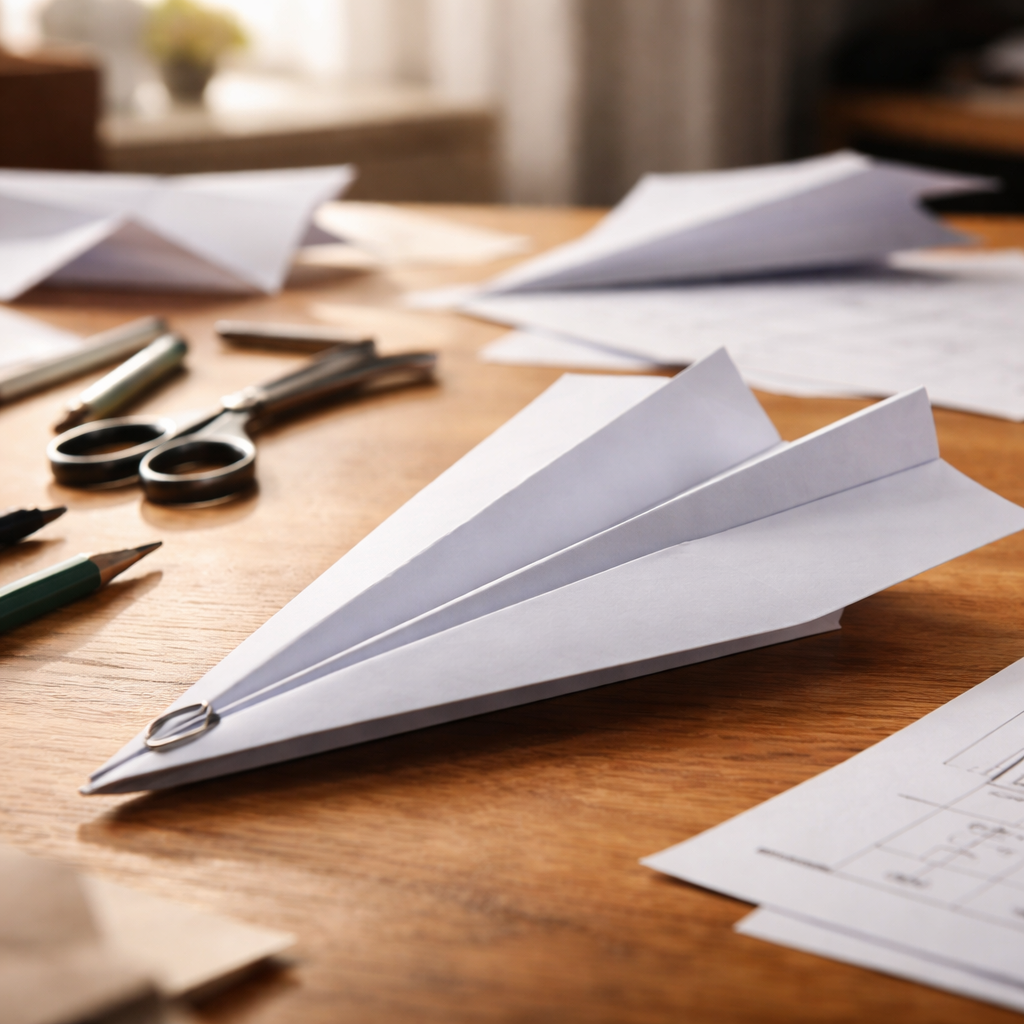
Most paper airplanes nose-dive within a few seconds — and that happens for very specific, fixable reasons. If you want to know how to make a paper airplane that flies far, the answer isn’t just about folding technique. It’s about understanding lift, drag, weight distribution, and the small details that most tutorials casually skip over.
Why some paper airplanes outperform others
Before you grab a sheet of paper, it helps to understand what actually keeps a paper airplane in the air. Like any real aircraft, a paper glider is subject to four forces: lift, gravity, thrust, and drag. The goal is to maximize lift while minimizing drag — and that starts with your paper choice and folding precision.
Standard 80 g/m² printer paper works well for most designs. It’s stiff enough to hold its shape but light enough to glide efficiently. Thicker paper adds unnecessary weight; too thin and the plane loses structural rigidity mid-flight.
The design that actually works for distance
Among dozens of folding styles, the dart-style airplane — sometimes called the classic arrow — consistently performs best for straight-line distance. It has a narrow fuselage, pointed nose, and relatively flat wings, which reduce air resistance and allow a stable glide path.
Here’s a step-by-step breakdown of the dart fold:
- Place a standard A4 or letter-size sheet horizontally in landscape orientation.
- Fold it in half lengthwise, crease firmly, then unfold — this center line is your reference.
- Fold the top two corners down so they meet at the center line, forming a triangle at one end.
- Fold the new diagonal edges in again toward the center line — this creates a sharper, more aerodynamic nose.
- Fold the entire plane in half along the original center crease, with the folds on the inside.
- Fold each wing down parallel to the fuselage, leaving about 2–2.5 cm of body below the wing fold.
- Slightly angle the trailing edge of each wing upward — this is called the elevator, and it controls lift.
Every crease should be sharp and symmetrical. Uneven folds cause the plane to veer left or right, no matter how well you throw it.
Symmetry is the single most important factor in paper airplane flight. A perfectly thrown plane with uneven wings will always underperform a moderately thrown plane with balanced folds.
Throwing technique matters as much as folding
A common mistake is launching a paper airplane like a baseball — hard and at a steep upward angle. That approach almost always causes a stall, where the nose pitches up too sharply and the plane loses forward momentum, falling straight down.
For maximum distance, use a smooth, moderate-force throw at a slight upward angle — around 10 to 15 degrees above horizontal. Hold the plane near its center of gravity, which is typically just behind the nose folds. Release cleanly without spinning your wrist.
Small adjustments that make a measurable difference
Fine-tuning is where casual paper folders separate from people who actually get impressive results. These micro-adjustments are easy to overlook but have a direct impact on flight distance:
| Adjustment | Effect on flight |
|---|---|
| Upward elevator (trailing edge bent up slightly) | Increases lift, helps maintain altitude over distance |
| Paper clip on nose | Shifts center of gravity forward, stabilizes flight path |
| Wing dihedral (wings angled slightly upward from body) | Improves lateral stability, reduces rolling |
| Narrower wing fold | Reduces drag, increases glide ratio |
| Sharper nose folds | Cuts through air more efficiently |
Test each change individually rather than applying multiple adjustments at once. That way you’ll know exactly what’s improving your results — and what isn’t.
Environment plays a bigger role than most people expect
Indoor conditions give you the most consistent results. Even a light breeze outdoors can dramatically alter the glide path of a paper airplane, since the plane has very little mass to resist air movement. If you’re testing for distance, a long hallway or a calm gymnasium is ideal.
When flying outdoors, a gentle tailwind can extend your flight significantly — but a crosswind will send even a well-built plane sideways almost immediately. Pay attention to wind direction and launch with it, not against it.
Beyond the basic dart: exploring other long-distance designs
Once you’re comfortable with the dart, it’s worth exploring other paper airplane designs that are specifically optimized for gliding distance rather than speed. The Suzanne, designed by aeronautics enthusiast John Collins, set a Guinness World Record for paper airplane distance. It features a long, narrow body with wide wings that generate substantial lift relative to drag — a high glide ratio.
Another option worth trying is the Nakamura Lock, a Japanese-origin design known for its stable, slow glide. It’s not the fastest plane in the air, but its low stall speed means it stays airborne longer on a single throw.
- The Suzanne — best for long, straight indoor distance flights
- The Nakamura Lock — slow, stable glider ideal for calm environments
- The Sea Glider — wide-wing design with reliable lift, good for beginners moving past the basic dart
- The Harrier — slightly more complex fold with excellent glide efficiency
Each of these designs has documented folding instructions available in books and through origami aviation communities. The key is to practice each fold enough times that your creases become consistent — sloppy folds produce unpredictable results, regardless of the design.
The part that actually takes your results to another level
Distance-focused paper airplane folding is genuinely iterative. The people who get the best throws aren’t those who found one magic technique — they’re the ones who tested, adjusted, and paid attention to what changed. Keep a few sheets handy, throw each variant multiple times, and track what works. You’ll likely find that a combination of a sharp dart fold, a slight upward elevator adjustment, and a smooth mid-force release gives you the most consistent distance — and that consistency is what actually makes the difference between a plane that crashes in three meters and one that sails across the room.