
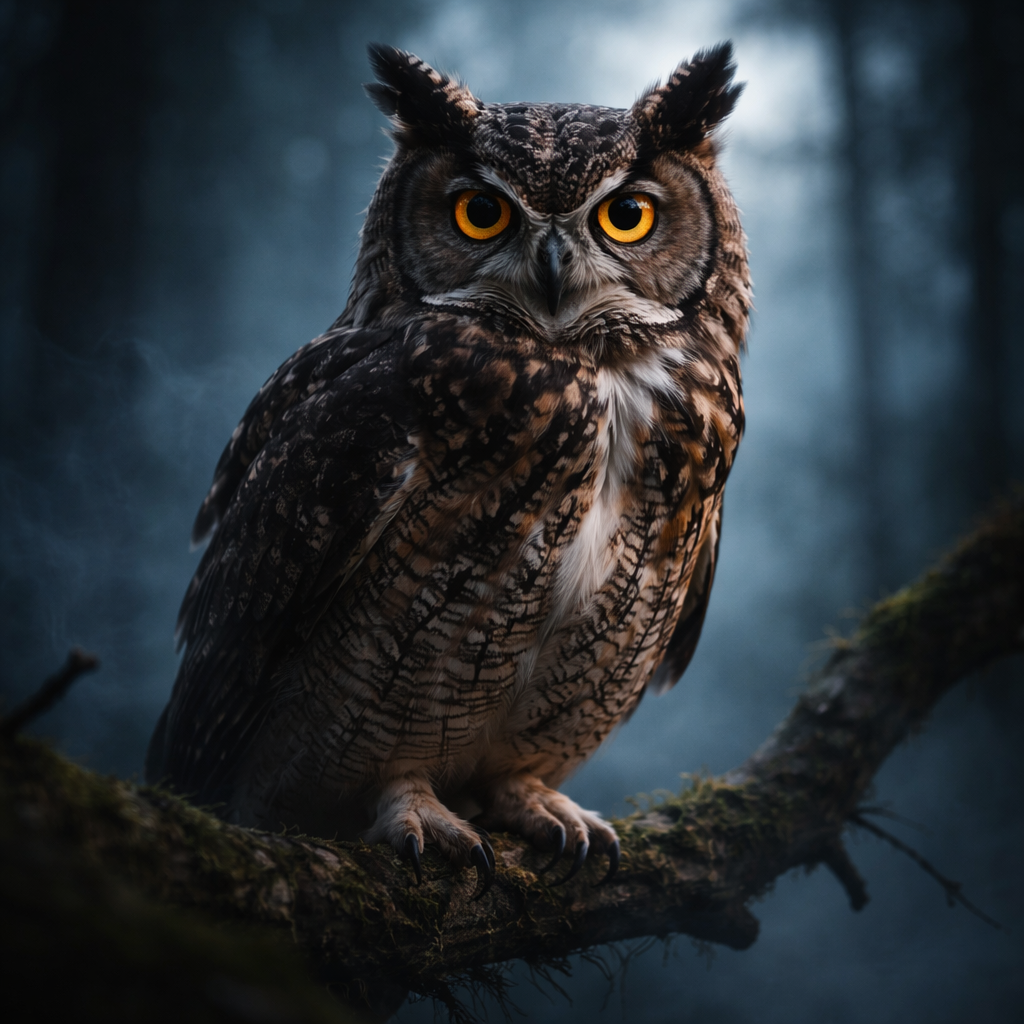
People rarely talk about owl dreams the way they talk about falling or flying — yet those who experience what does dreaming about owls mean often wake up with a lingering sense that something important just happened. That feeling is worth paying attention to, because owl dreams tend to be unusually vivid, emotionally charged, and surprisingly consistent in the themes they carry across different dreamers.
Why owls show up in dreams more often than you’d think
Owls occupy a peculiar space in the human imagination. Unlike most birds, they’re nocturnal, nearly silent in flight, and capable of rotating their heads to an almost unsettling degree. These physical traits have shaped how cultures around the world have interpreted them — as symbols of hidden knowledge, transition, and the boundary between the conscious and unconscious mind.
When the brain selects an owl as a dream symbol, it’s often drawing on this deep reservoir of collective association. Dream researchers and Jungian analysts frequently note that animals appearing in dreams tend to represent instinctual aspects of the self or external forces the dreamer is processing. The owl, in particular, is strongly linked to intuition, perception beyond the obvious, and truths that are uncomfortable to face.
What the specific details of your owl dream actually reveal
The interpretation shifts significantly depending on what happened in the dream. A single owl perched silently carries a very different charge than a flock of owls in flight, or an owl that spoke to you, or one that felt threatening. Pay close attention to the emotional tone when you woke — that’s often the most reliable signal.
| Dream scenario | Common interpretation |
|---|---|
| Owl watching you silently | A situation in your waking life requires deeper reflection before action |
| Owl flying toward you | Change or an important message is approaching — not necessarily negative |
| Owl speaking or delivering a warning | Your subconscious is surfacing something your conscious mind has been avoiding |
| Dead or injured owl | Loss of clarity, a period of confusion, or the end of a chapter |
| White owl | Often associated with clarity, spiritual insight, or a turning point |
| Attacking owl | Suppressed fears or a situation that feels threatening to your sense of control |
These aren’t rigid rules — they’re starting points. The same dream can mean something entirely different to two people based on their current life circumstances. Someone in the middle of a difficult decision and someone grieving a loss might both dream of an owl, but what it represents for each of them will diverge considerably.
Cultural and psychological layers behind owl dream symbolism
It helps to know where these interpretations come from, because they’re not invented — they’re observed patterns across centuries of human experience with dreaming.
- In ancient Greek tradition, the owl was the companion of Athena, goddess of wisdom — making it a symbol of intellectual clarity and strategic thinking.
- In many Indigenous North American traditions, owl dreams were taken as messages from the spirit world, sometimes related to ancestral guidance or impending change.
- In Roman culture, owls were sometimes associated with death — not as a curse, but as a sign of transition and the natural cycle of endings.
- In Jungian dream psychology, nocturnal animals often represent the shadow self — the parts of your personality that exist outside of your everyday awareness.
The psychological angle is particularly useful for modern dreamers. Carl Jung’s framework suggests that when a powerful animal appears in a dream, it may be pointing toward qualities you either need to develop or are currently suppressing. An owl in this context could be asking: are you truly seeing the situation in front of you clearly, or are you operating on assumptions?
“Dreams are the royal road to the unconscious.” — Sigmund Freud. While Freud and Jung diverged sharply in their methods, both agreed that recurring animal symbols in dreams deserved serious interpretive attention.
How to work with an owl dream rather than just wonder about it
Understanding a dream is only useful if it connects back to something real in your life. Here’s how to actually use an owl dream as a reflective tool rather than a curiosity that fades by lunchtime.
Start by writing down everything you remember — not just the owl, but the setting, your emotional state, whether it was day or night in the dream, and anyone else who appeared. Context in dreams is never irrelevant.
Once you have the details down, ask yourself three questions:
- What major decision or unresolved situation am I currently navigating in my waking life?
- Is there something I’ve been avoiding thinking about honestly?
- What did the owl’s behavior in the dream feel like it was responding to?
You don’t need to arrive at a definitive answer. The value is in the noticing — dreams function more like questions than answers, and owl dreams in particular seem to appear at junctures where a clearer perspective would genuinely help.
When owl dreams repeat — and what that pattern suggests
Recurring owl dreams deserve extra attention. Repetition in dreams is typically a signal that something hasn’t been resolved or acknowledged. If owls keep showing up across multiple nights or over weeks, the subconscious may be amplifying a theme that hasn’t gotten sufficient attention during waking hours.
Therapists who work with dream analysis — particularly those trained in depth psychology or somatic approaches — often find that recurring animal symbols in dreams correlate with ongoing stress patterns, relationship dynamics, or life transitions the person hasn’t fully processed. This doesn’t mean something is wrong; it means something is asking to be seen.
If the dreams are accompanied by anxiety or a strong feeling of dread upon waking, that emotional residue is information too. Fear of the owl in a dream is rarely about the bird — it’s usually about whatever the owl seems to represent in the context of your current life: a decision you’ve been postponing, a truth you find difficult, or a change you know is coming.
Owls, night, and the mind’s quiet wisdom
There’s something fitting about an owl being the messenger your sleeping mind chooses. Owls hunt in darkness, navigate by sound and subtle perception, and see what others miss. These are precisely the capacities that good dreaming cultivates — the ability to perceive what isn’t immediately visible in the noise of daily life.
Whether you approach owl dreams through a spiritual lens, a psychological framework, or simply as an interesting signal from your own mind, the core invitation tends to be the same: slow down, look again, and trust that you already know more than you’re currently letting yourself acknowledge.
That’s not a bad message to wake up to.