
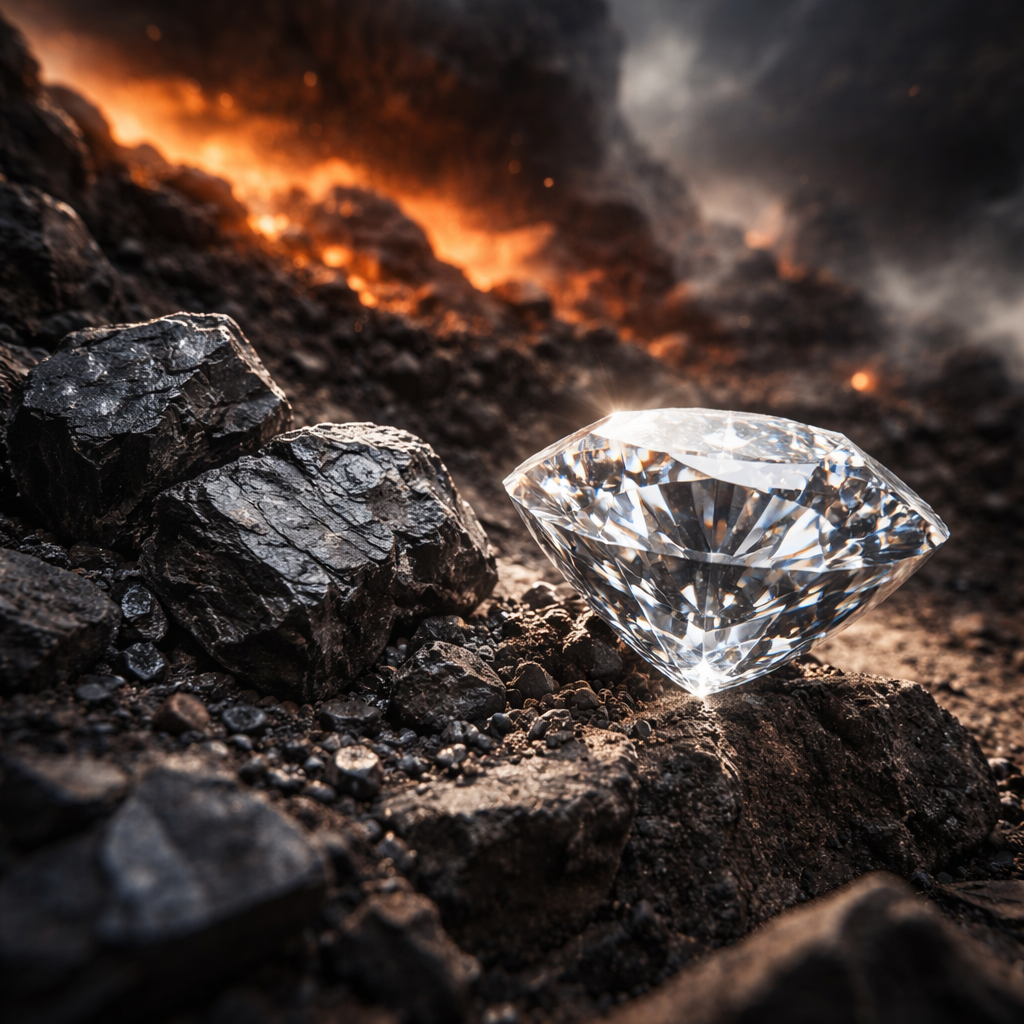
Carbon is the fourth most abundant element in the universe by mass — and yet, under the right conditions of heat and pressure deep within the Earth, it transforms into one of the hardest natural substances ever known. The facts about diamonds and carbon reveal a relationship far more complex and fascinating than most people realize, stretching from geology and physics to jewelry, industry, and even outer space.
Not all carbon becomes a diamond — here’s why
Carbon exists in several structural forms called allotropes, and diamond is just one of them. Graphite — the soft, dark material used in pencils — is another allotrope of carbon. What separates a diamond from a pencil is not the element itself, but the arrangement of atoms. In graphite, carbon atoms form flat layers that slide easily against each other. In a diamond, each carbon atom bonds to four others in a rigid three-dimensional lattice known as a tetrahedral structure. This difference in bonding is entirely responsible for the dramatic contrast in hardness.
Natural diamonds form roughly 150 to 200 kilometers below the Earth’s surface, where temperatures exceed 1,000°C and pressure reaches around 45,000 to 60,000 atmospheres. These conditions force carbon atoms into that dense crystalline arrangement. Without both extremes — temperature and pressure working together — diamond simply cannot form.
What makes a diamond so hard
Diamond scores 10 on the Mohs hardness scale — the maximum possible rating. This isn’t a slight edge over other materials; it’s a significant leap. Corundum, which includes rubies and sapphires, scores 9, yet diamond is roughly four times harder by absolute measurement. The reason goes back to the carbon-carbon covalent bonds in the crystal lattice: they are among the shortest and strongest bonds in chemistry.
| Material | Mohs Hardness | Composition |
|---|---|---|
| Talc | 1 | Magnesium silicate |
| Quartz | 7 | Silicon dioxide |
| Corundum | 9 | Aluminum oxide |
| Diamond | 10 | Pure carbon |
This exceptional hardness makes diamonds far more than decorative stones. Industrial-grade diamonds — most of which are lab-grown — are used in cutting tools, grinding wheels, drill bits for oil and gas exploration, and polishing surfaces that no other material can handle effectively.
Diamonds in nature: more common than you might think
Most natural diamonds were brought closer to the Earth’s surface through volcanic activity, carried upward by magma in formations called kimberlite pipes. These geological structures are found on every continent, though gem-quality diamond deposits are concentrated in specific regions, particularly in southern Africa, Russia, Canada, and Australia.
Interestingly, diamonds have also been found in meteorites, confirming that the conditions for carbon crystallization are not unique to Earth. Some astronomers have identified what appears to be a white dwarf star — essentially a dead star — with a core made largely of crystallized carbon, effectively a diamond the size of a planet. Our solar system alone contains carbon compounds in enormous quantities across asteroids, comets, and planetary atmospheres.
Diamond is the only gemstone made of a single element — and that element is the same one found in every living organism on Earth.
Lab-grown diamonds: same carbon, different origin
Lab-grown diamonds are chemically, physically, and optically identical to mined diamonds. They are not simulants like cubic zirconia or moissanite — they are actual carbon crystals with the same tetrahedral lattice structure. The two main methods used to produce them are:
- High Pressure High Temperature (HPHT) — replicates the natural conditions deep underground using hydraulic presses and extreme heat
- Chemical Vapor Deposition (CVD) — grows diamond layer by layer from a carbon-rich gas in a controlled chamber
Gemological instruments can distinguish lab-grown from natural diamonds through microscopic growth patterns and trace element profiles, but the naked eye — and even most standard gemological tools — cannot tell them apart. This technological development has reshaped the diamond market significantly, making gem-quality stones more accessible and shifting how the industry defines value.
Carbon’s role in diamond color and clarity
Pure diamond is colorless because it consists entirely of carbon with no foreign atoms in the lattice. Color variations arise when trace elements or structural defects interrupt the crystal. Nitrogen — the most common impurity — produces yellow and brown tones. Boron causes the rare blue color seen in famous stones like the Hope Diamond. The equally rare red and pink diamonds get their color not from impurities but from structural distortions in the crystal lattice itself, making them among the most scientifically interesting and commercially valuable stones.
Clarity, on the other hand, refers to internal features called inclusions — small pockets of other minerals, fractures, or growth irregularities that formed during crystallization. These imperfections are essentially a record of the diamond’s geological history. Gemologists use them as fingerprints to trace where a stone formed and how.
A few things about diamonds that genuinely surprise people
- Diamond can burn. At around 700–900°C in the presence of oxygen, diamond oxidizes and converts to carbon dioxide — the same gas exhaled when breathing.
- Diamond is not the rarest gemstone. Alexandrite, red beryl, and several others are far rarer in gem quality than diamonds.
- Diamonds conduct heat better than any other natural material — approximately five times more efficiently than copper.
- The word “diamond” derives from the ancient Greek “adamas,” meaning unconquerable or unbreakable.
- A diamond can be cleaved along specific crystal planes — meaning a perfectly precise blow can split it cleanly, despite its extreme hardness.
Why understanding carbon changes how you see diamonds
Once you understand that a diamond is simply carbon in an extraordinary arrangement, the stone starts to look different — not less impressive, but more so. The same atom that builds DNA, fuels stars, and cycles through every living thing on the planet can, under immense geological force, become the hardest known natural material with unmatched optical clarity and thermal conductivity. That’s not just interesting — it’s a reminder of how dramatically structure shapes substance at the atomic level.
Whether you’re drawn to diamonds for their appearance, curious about their science, or making a purchasing decision, knowing what they actually are gives you a better foundation than any marketing narrative. Carbon, in this particular configuration, has earned its reputation — not through mythology, but through physics.