
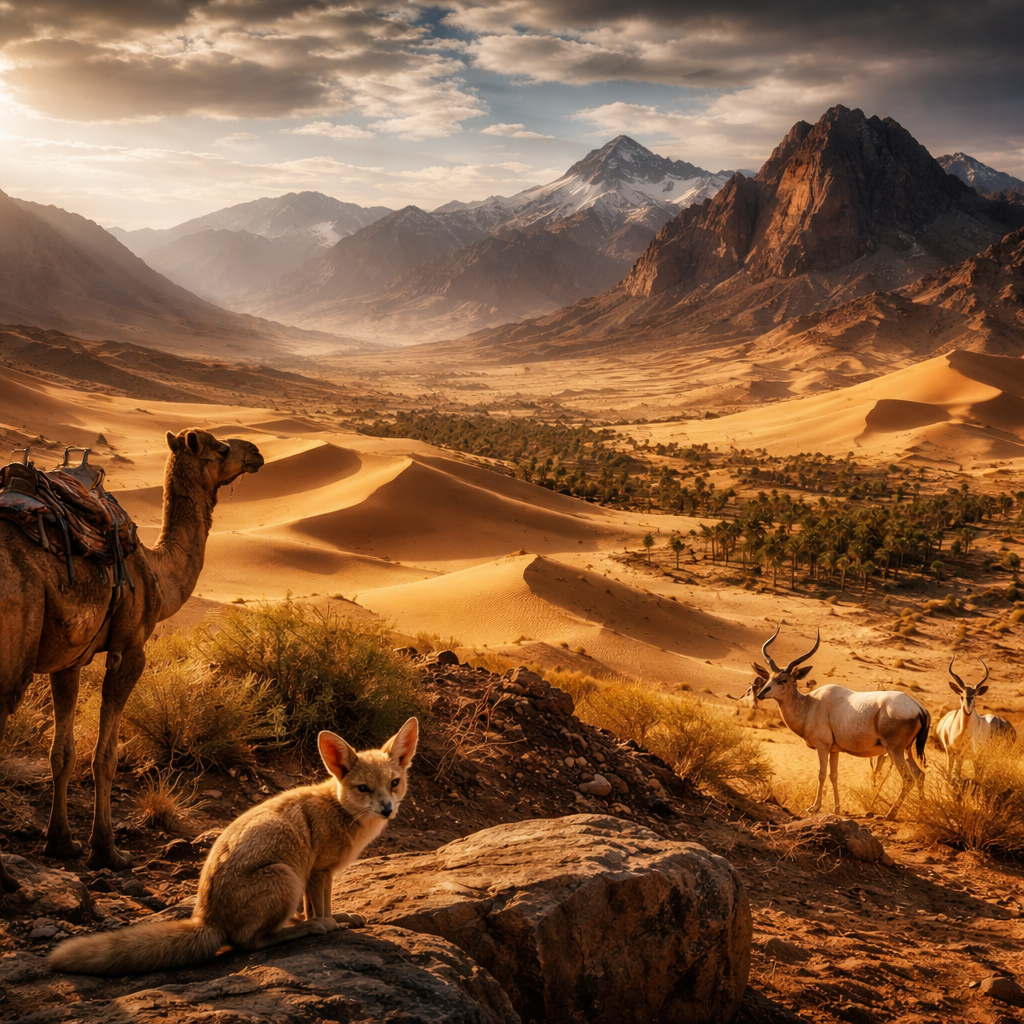
When most people picture the Sahara, they imagine an endless sea of golden dunes baking under a relentless sun — and while that image holds some truth, the full picture is far more surprising. The facts about the Sahara Desert challenge nearly every assumption you might carry into the conversation, from its actual size and climate history to the astonishing diversity of life that manages to thrive there.
Not Just Sand: The Real Geography of the Sahara
Stretching across northern Africa, the Sahara covers roughly 9.2 million square kilometers, making it the largest hot desert on Earth and roughly the size of the United States. But here is what tends to surprise people: only about 25% of the Sahara is actually covered by sand dunes, which geographers call ergs. The remaining landscape is dominated by rocky plateaus known as hamadas, gravel plains called regs, dry valleys, and even mountain ranges.
The Ahaggar Mountains in Algeria and the Tibesti Mountains in Chad rise dramatically from the desert floor, with peaks exceeding 3,000 meters. These highlands create their own microclimates, occasionally receiving frost and supporting vegetation that would look completely out of place on the dunes below.
Temperature Swings That Would Shock You
The Sahara holds some of the most extreme temperature records ever documented. Surface temperatures have been measured above 70°C on exposed rock and sand, while air temperatures regularly exceed 50°C in summer. Yet the same regions that broil during the day can drop close to freezing at night, sometimes within a matter of hours. This happens because desert air holds very little moisture, which means heat escapes rapidly once the sun goes down.
The Sahara is not a place of constant heat — it is a place of constant extremes. The absence of humidity makes every temperature shift dramatic and fast.
Snow has actually fallen in parts of the Sahara on multiple recorded occasions, most notably in the Algerian town of Ain Sefra, which sits at a higher elevation. These events are rare but real, and they offer a reminder that desert climate is defined by aridity, not necessarily by warmth alone.
A Desert That Was Once Green
One of the most striking chapters in Saharan history is what scientists call the African Humid Period, sometimes referred to as the Green Sahara. Roughly 11,000 to 5,000 years ago, shifts in Earth’s orbital cycle altered monsoon patterns, bringing significantly more rainfall to the region. The Sahara at that time supported lakes, rivers, grasslands, and forests. Hippos swam in rivers that now exist only as dry riverbeds called wadis, and early human populations settled across areas that today are completely uninhabitable.
Cave paintings discovered in the Tassili n’Ajjer region of Algeria depict cattle herding, swimming, and hunting scenes that tell the story of this vanished world. The rock art is extraordinarily well-preserved and offers one of the most vivid windows into prehistoric life anywhere on the continent.
Wildlife and Adaptation: Life Finds a Way
The idea that the Sahara is biologically empty is simply not accurate. The desert supports a remarkable range of species, each adapted in specific ways to survive intense heat, scarce water, and unpredictable food sources.
- The fennec fox uses its oversized ears to radiate body heat and hunts insects and small animals at night when temperatures drop.
- The dromedary camel, while domesticated, has physiological traits that allow it to lose up to 30% of its body weight in water without ill effects.
- Addax antelopes can survive without drinking water at all, extracting moisture entirely from the plants they eat.
- Several species of desert-adapted monitor lizards and vipers are active during cooler morning hours and shelter underground or under rocks during peak heat.
- Saharan silver ants are capable of foraging at surface temperatures that would kill virtually any other insect — one of the most heat-tolerant animals known to science.
Key Facts at a Glance
| Feature | Detail |
|---|---|
| Total area | Approximately 9.2 million km² |
| Countries covered | 11 African nations |
| Highest recorded air temperature | Around 58°C (in Libya) |
| Lowest annual rainfall (core desert) | Less than 25 mm per year |
| Largest sand sea (erg) | Grand Erg Oriental, Algeria/Tunisia |
| Highest peak | Emi Koussi, Chad — 3,415 m |
The Sahara’s Role in Global Climate Systems
What happens in the Sahara does not stay in the Sahara. The desert plays a genuinely significant role in global atmospheric and ecological systems. Saharan dust, lifted by powerful wind systems and carried thousands of kilometers across the Atlantic Ocean, deposits nutrients — particularly phosphorus — onto the Amazon rainforest, essentially fertilizing one of the world’s most biodiverse ecosystems from thousands of miles away.
The same dust also influences hurricane formation in the Atlantic by creating dry, stable air layers that can suppress tropical storm development. Scientists continue to study how shifts in Saharan dust output affect weather patterns well beyond Africa’s borders.
Additionally, solar energy potential across the Sahara is enormous. The desert receives more solar radiation per square meter than almost anywhere else on Earth, making it a focus of ongoing research and development in large-scale renewable energy infrastructure.
Human Presence: Ancient Routes and Modern Communities
Despite its reputation for hostility, the Sahara has supported human life for thousands of years. Trans-Saharan trade routes connected sub-Saharan Africa with the Mediterranean world long before modern roads existed. Salt, gold, ivory, and enslaved people moved along these routes, shaping the economies and cultures of entire civilizations.
Today, communities including the Tuareg, Toubou, and Berber peoples continue to live across the Sahara, maintaining traditions of nomadic pastoralism and desert navigation that have been refined over generations. Their knowledge of the terrain, seasonal water sources, and wind behavior represents a form of environmental intelligence that modern instruments are only beginning to fully document and appreciate.
The Sahara Keeps Rewriting What We Think We Know
Every decade of research adds new layers to our understanding of this extraordinary place. Fossil discoveries continue to reveal ancient marine life — the Sahara was once covered by a shallow sea, and the bones of creatures like Spinosaurus have been uncovered in what is now remote desert. Satellite imaging regularly reveals previously unknown river systems and archaeological sites buried beneath the sands.
The Sahara is neither static nor simple. It is a place shaped by deep time, extreme physics, remarkable biology, and enduring human ingenuity. The more closely you look, the more it pushes back against the idea that emptiness and life are opposites — because in the Sahara, they have always coexisted.