
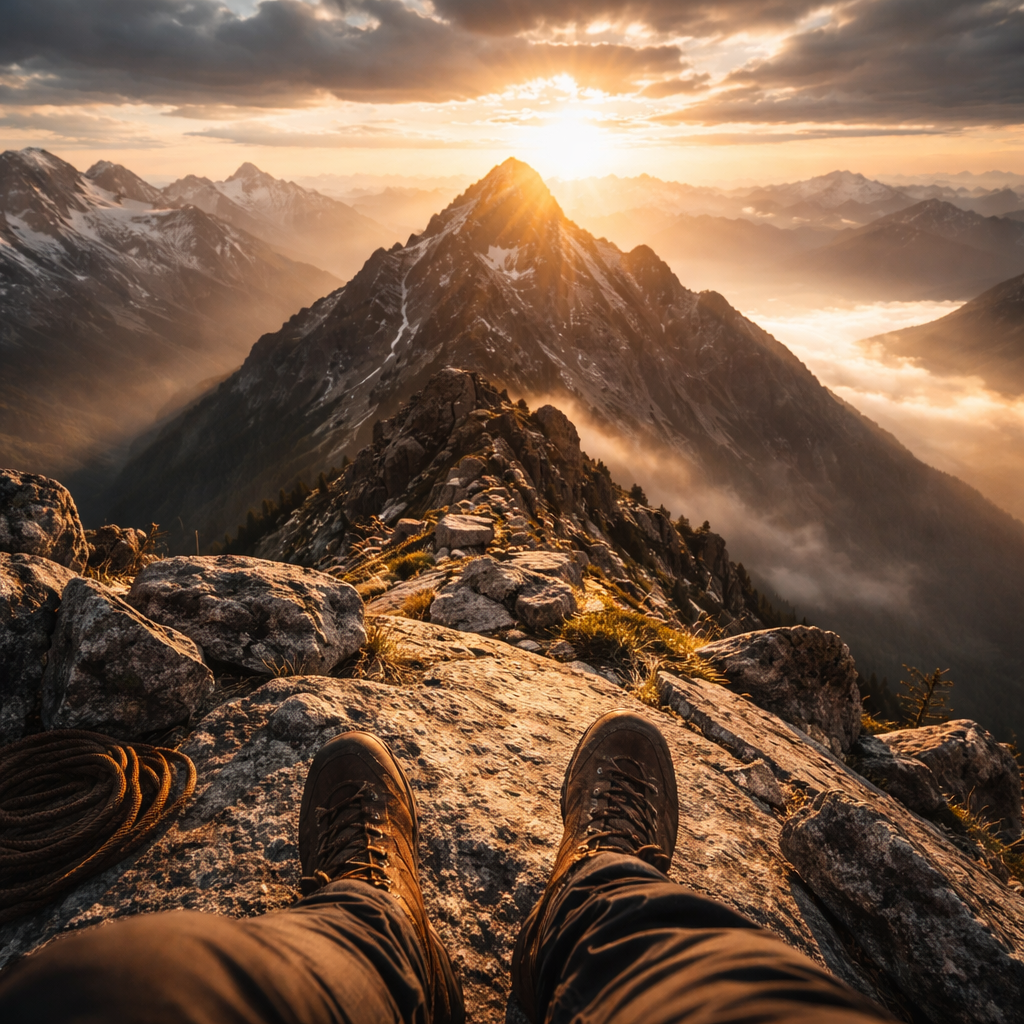
People rarely talk about mountain dreams the way they talk about falling or flying — yet what does dreaming about mountains mean is one of the most searched dream-related questions, and for good reason. These dreams tend to feel weighty, almost cinematic, and they linger long after waking up.
Why mountains show up in dreams at all
Mountains are one of the most universally recognized symbols across cultures and centuries. In dreams, they rarely appear without context — there’s almost always movement involved: you’re climbing, descending, standing on a summit, or staring up at a peak you can’t reach. That movement is usually where the meaning lives.
From a psychological standpoint, mountains in dreams tend to represent challenges, ambitions, and the mental load of goals we’re carrying in waking life. Carl Jung, who spent decades analyzing dream symbolism, associated elevated terrain with the self — specifically with the higher, more conscious aspects of the psyche. That doesn’t mean every mountain dream is a profound philosophical message, but it does suggest these images aren’t random noise.
Climbing a mountain in a dream — effort and direction
Dreams about climbing are among the most common mountain-related scenarios, and their interpretation depends heavily on how the climb feels. Struggling up a steep slope with no clear path usually reflects a real sense of overwhelm — a project, a relationship, or a life decision that feels harder than expected. On the other hand, climbing steadily with a clear view ahead tends to mirror a sense of progress and growing confidence.
The emotional tone of the climb matters more than the destination. A difficult ascent in a dream doesn’t predict failure — it often just reflects how you feel about the challenge right now.
It’s also worth paying attention to who’s with you. Climbing alone can suggest independence or isolation depending on the emotional color of the dream. Climbing with others often connects to teamwork, shared goals, or dependence — again, whether that feels supportive or burdensome in the dream is telling.
Reaching the summit — and what happens there
Standing at the top of a mountain in a dream is generally associated with achievement, clarity, and perspective. The wide view from a summit symbolically represents the ability to see your life situation from above — to step outside the immediate mess of daily decisions and get a broader sense of direction.
However, the feeling at the top changes everything. Some people reach the summit in a dream and feel peaceful, even euphoric. Others feel exposed, lonely, or anxious — which can reflect a fear of success, a worry about what comes after a big accomplishment, or simply the vulnerability of being “seen” in a high-visibility moment in life.
| Summit feeling in dream | Possible waking-life connection |
|---|---|
| Peaceful and clear | Confidence in a current goal or decision |
| Lonely or exposed | Fear of visibility or success |
| Excited but unstable | Ambition mixed with anxiety about the next step |
| Unable to enjoy the view | Difficulty recognizing your own progress |
Falling, descending, or being blocked
Not all mountain dreams are about upward movement. Falling off a mountain is one of the more jarring versions — and while falling dreams in general are linked to stress and a sense of losing control, falling specifically from a mountain often connects to fears around failure in high-stakes situations. This doesn’t mean something bad is coming; it usually means your mind is processing the weight of what’s at stake.
Dreams where you’re descending deliberately tend to carry a different quality. Coming down from a mountain consciously can represent the end of a demanding phase — a return to ordinary life after a period of intense effort. It can also symbolize humility, grounding, or the necessary process of integrating a big experience.
Being blocked — unable to move forward on the mountain, frozen at a certain point, or watching others climb while you stay still — often mirrors frustration, self-doubt, or external obstacles that feel immovable in real life.
Mountains in different cultural dream traditions
Across various cultural frameworks, mountains in dreams carry recognizable meanings, though they’re not identical.
- In many East Asian traditions, dreaming of mountains is associated with stability, longevity, and ancestral strength — mountains are sacred, enduring presences rather than obstacles.
- In Indigenous American traditions, mountains often appear in dreams as spiritual thresholds — places where the ordinary and the sacred intersect.
- In Western psychological interpretation (following both Freudian and Jungian lines), mountains represent challenge, ambition, and the ego’s drive to overcome limitations.
- In Islamic dream interpretation, a tall mountain can symbolize a powerful figure, authority, or a significant life task depending on the surrounding context.
None of these frameworks should be taken as a fixed rulebook. They’re useful lenses, not answers — and your personal associations with mountains (a childhood hiking trip, a fear of heights, a memory of a particular landscape) will often be more meaningful than any cultural template.
What your mountain dream might actually be telling you
If you’re trying to make sense of a specific dream, it helps to ask yourself a few grounding questions rather than looking for a single universal meaning.
Dreams don’t deliver verdicts — they reflect the texture of what’s already on your mind. The mountain is a mirror, not a forecast.
Consider what’s currently demanding the most energy in your life. A work project, a difficult relationship, a health situation, a major decision — any of these can manifest as mountain imagery because the brain uses physical metaphors to process abstract pressure. The shape of the mountain, the weather around it, the time of day, and most importantly how you felt during the dream all carry information.
It’s also worth noting whether the mountain felt familiar or completely unknown. A mountain you recognize from real life often connects to something specific in your past or present. An entirely unfamiliar range might suggest something newer — an uncharted territory in your emotional or professional life that you haven’t fully mapped yet.
A simple way to track recurring mountain dreams
If mountains show up repeatedly in your dreams, keeping a brief dream journal can reveal patterns that single-instance analysis misses. You don’t need to write paragraphs — just a few lines noting the key image, the emotional tone, and one thing that was happening in your life at the time.
Over several entries, you may notice that mountain dreams cluster around specific situations — before major decisions, during periods of stress, or when you’re feeling particularly purposeful. That pattern is more informative than any single dream and gives you a personalized map of what your dreaming mind associates with this imagery.
Mountain dreams, at their core, tend to be about navigation — about how we move through difficulty, how we relate to ambition, and how we feel about the distance between where we are and where we want to be. That’s not a small thing to sit with, and it’s worth taking these dreams seriously rather than dismissing them as background noise.