
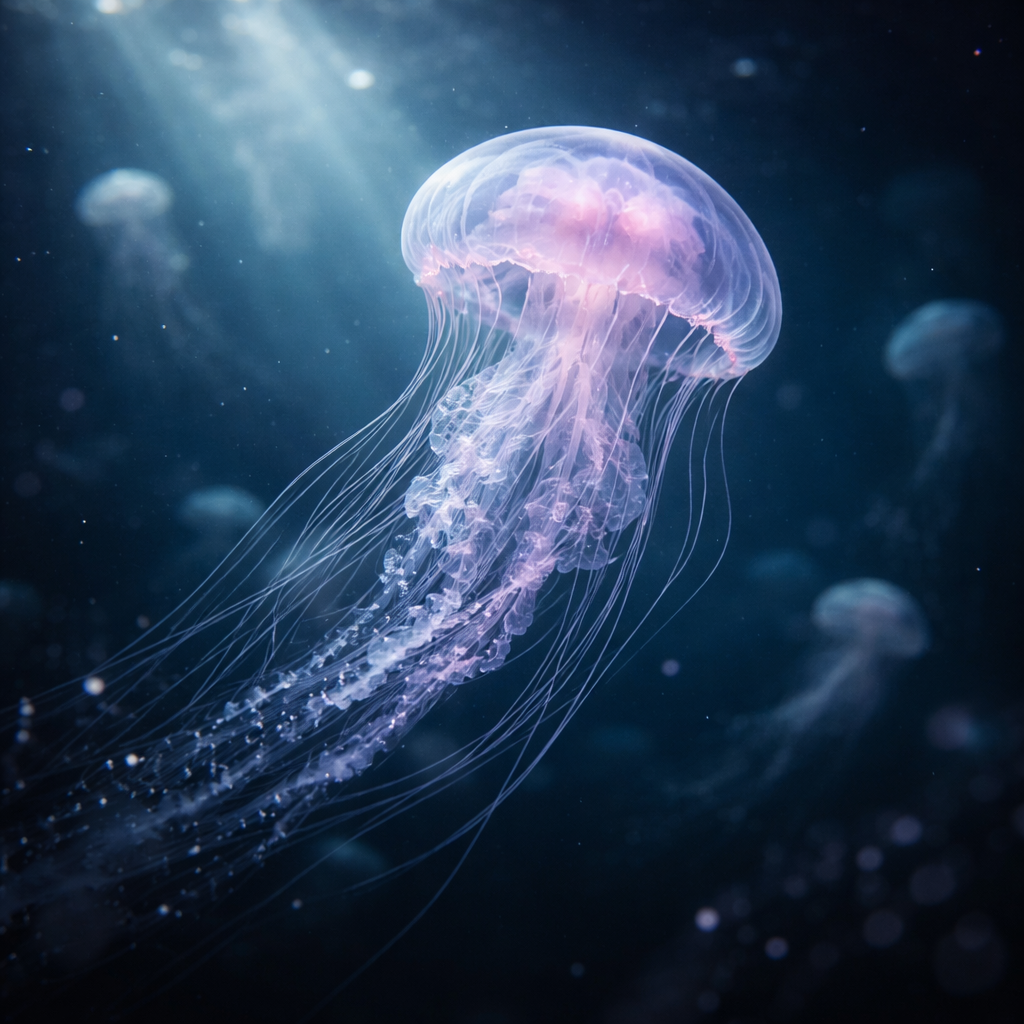
Few dream symbols feel quite as disorienting as a soft, pulsing creature floating through dark water — and if you’ve ever woken up wondering what does dreaming about jellyfish mean, you’re far from alone. These creatures show up in dreams more often than most people expect, and the imagery they carry is layered, specific, and worth exploring carefully.
Why jellyfish appear in dreams at all
Jellyfish occupy a strange place in the animal kingdom — they have no brain, no heart, and no bones, yet they’ve survived for hundreds of millions of years. In the world of dream symbolism, this combination of vulnerability and resilience makes them unusually rich as a symbol. They move with the current rather than against it, they’re beautiful but capable of causing pain, and they exist in an environment that humans fundamentally cannot inhabit without assistance.
Dream researchers and psychologists who work within the tradition of symbolic interpretation often point out that ocean creatures in general tend to represent the unconscious mind — the vast, unlit part of our inner life that we don’t access during waking hours. Jellyfish, specifically, add another layer: their translucency suggests things that are visible but not fully understood, and their stinging capability introduces the idea of hidden dangers in situations that appear gentle or harmless.
The emotional context matters more than the image itself
Before jumping to any fixed interpretation, it’s worth pausing on how the dream actually felt. Dream analysis consistently shows that the emotional tone of a dream often carries more meaning than the specific symbols present. Two people can dream of jellyfish in completely different emotional states and the meaning shifts significantly.
The feeling you carry out of the dream — whether it’s awe, dread, calm, or pain — is usually the clearest signal your unconscious is sending you.
Here’s how emotional context tends to reframe jellyfish dream symbolism:
- Feeling calm while watching jellyfish drift suggests you may be in a period of emotional flow, going with life’s changes rather than resisting them.
- Feeling afraid or stung by a jellyfish in a dream may point to a situation in waking life where something — or someone — appears harmless but has caused unexpected pain.
- Feeling fascinated or drawn toward the jellyfish often connects to curiosity about your own emotional depths or unconscious patterns.
- Feeling trapped among many jellyfish can reflect a sense of being surrounded by passive-aggressive behavior or situations that feel impossible to navigate without getting hurt.
Common jellyfish dream scenarios and what they suggest
Rather than offering a single blanket meaning, it helps to look at the specific scenario your dream presented. The details — location, your role, the jellyfish’s behavior — all contribute to a more nuanced picture.
| Dream scenario | Possible interpretation |
|---|---|
| Watching jellyfish from above or from shore | Observing your emotions from a safe distance; emotional awareness without being overwhelmed |
| Swimming peacefully among jellyfish | Comfort with uncertainty; ability to coexist with things you don’t fully understand |
| Being stung by a jellyfish | Feeling betrayed or hurt by something or someone that seemed safe or non-threatening |
| Holding a jellyfish | Attempting to control or understand something inherently fluid and difficult to grasp |
| A jellyfish on land or out of water | Something feeling out of place in your life; a situation that has lost its natural context |
| A glowing or bioluminescent jellyfish | Discovering something beautiful within confusion or darkness; intuitive insight |
What jellyfish symbolize across different interpretive frameworks
Depending on which lens you look through, jellyfish carry different but often complementary meanings. It’s useful to consider more than one framework, especially if a single interpretation doesn’t resonate with your personal situation.
From a psychological standpoint influenced by Jungian thought, jellyfish can represent the shadow self — aspects of our personality that exist below conscious awareness. Their formlessness suggests that what you’re dealing with emotionally may not yet have taken a defined shape in your mind. Something is there, you can sense it, but it hasn’t fully surfaced.
In spiritual symbolism, jellyfish are sometimes associated with acceptance, trust, and surrender — not in a passive, defeated way, but in the sense of trusting a larger process. Their movement is entirely dependent on ocean currents, which has led many symbolic traditions to connect them with themes of faith and flow.
From a more grounded psychological perspective, dreams involving jellyfish can also reflect real interpersonal dynamics — particularly situations involving people who seem gentle or non-confrontational on the surface but who have caused hurt through indirect or ambiguous behavior. This connects to concepts like emotional unavailability or boundary violations that don’t feel aggressive but still leave a mark.
A few things worth reflecting on after a jellyfish dream
Rather than searching for one definitive answer, the most productive approach after this kind of dream is gentle self-inquiry. Dreams rarely deliver direct messages — they work through imagery, sensation, and association.
Ask yourself: where in my life do I feel something beautiful that might also hurt me? Where am I drifting, and is that a problem or actually okay right now?
Some questions that can help you work through the imagery:
- Is there a relationship in my life that feels delicate or difficult to hold onto without getting hurt?
- Am I resisting a situation I might be better served by accepting or moving through?
- Have I recently felt stung by something I didn’t see coming?
- Is there something I’m sensing emotionally that I haven’t fully articulated to myself yet?
Writing down the dream in as much detail as possible shortly after waking tends to reveal more over time. Often, the meaning becomes clearer days or weeks later when a waking-life situation catches up to what the dream was already processing.
When the dream keeps returning
Recurring jellyfish dreams — especially if they involve the same scenario or emotional tone — are generally understood by dream researchers as a signal that something hasn’t been resolved or acknowledged. The unconscious mind tends to repeat imagery when it’s pointing at something the conscious mind keeps setting aside.
If you’re experiencing this kind of recurring dream, it may be worth paying closer attention to your emotional life in the days surrounding the dream. Journaling, talking through the imagery with someone you trust, or working with a therapist who incorporates dreamwork can all be productive next steps — not because jellyfish dreams are alarming, but because they often point to something genuinely worth understanding about your current inner state.
Ultimately, jellyfish dreams are rarely negative omens. More often, they’re an invitation — to slow down, to look at something with honesty, and to consider what you might be drifting toward or away from in your own life.