
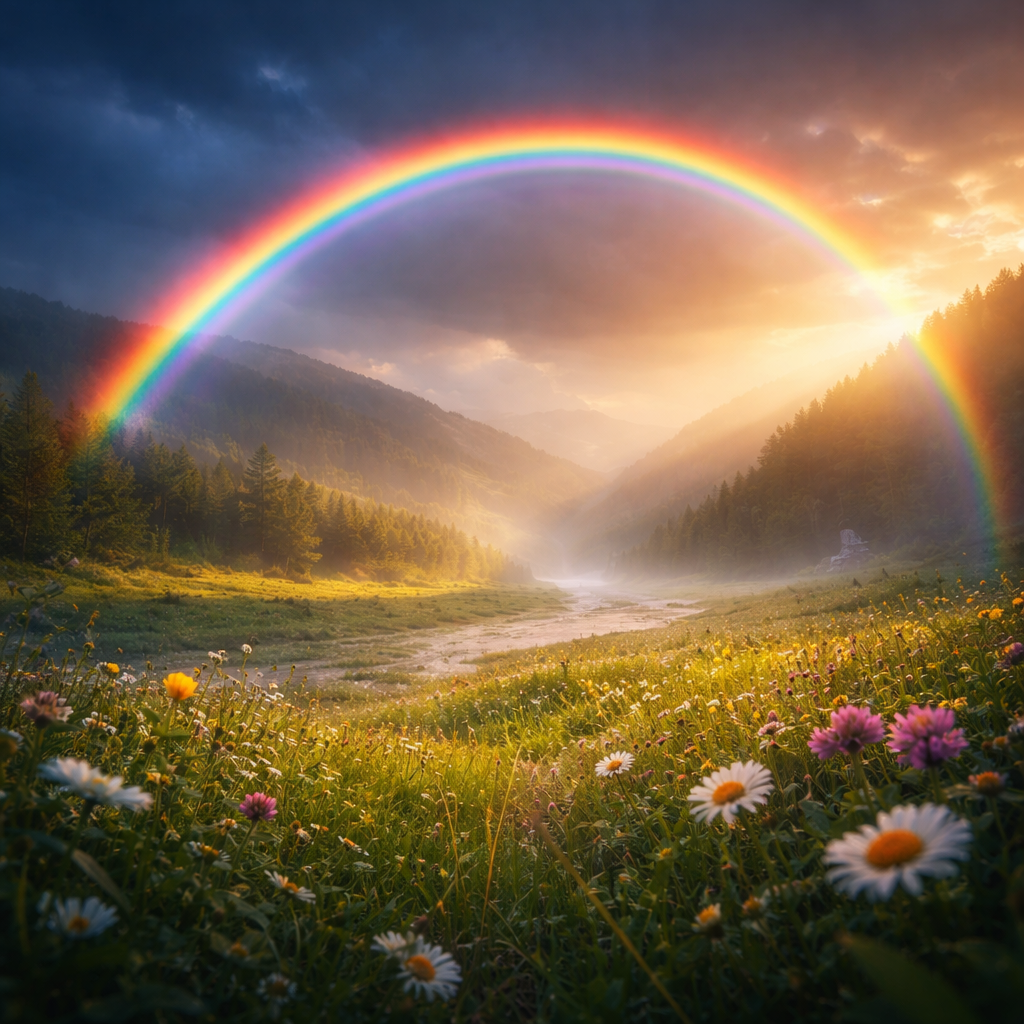
Most people wake up from a rainbow dream with a lingering sense of warmth — and then immediately wonder what does dreaming about a rainbow mean beyond the obvious beauty of the image. The short answer is: quite a lot, depending on the context of the dream, your emotional state, and the symbolism your mind attaches to color and light.
Why rainbows appear in dreams at all
From a psychological standpoint, dreams about rainbows tend to emerge during periods of transition. This aligns with what Carl Jung described as the “transcendent function” — the psyche’s natural tendency to bridge opposites: tension and release, loss and recovery, uncertainty and hope. A rainbow, by its very nature, is a meteorological bridge between storm and sunlight. It makes sense that the dreaming mind would reach for this symbol when navigating a similar emotional arc in waking life.
Neuroscientifically, the emotional quality of a dream — whether it feels hopeful, anxious, or peaceful — is processed through the limbic system, particularly the amygdala. When you wake up feeling genuinely uplifted after a rainbow dream, that emotional tone itself carries interpretive weight. It suggests your brain was processing something positive or resolving an internal conflict.
What the colors in the dream might signal
Not all rainbow dreams are equal. The visual details matter — whether the rainbow is full or partial, vivid or faded, close or distant. Color psychology research consistently shows that humans attach emotional meaning to specific hues, and dreams are no exception.
| Color in the rainbow | Common psychological association |
|---|---|
| Red | Strong emotion, passion, urgency |
| Orange | Creativity, warmth, social energy |
| Yellow | Clarity, optimism, mental activity |
| Green | Growth, healing, personal renewal |
| Blue | Calm, communication, inner truth |
| Violet/Purple | Spiritual insight, intuition, transition |
If one color in your dream stood out above the others — say, the green band seemed unusually vivid — that specific hue may be worth paying closer attention to when reflecting on what’s happening in your daily life.
Common scenarios and what they tend to reflect
Dream interpretation isn’t a science with fixed rules, but recurring patterns in how people describe their rainbow dreams do reveal some consistent themes. Here are a few of the most frequently reported scenarios:
- Seeing a rainbow after a storm in a dream — often reflects a real-life situation moving toward resolution. The storm you experienced emotionally may be losing its grip.
- A double rainbow — symbolically associated with amplified meaning, alignment, or a sense that something significant is unfolding on multiple levels of your life simultaneously.
- Trying to reach the end of a rainbow and failing — may point to frustration with goals that feel perpetually out of reach, or the fear that good things are never quite attainable.
- Standing inside or under a rainbow — a relatively rare dream image linked to feelings of belonging, protection, or being in exactly the right place at the right time.
- A faded or incomplete rainbow — can reflect doubt, a hope that hasn’t fully materialized yet, or a transition still in progress.
“Dreams are not random noise. They are the mind’s way of processing emotional experience through metaphor — and few metaphors are as universally understood as the rainbow.”
— adapted from research in contemporary dream psychology
Cultural and symbolic layers worth knowing
The meaning of a rainbow dream doesn’t exist in a cultural vacuum. Across many traditions, the rainbow has served as a powerful symbol connecting the human and the divine, the earthly and the beyond. In Norse mythology, Bifrost — the rainbow bridge — connected the mortal world to the realm of the gods. In Judeo-Christian tradition, the rainbow is a covenant symbol, a sign of promise after catastrophe. Indigenous cultures across the Americas and Oceania have long associated rainbow imagery with healing, spiritual messengers, and transformation.
This doesn’t mean your dream carries literal mythological significance, but it does suggest that when rainbow symbolism appears in sleep, it may be tapping into deeply embedded cultural memory — what Jung called the collective unconscious. Your personal associations with rainbows, shaped by childhood memories, cultural background, or even artistic preferences, layer on top of this shared symbolic base.
How to actually use this when you wake up
The most grounded approach to any dream interpretation is treating it as a conversation starter with yourself — not a prophecy. If you dream about a rainbow, here’s a practical way to reflect on it:
- Write down exactly what you remember within the first few minutes of waking. Emotions fade faster than visual details.
- Note what was happening in the dream just before the rainbow appeared — context often reveals more than the symbol itself.
- Ask yourself honestly: what is currently transitioning in your life? A job, a relationship, a belief system, a habit?
- Notice whether the dream left you feeling hopeful or unsettled — your gut reaction is data worth keeping.
Dream journaling, even done casually, has been studied as a tool for emotional self-awareness. It’s not about decoding hidden messages — it’s about using vivid nocturnal imagery as a mirror for your waking mind.
When the rainbow shows up more than once
Recurring rainbow dreams are actually less common than single occurrences, which makes them more noteworthy when they do happen. Sleep researchers generally agree that recurring dreams — regardless of their content — tend to persist until the underlying emotional or psychological theme finds some kind of resolution or acknowledgment in waking life.
If you keep seeing rainbows in your dreams, pay attention to what changes between each dream. Is the rainbow getting clearer, or more distant? Are you moving toward it or simply watching? These shifts in dream narrative often track real shifts in your inner landscape — and noticing them is itself a form of emotional intelligence.
Rainbow dreams, at their core, seem to be the mind’s way of reminding itself that light follows storms. Whether you take that as a psychological pattern, a symbolic message, or simply a beautiful piece of nocturnal theater is entirely up to you — but either way, it’s worth pausing to listen.