
You flip the switch, plug in your phone charger, and nothing happens. A wall outlet not working is one of those household problems that feels minor until it isn’t — and knowing why it happens can save you both time and money before you even think about calling an electrician.
Start here before assuming the worst
Most people’s first instinct is to assume the outlet is broken or that something went wrong with the wiring. In reality, the cause is often much simpler. Before opening any panel or reaching for tools, run through a few quick checks that take less than two minutes.
- Check whether other outlets in the same room are working — if they’re all dead, the issue is likely the circuit breaker, not the outlet itself.
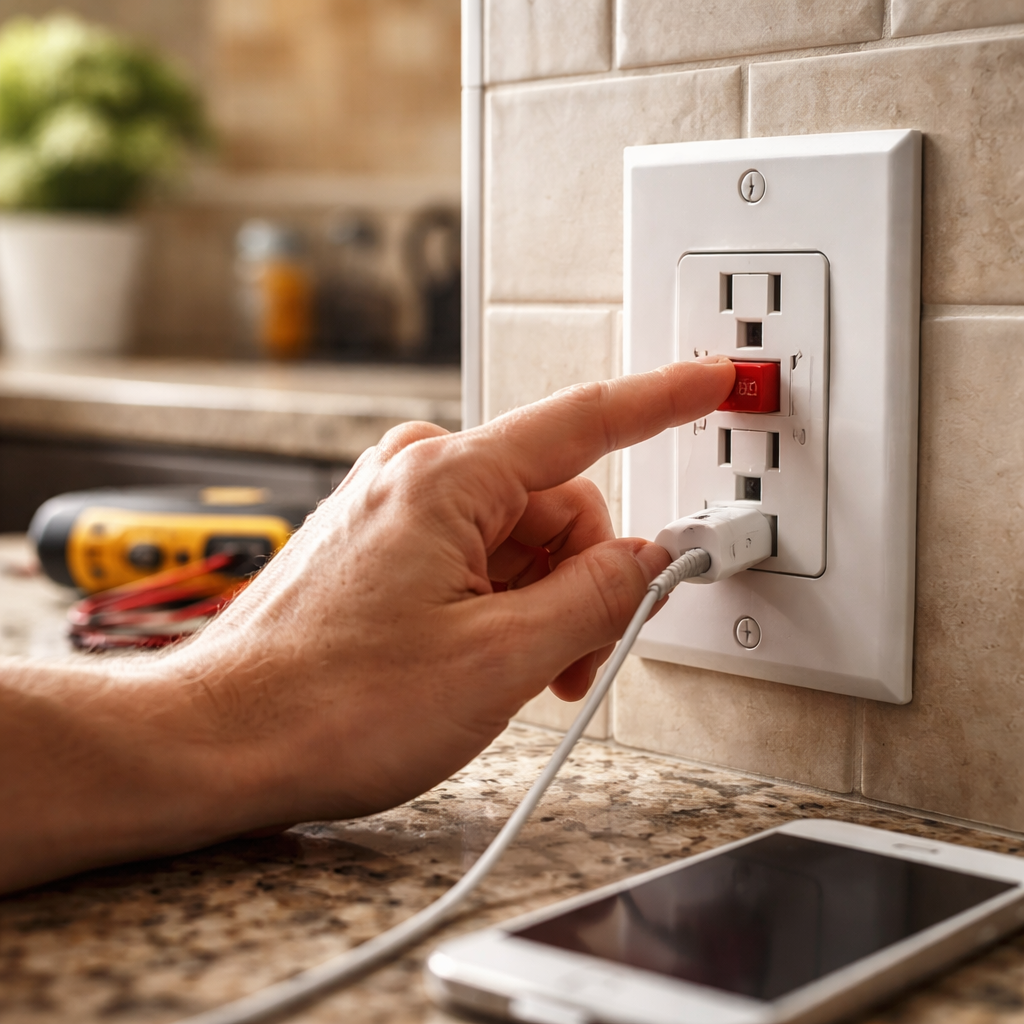
- Look at the outlet itself. Is it a GFCI outlet (the kind with small “Test” and “Reset” buttons in the middle)? A tripped GFCI is one of the most common and easily missed reasons for a dead outlet.
- Try plugging a different device into the same outlet to rule out a faulty cord or appliance.
- Check if a wall switch controls that outlet — some rooms are wired this way, especially for floor lamps.
These four steps resolve the problem in a surprisingly high percentage of cases. Only after ruling them out should you dig deeper.
The tripped GFCI outlet: the silent culprit in bathrooms and kitchens
Ground Fault Circuit Interrupter outlets are installed in areas where water is present — bathrooms, kitchens, garages, and outdoor spaces. They’re designed to cut power instantly when they detect an imbalance in electrical current, protecting you from shock.
Here’s the part many homeowners don’t realize: a single tripped GFCI outlet can knock out power to several other regular outlets that are wired “downstream” from it. So an outlet in your hallway or bedroom might be dead because a GFCI in the bathroom tripped — even though those rooms have nothing to do with each other visually.
Always check every GFCI outlet in your home when any outlet stops working, even if the dead outlet is far from water sources.
Resetting a GFCI is straightforward: press the “Reset” button firmly until you feel it click. If it trips again immediately, there’s a deeper electrical issue that needs professional attention — do not keep resetting it and hoping for the best.
When the circuit breaker is the real issue
Your home’s electrical panel contains circuit breakers that protect individual circuits from overloads. When too many high-draw devices run simultaneously on the same circuit — a space heater, a hair dryer, a microwave — the breaker trips and cuts power to everything on that line.
Go to your electrical panel and look for a breaker that’s in the middle position (between “On” and “Off”) or fully in the “Off” position. To reset it, push it fully to “Off” first, then back to “On.” If the breaker trips again within minutes of resetting, stop — that’s a sign of a persistent overload or a wiring fault that requires an electrician.
| Symptom | Most likely cause | DIY fix possible? |
|---|---|---|
| Single outlet dead, others work | Faulty outlet or tripped GFCI | Yes, in most cases |
| Multiple outlets dead in one area | Tripped breaker or GFCI | Yes, check panel and GFCI |
| Breaker trips repeatedly | Overloaded or faulty circuit | No — call an electrician |
| Outlet works but device doesn’t charge | Faulty device or cable | Yes — test with another device |
| Outlet is warm or smells burnt | Wiring problem or loose connection | No — urgent, call a professional |
Loose wiring inside the outlet — more common than you’d expect
Over time, the connections inside an outlet can loosen. This happens gradually due to heat cycles, vibration, or simply age. A loose wire means intermittent or total loss of power to that outlet, even when everything else on the circuit is fine.
If you’re comfortable working with basic home electrical systems and the power to that circuit is confirmed off at the breaker, you can remove the outlet cover plate and inspect the wiring. Look for wires that have pulled away from the terminal screws or are only barely making contact.
If wires look intact but the outlet still doesn’t work after reconnecting everything properly, the outlet receptacle itself may have failed internally. Replacing an outlet is a straightforward job for someone with basic electrical knowledge, but if you’re unsure, there’s no shame in calling a licensed electrician — it’s a quick and inexpensive fix for them.
Signs that mean you should not touch it yourself
Some situations go beyond a simple DIY reset. Knowing when to step back is just as important as knowing how to troubleshoot.
- The outlet feels warm or hot to the touch.
- You notice a burning smell near the outlet or in the room.
- The outlet shows visible scorch marks or discoloration.
- You hear crackling or buzzing sounds near the outlet or panel.
- The breaker keeps tripping no matter what you do.
Any of these signs point to a potentially dangerous wiring fault. Electrical fires often start inside walls, invisible until serious damage is done. In these cases, turn off the circuit at the breaker and contact a licensed electrician before using that circuit again.
One small check that most people skip entirely
There’s one final thing worth mentioning, because it catches people off guard more often than you’d expect: arc fault circuit interrupters, or AFCIs. These are breakers — not outlets — that look like regular breakers but have a small “Test” button on them. They’re required in modern homes for bedroom circuits and some living areas.
An AFCI breaker can trip due to electrical arcing inside the wiring, and when it does, it cuts power just like a regular tripped breaker. The difference is that it won’t reset if the underlying arcing condition is still present — which again is a signal to get a professional involved rather than keep forcing it back on.
Dead outlets are rarely a mystery once you work through the logical sequence: GFCI, breaker, the outlet itself, and the wiring behind it. Most of the time, the fix is already in your hands — it just takes knowing where to look first.