
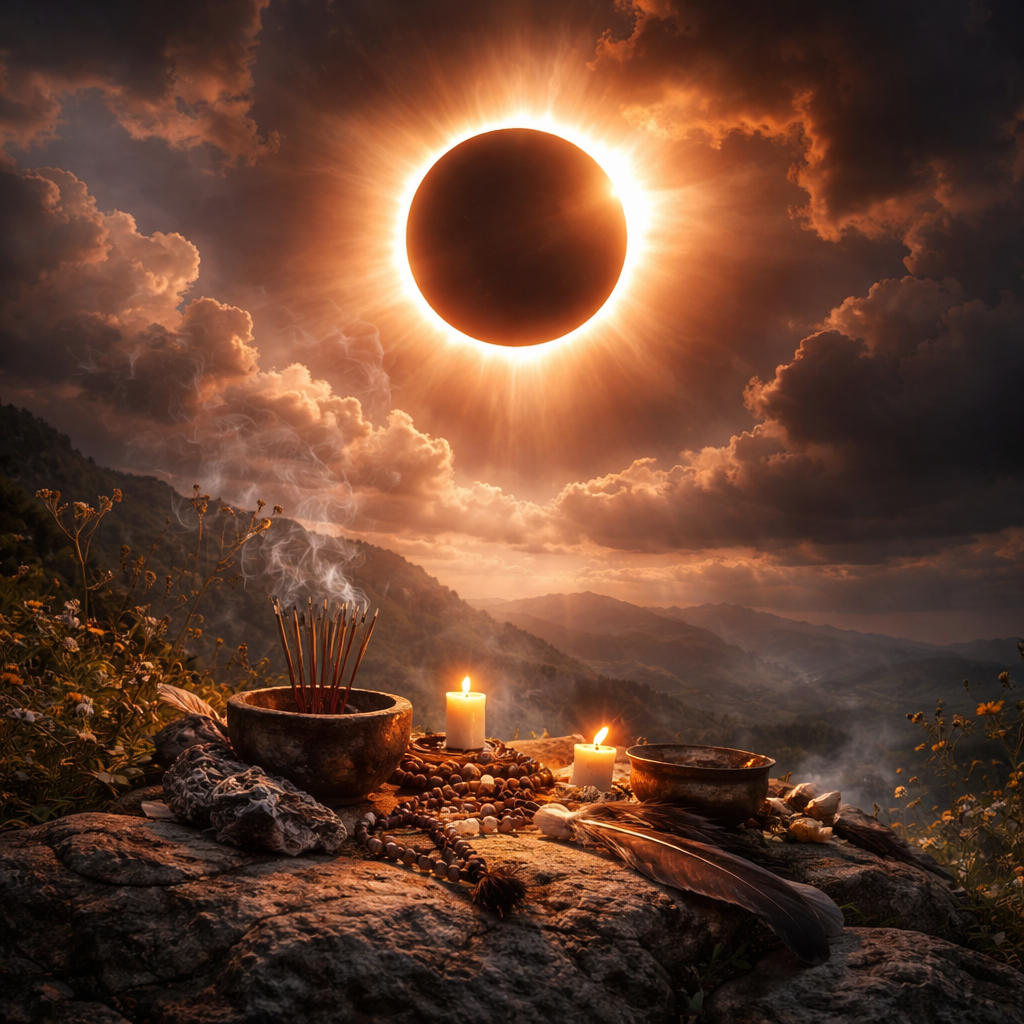
Cultures separated by oceans and centuries have looked up at the same darkened sky and felt something shift — not just in the atmosphere, but within themselves. The meaning of solar eclipse spiritual significance runs far deeper than astronomy textbooks suggest, touching on themes of transformation, surrender, and inner awakening that continue to resonate with people today.
Why the Sun Going Dark Feels Personal
There is something almost visceral about watching the sun disappear in the middle of the day. Animals go quiet, temperatures drop, and the familiar world briefly becomes unfamiliar. Long before science explained the mechanics of lunar alignment, people interpreted this event as a message — a disruption of the natural order that demanded attention and reflection.
What is striking is that spiritual interpretations of solar eclipses, across vastly different traditions, tend to converge on a few shared themes: endings that make room for beginnings, the hidden becoming visible, and the importance of pausing rather than pushing forward.
How Different Traditions Have Interpreted Solar Eclipses
Rather than a single universal meaning, solar eclipses carry a rich variety of symbolic weight depending on the cultural lens through which they are viewed. Here is a look at how several traditions have understood this event:
| Tradition | Core Spiritual Interpretation |
|---|---|
| Hindu | A time of heightened spiritual energy; rituals are performed to cleanse karmic debt and honor ancestors |
| Indigenous North American | Varies widely by nation, but often seen as a time of rest, prayer, and non-interference with the natural world |
| Ancient Mesopotamian | Regarded as an omen, often connected to the fate of rulers and kingdoms; interpreted by trained astrologers |
| Chinese traditional | Historically seen as a dragon consuming the sun; communal rituals were performed to restore balance |
| Western astrology | A powerful reset point, especially in the zodiac sign where the eclipse falls; linked to sudden revelations and life changes |
Despite the differences in imagery and ritual, the thread connecting all of these perspectives is that a solar eclipse is not something to simply observe passively. It is an invitation to engage — internally, communally, or spiritually.
The Symbolism of Darkness at Noon
In many spiritual frameworks, the sun represents consciousness, vitality, and the visible self — the part of us we present to the world. When the moon temporarily obscures the sun, it is often read as the unconscious mind stepping into the light, if only briefly.
“The eclipse does not destroy the sun. It reveals what is usually invisible — the corona, the stars in daytime, and perhaps something in ourselves.”
This idea of revelation through obscuration shows up consistently in eclipse symbolism. What you have been ignoring, suppressing, or simply not noticing may suddenly become harder to avoid. Spiritual practitioners often describe eclipse periods as emotionally charged times when old patterns surface, relationships reach turning points, and long-postponed decisions can no longer be deferred.
Eclipse Energy and Personal Transformation
In contemporary spiritual communities, solar eclipses are frequently associated with accelerated personal change. Whether or not one follows astrology, the concept is worth considering: certain moments in time feel more charged with possibility than others. Eclipses, because of their rarity and visual drama, naturally create a psychological pause.
That pause can be genuinely useful. When the routine of daily life is momentarily interrupted — even symbolically — people tend to reflect. What am I actually doing with my time? What am I avoiding? What needs to end so something else can begin?
- What chapter of your life feels ready to close?
- Where have you been seeking external validation instead of internal clarity?
- What truth have you been reluctant to face?
- What would you do differently if you stopped waiting for the “right moment”?
What Astrology Says About Eclipse Cycles
In astrological tradition, eclipses occur in pairs — a solar eclipse is typically followed by a lunar eclipse roughly two weeks later — and they travel through what are called eclipse cycles tied to the lunar nodes. These nodes, known as the North Node and South Node, are associated with collective and personal destiny in Vedic and Western astrology alike.
A solar eclipse at the North Node is generally interpreted as a time of forward movement, new beginnings, and stepping into unfamiliar territory. One near the South Node, on the other hand, tends to correspond with release — letting go of what no longer serves. Neither is inherently negative; both are considered significant points of shift.
- Solar eclipses on the North Node: associated with new directions, bold beginnings, and expanding beyond comfort zones
- Solar eclipses on the South Node: associated with completion, release, and revisiting unresolved patterns
- The zodiac sign of the eclipse adds additional symbolic context to the themes at play
When the Sky Asks You to Stop
Perhaps the most universally applicable spiritual lesson of a solar eclipse is simply this: some moments are meant for stillness, not action. Across traditions — from Vedic astrology, which advises against starting new ventures during an eclipse, to Indigenous practices of rest and prayer — there is a shared recognition that not every window of time is equally suited for moving forward.
In a culture that prizes constant productivity, the idea of deliberately pausing during a significant celestial event has its own quiet wisdom. It is not about superstition. It is about using a rare and striking natural phenomenon as an anchor for self-awareness — a moment to look inward with the same attentiveness we instinctively give to the darkened sky above.
Whatever your spiritual background or lack thereof, the eclipse offers something genuinely valuable: a reason to stop, look up, and ask yourself honestly where you are headed and why.