
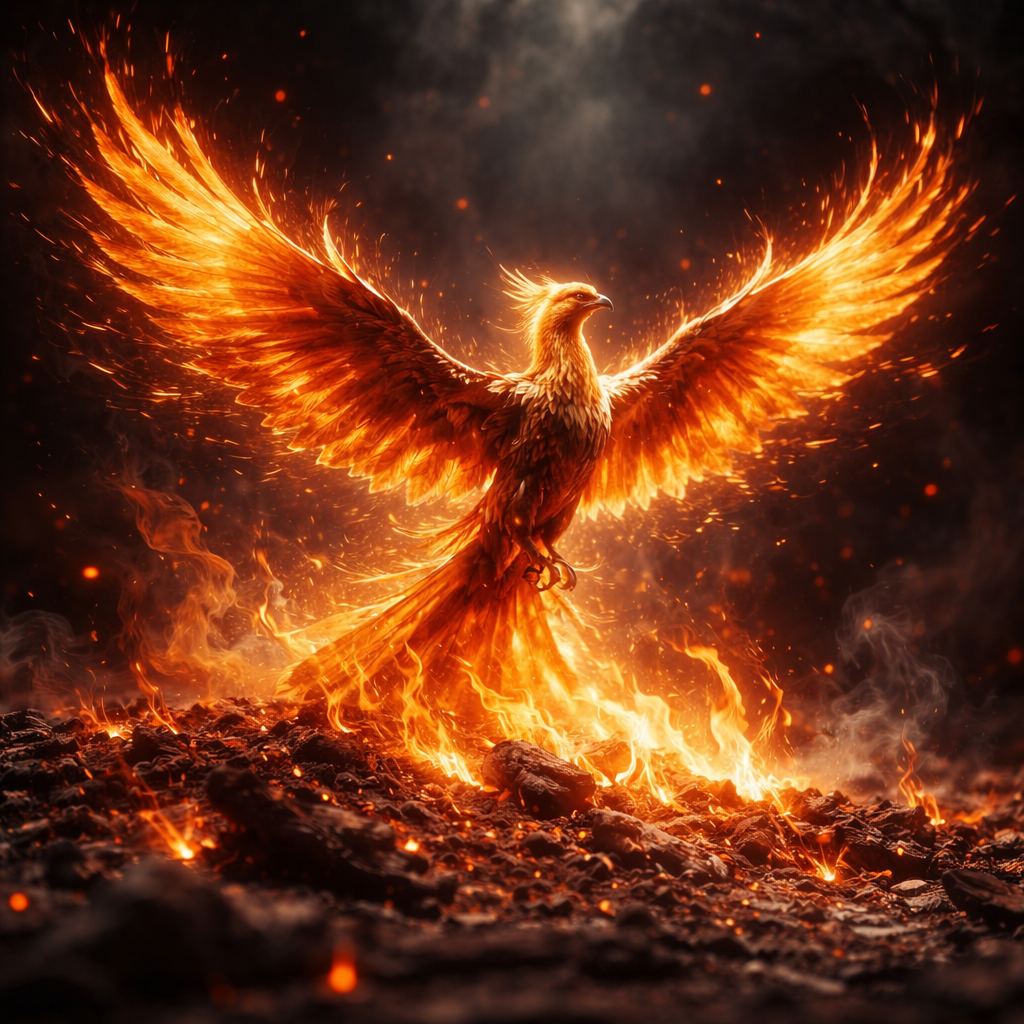
Few symbols have traveled as far across time and cultures as the phoenix — and the meaning of phoenix rising from ashes goes well beyond decorative mythology. It describes something remarkably specific: the capacity to be completely destroyed and still return, not diminished, but transformed. That idea has resonated with philosophers, poets, theologians, and ordinary people for thousands of years, and it continues to show up in art, psychology, and everyday language for a reason.
Where the phoenix actually comes from
Most people assume the phoenix is a purely Greek invention, but the origins are more layered than that. Ancient Egyptian mythology described a bird called the Bennu — a heron-like creature associated with the sun god Ra and the primordial mound of creation. The Bennu was linked to cycles of death and rebirth, and many historians trace the Greek phoenix directly to this figure.
Greek writers, including Herodotus, mentioned the phoenix as a bird from Arabia that lived for hundreds of years, then built a nest of aromatic wood, ignited it, and was reborn from the remains. Roman, Persian, Chinese, and even early Christian traditions each adopted a version of this creature, adjusting the details but keeping the core narrative intact: destruction leads to renewal.
“The phoenix hope, can wing her way through the desert skies, and still defying fortune’s spite; revive from ashes and rise.” — Miguel de Cervantes
What the symbol actually means — layer by layer
The phoenix is not simply about surviving hardship. That reading is too thin. The deeper meaning involves a specific sequence: something must fully end before something new can begin. The bird does not escape the fire — it enters it completely. That distinction matters, because the symbol is not about avoidance or resilience in the sense of staying the same through difficulty. It is about fundamental change through loss.
Across different traditions, this plays out in recognizable ways:
- In early Christian symbolism, the phoenix was used as an allegory for resurrection — the idea that physical death is not an endpoint but a passage.
- In alchemical tradition, the phoenix represented the final stage of transformation, when base material becomes gold — a metaphor for spiritual purification.
- In Chinese mythology, the Fenghuang (often compared to the phoenix) symbolized harmony between opposites and the union of yin and yang forces.
- In Persian literature, the Simurgh — a related mythical bird — embodied wisdom accumulated through centuries of witnessing the rise and fall of civilizations.
Each of these readings shares a common thread: transformation is not accidental. It requires something to be released, burned away, or surrendered before the new form can emerge.
The psychology behind the myth
It is not coincidental that the phoenix symbol appears so naturally in conversations about personal crisis, grief, addiction recovery, and major life transitions. Psychologically, the image captures something that clinical language sometimes struggles to express: the idea that identity itself can be rebuilt after collapse.
Carl Jung wrote extensively about the process he called individuation — the journey toward wholeness through confronting the parts of oneself that have been suppressed or destroyed. While Jung did not always use the phoenix directly, the symbolic structure maps closely onto his thinking. The ego that has been shattered by life experience has the potential to reconstitute at a deeper, more integrated level.
| Life experience | What gets “burned” | What can emerge |
|---|---|---|
| Loss of a relationship | A particular identity or role | Clearer sense of self and values |
| Career failure | A fixed idea of success | More authentic direction or purpose |
| Health crisis | The illusion of control | Deeper presence and priorities |
| Grief | The world as it was | New relationship with what remains |
These are not guaranteed outcomes — the phoenix story is aspirational, not automatic. But the framework it offers is genuinely useful: it reframes destruction as a potential starting condition rather than a final verdict.
Why this symbol keeps appearing in modern culture
From tattoos and album covers to corporate rebranding campaigns and sports team names, the phoenix has never really left popular consciousness. This persistence is worth examining, because cultural symbols that last this long tend to be doing something functional — they are helping people organize experiences that are otherwise hard to articulate.
The phoenix gives language to a specific kind of experience: coming through something that felt unsurvivable. It does not minimize the difficulty or suggest that suffering is a gift. What it offers instead is a narrative structure — a way of understanding that an ending can also be a beginning, without pretending the two things are the same.
The symbol works precisely because it does not skip over the fire. The burning is part of the story, not a footnote to it.
How different cultures picture the rebirth
One interesting detail is how the actual mechanism of rebirth varies across traditions. In some accounts, the phoenix regenerates from the ashes directly. In others, a worm or larva emerges first from the remains, and the bird grows from that intermediate form — a detail that adds a layer of humility to the myth. The new phoenix does not simply reappear fully formed. It passes through a vulnerable, formless stage before becoming what it will be.
That version of the story is arguably more honest about what recovery and transformation actually feel like. There is often a period that does not look like strength or renewal — it looks like confusion, slowness, or starting over from an uncomfortable place. The myth, in its more detailed forms, accounts for that.
The fire is not the enemy
Perhaps the most counterintuitive aspect of the phoenix symbol is the role of fire itself. In most narratives, fire represents destruction, threat, or punishment. In the phoenix myth, fire is the mechanism of transformation. The bird builds the pyre deliberately — it is not a passive victim of circumstance but an active participant in its own reinvention.
This reframes crisis not as something that happens to a person, but as something a person can, at some point, choose to engage with rather than escape. That does not mean seeking suffering — it means recognizing that certain forms of difficulty, once entered fully, carry the possibility of genuine change rather than just damage.
Whether you encounter this symbol in mythology, art, therapy, or your own life experience, the core message holds: what has been reduced to ash is not necessarily gone. It may simply be in the process of becoming something else.