
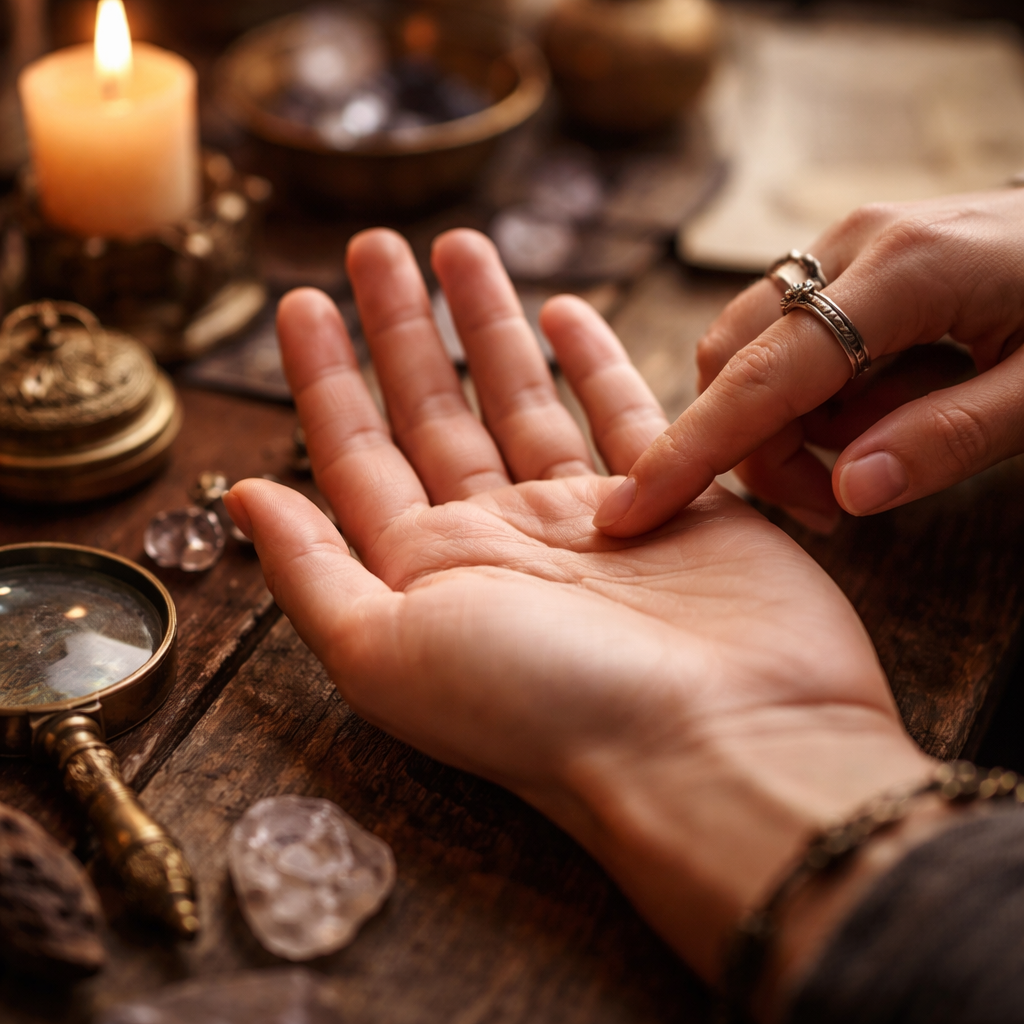
Most people glance at their hands dozens of times a day without giving them a second thought — yet the meaning of palm reading lines has fascinated cultures from ancient India and China to medieval Europe for thousands of years. Whether you approach palmistry as a spiritual practice, a psychological mirror, or simply a curious lens for self-reflection, understanding what those lines actually represent is genuinely useful. And no, you don’t need to visit a fortune teller to start making sense of them.
Where palmistry actually comes from
Palmistry, also known as chiromancy, has documented roots in the Vedic tradition of ancient India, where it was practiced as part of a broader system called Samudrika Shastra — the study of body features and their connection to personality and destiny. From India, the practice traveled along trade and migration routes into China, Persia, Egypt, and eventually Greece, where Aristotle reportedly wrote about it in his treatise “Historia Animalium.”
It’s worth being honest here: modern science doesn’t validate palmistry as a predictive system. However, dermatoglyphics — the scientific study of skin ridge patterns — does confirm that palm lines form during fetal development and can carry genetic and neurological information. That’s a real and well-established field. Palmistry as a cultural and introspective practice sits in a different category, but that doesn’t make it any less interesting to explore.
The four major lines and what they’re said to represent
When people ask about palm line meanings, they’re usually referring to four primary lines that appear on almost every hand. Each one has a traditional interpretation that has remained fairly consistent across different palmistry traditions.
| Line | Location | Traditional association |
|---|---|---|
| Heart line | Runs horizontally near the top of the palm | Emotional life, relationships, capacity for love |
| Head line | Runs horizontally across the middle of the palm | Thinking style, intellect, decision-making |
| Life line | Curves around the base of the thumb | Vitality, major life changes, physical energy |
| Fate line | Runs vertically from the base of the palm upward | Career path, life direction, external circumstances |
A few things to know right away: not everyone has a fate line, and that’s completely normal. The absence of a line doesn’t carry a negative meaning — it often simply suggests that a person’s path is more self-directed rather than shaped by external forces or social expectations.
Reading between the lines — literally
The depth, length, and curvature of each line are considered just as important as the line’s presence. Here’s how traditional palmistry breaks this down:
The heart line
A long, clear heart line curving up toward the index finger is traditionally associated with idealism in relationships and a tendency to lead with emotion. A shorter, straighter line is linked to a more pragmatic approach to love and connection. When the heart line is deeply etched, it’s said to reflect intense emotional experiences; when it’s faint or broken, it may indicate emotional complexity or periods of significant change in personal relationships.
The head line
This line is particularly interesting because it doesn’t describe intelligence in a fixed sense — it’s more about cognitive style. A straight head line is associated with logical, systematic thinking. A curved or sloping line suggests creativity, imagination, and a tendency to think in unconventional ways. When the head and life line are joined at the start (which is common), it traditionally indicates a cautious nature and strong family influence in early life.
The life line
One of the most persistent myths in palmistry is that a short life line predicts an early death. This is not what traditional palmistry actually teaches. The life line reflects vitality and life experiences, not lifespan.
A wide arc on the life line is associated with abundant energy and an outgoing personality. A life line that hugs closely to the thumb is linked to a more cautious or reserved nature. Breaks or branches in the line are interpreted as significant transitions — not endings, but turning points.
The fate line
When present, the fate line is often read in conjunction with the life line to understand how personal effort and external circumstances interact. A fate line that starts connected to the life line suggests early family influence on career or life direction. One that starts from the center of the palm and rises freely is associated with self-determination and an independent path.
Minor lines that add nuance
Beyond the four major lines, palmistry recognizes a range of secondary lines that appear on some hands and not others. These include:
- The sun line (Apollo line) — associated with creativity, public recognition, and personal fulfillment
- The Mercury line — linked to communication skills, business acumen, and health
- The girdle of Venus — a curved line above the heart line, associated with emotional sensitivity
- Marriage or relationship lines — small horizontal lines on the edge of the palm below the little finger
- Travel lines — lines that branch from the life line or the base of the palm outward
These minor lines are highly variable between individuals, and their absence on a hand tells you very little on its own. They’re most meaningfully read as part of the whole hand rather than in isolation.
Which hand do you read — and does it matter?
This is one of the most common practical questions people have. Different palmistry traditions handle this differently, but the most widely used approach distinguishes between the passive hand (the one you don’t write with) and the active hand (your dominant hand).
The passive hand is generally read as reflecting innate traits — what you were born with, your natural tendencies and potential. The active hand shows how those traits have developed through lived experience, choices, and external influences. Comparing the two hands can be particularly revealing, as differences between them are interpreted as signs of personal growth or change over time.
A grounded way to approach palm reading
If you’re exploring palmistry for the first time, the most useful frame is self-reflection rather than prediction. Use the lines as prompts for honest questions: How do I tend to handle emotional situations? Do my career choices feel internally driven or shaped by expectations around me? Am I more of a logical or intuitive thinker?
Palm lines also change over time — they deepen, fade, and new ones form as we age and as our habits evolve. That alone is a reminder that palmistry, at its most thoughtful, was never really about fixed destiny. It was about understanding the person holding the hand at a particular moment in their life.
Whether you’re reading your own palm out of curiosity or learning to read for others, the most valuable takeaway is this: the lines don’t make decisions for you. They’re a starting point for a conversation — with yourself, or with someone else — about what shapes a human life.