
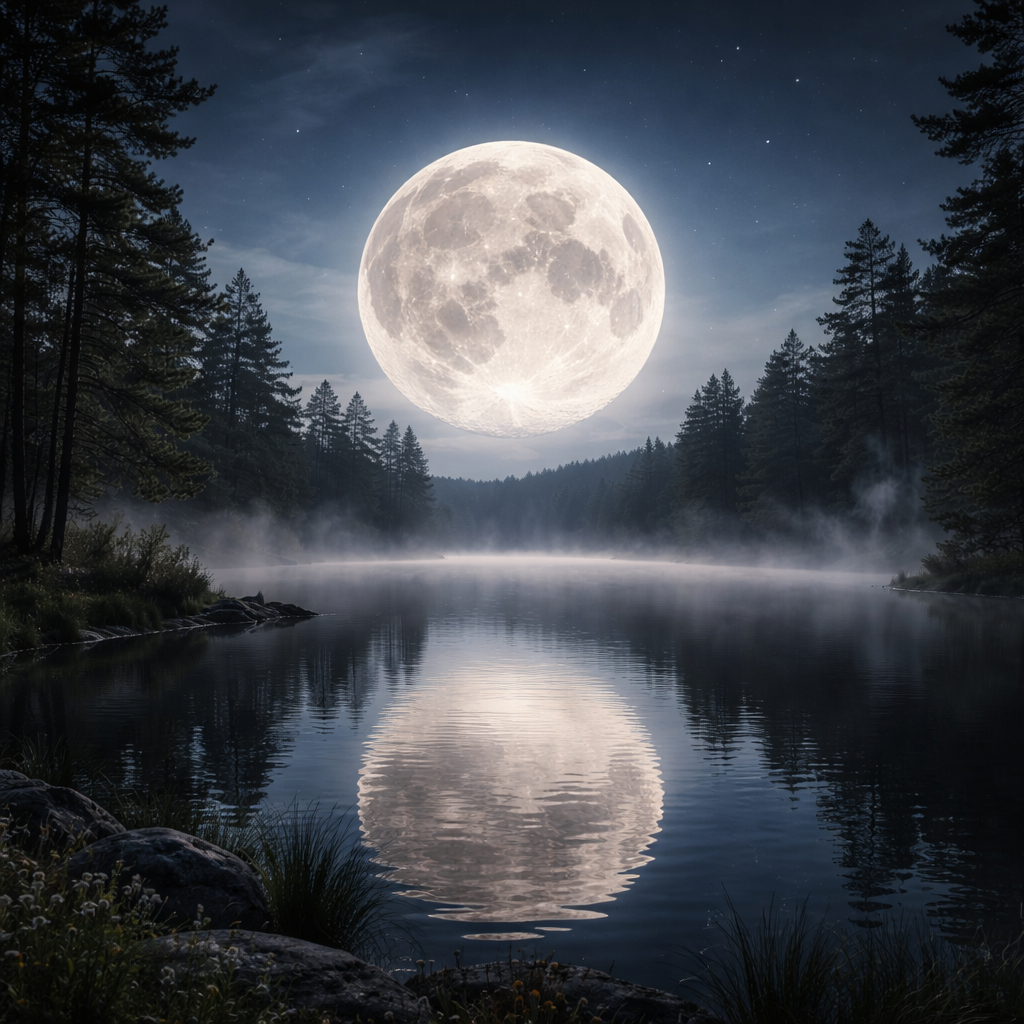
Every month, the night sky offers something that quietly pulls at human emotion, habit, and awareness — and understanding the meaning of full moon energy helps explain why so many people feel a noticeable shift during this lunar phase. This isn’t superstition dressed up in modern clothing. There’s a layered mix of astronomical reality, psychological response, and centuries of human observation behind it.
What actually happens during a full moon
A full moon occurs when the Earth sits directly between the Sun and the Moon, causing the lunar surface to be fully illuminated as seen from Earth. This happens approximately every 29.5 days — a cycle known as the synodic month. During this time, the gravitational pull between the Earth and Moon is at a particular alignment that affects ocean tides, and some researchers have explored whether it influences biological systems as well.
The gravitational effect on large bodies of water is well-documented. Since the human body contains a significant percentage of water, some theories suggest this pull may have subtle physiological effects, though scientific consensus on direct human impact remains mixed. What’s less debatable is the effect of increased nighttime light on sleep patterns and mood — something measurable and reproducible in studies on circadian rhythms.
The emotional and psychological dimension
Many people report heightened emotions, vivid dreams, or a sense of restlessness around the full moon. While attributing this entirely to lunar mechanics would be an oversimplification, the perception itself is real and worth examining. Sleep research has shown that people tend to take longer to fall asleep and experience less deep sleep during full moon nights, which alone can amplify emotional reactivity the following day.
“The moon does not fight. It attacks no one. It does not worry. It does not try to crush others. It keeps to its course, but by its very nature, it gently influences.” — Deng Ming-Dao
This quote resonates because it reflects something many people intuitively sense — the full moon doesn’t force anything, but its presence seems to amplify what’s already there. Emotions that were manageable suddenly feel bigger. Thoughts that were quiet get louder. From a psychological standpoint, this may relate to how light, sleep disruption, and cultural expectation combine to create a heightened state of awareness.
Cultural and spiritual interpretations across traditions
The full moon holds significance in virtually every major culture throughout recorded history. The ways these meanings differ — and sometimes overlap — reveal how universally humans have responded to this celestial event.
| Tradition | Full Moon Meaning |
|---|---|
| Hinduism | Purnima — a time for fasting, prayer, and spiritual merit |
| Buddhism | Associated with key events in the Buddha’s life; celebrated with meditation |
| Celtic tradition | Linked to harvest, ritual, and communal gathering |
| Native American cultures | Each full moon is named after seasonal events (Harvest Moon, Wolf Moon, etc.) |
| Chinese culture | Mid-Autumn Festival — reunion, gratitude, and moon gazing |
Across these traditions, a pattern emerges: the full moon is treated as a threshold — a moment to pause, reflect, and either release or celebrate. Whether viewed through a spiritual or purely cultural lens, these practices have real psychological value. Ritual and intentional pausing are well-recognized tools for emotional regulation and mental clarity.
How people work with full moon energy in daily life
You don’t need to follow any particular spiritual framework to find value in aligning certain habits with the lunar cycle. Many people use the full moon as a natural checkpoint — a built-in calendar moment that encourages reflection without requiring any additional structure.
Here are some of the most commonly reported practices that people find genuinely useful:
- Journaling about what the past month brought — achievements, lessons, and unresolved tensions
- Setting aside time for physical rest, since sleep can be lighter around this phase
- Reviewing goals set at the new moon two weeks earlier
- Spending time outdoors in natural moonlight, which some find grounding
- Reducing screen time in the evening to counter increased light exposure
- Having honest conversations that may have been postponed
None of these practices require belief in anything metaphysical. They’re simply habits that use a recurring natural event as a trigger for intentional behavior — something behavioral science actively supports as an effective strategy for building consistency.
A practical note on sensitivity and individual experience
Not everyone experiences the full moon in the same way, and that’s worth acknowledging directly. Some people notice a distinct energetic or emotional shift; others observe nothing at all. Both experiences are valid. Individual sensitivity to light, personal sleep quality, stress levels, and even awareness of the lunar phase all play a role in how strongly someone might respond.
If you’ve never paid attention to lunar cycles and decide to start, give it at least two or three cycles before drawing conclusions. Tracking your mood, energy, and sleep quality across a full month gives you personal data — far more reliable than a single anecdote or a general claim.
When the light is at its fullest
The full moon doesn’t demand anything. It simply arrives, fully visible, at the same point in its cycle month after month. Whether you engage with it as a spiritual event, a sleep-awareness cue, or just a beautiful natural phenomenon — paying attention to it tends to bring people a little more into the present moment. And that, regardless of belief system or background, is almost always useful.
What makes the full moon a lasting point of human fascination isn’t mysticism alone — it’s the combination of a visible, predictable natural event with the very human tendency to find meaning in rhythm and pattern. The sky gives you a recurring moment. What you do with it is entirely up to you.