
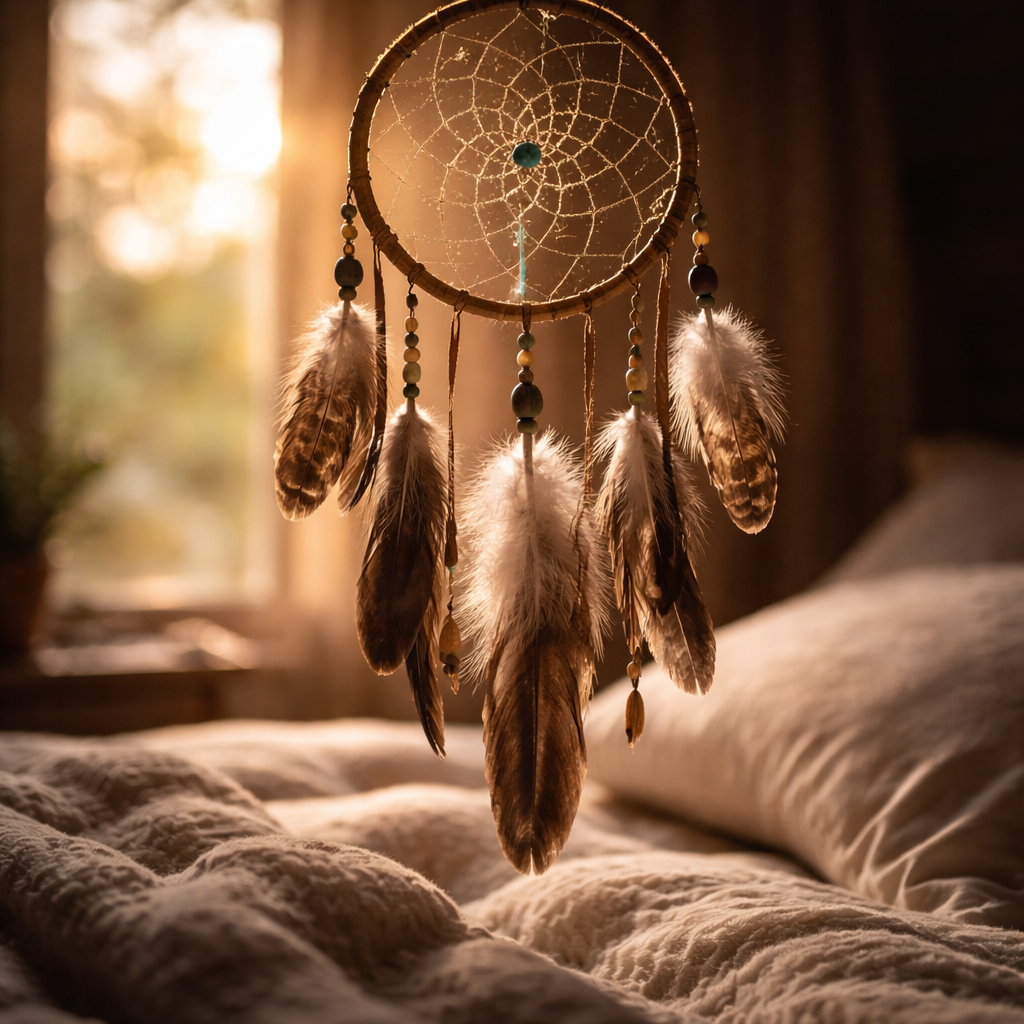
Few objects carry as much quiet symbolism as a woven hoop hung above a sleeping person’s head — and understanding the meaning of dreamcatchers history reveals that this isn’t just decorative tradition, but a deeply rooted spiritual practice with centuries of cultural significance behind it.
Where It All Began: The Ojibwe Nation
The dreamcatcher originates with the Ojibwe people, also known as the Anishinaabe, one of the largest Indigenous groups in North America. Their oral traditions describe a figure known as Asibikaashi — the Spider Woman — who held a protective, maternal role over the people of the land. As communities grew and spread across vast territories, it became physically impossible for her to visit every home and watch over every sleeping child. In response, grandmothers and mothers began crafting small web-like hoops to take on that protective function.
These early objects were made with willow frames — young, flexible branches bent into circles — and filled with woven sinew or plant fibers in patterns that deliberately mirrored a spider’s web. Natural materials like feathers, beads, and shells were attached as finishing elements, each one carrying its own layer of meaning.
How the Dream-Filtering Concept Actually Works
The logic behind a dreamcatcher is elegant in its simplicity. According to traditional Ojibwe belief, the night air carries both good and bad dreams. When a dreamcatcher is hung above a sleeping person — typically near a window or in a place where air circulates — it acts as a filter.
“Good dreams know the way through — they pass down the feathers gently to the sleeper. Bad dreams, tangled in the web, are destroyed by the first light of morning sun.”
This isn’t metaphor for the sake of it. The placement near light was intentional: sunlight was believed to neutralize the negative energy caught in the web, which is why traditional dreamcatchers were often positioned where dawn light could reach them.
The Materials and Their Deeper Meaning
Every element of a traditional dreamcatcher was chosen with intention. The materials weren’t decorative afterthoughts — they communicated specific values and spiritual concepts.
| Element | Traditional Material | Symbolic Meaning |
|---|---|---|
| Frame (hoop) | Young willow branch | The circle of life, continuity, strength |
| Web | Sinew or plant fiber | The spider’s web, filtering dreams |
| Feathers | Owl or eagle feathers | Wisdom, breath, connection to sky spirits |
| Beads | Natural gemstones or bone | Good dreams caught before dawn, or the spider itself |
| Leather wrapping | Animal hide | Grounding, connection to the earth |
Notably, owl feathers were traditionally associated with women and wisdom, while eagle feathers carried a warrior or masculine energy. These distinctions mattered — a dreamcatcher made for a child would differ in specific ways from one crafted for an elder or a warrior.
Spread Beyond the Ojibwe: Pan-Indigenous Adoption
The dreamcatcher didn’t stay confined to Ojibwe communities. During the Pan-Indian Movement of the 1960s and 1970s — a period of significant political and cultural awakening among Indigenous peoples across North America — the dreamcatcher emerged as a shared symbol of unity across many different nations. Tribes with no historical connection to the Ojibwe began adopting and incorporating dreamcatchers into their own cultural expressions.
This spread was partly organic — driven by intertribal relationships, shared ceremonies, and a collective desire to assert Indigenous identity — and partly shaped by broader cultural visibility in mainstream American society. By the late 20th century, the dreamcatcher had become one of the most widely recognized symbols associated with Native American culture as a whole, even though its specific origins lie with one particular people.
The Commercialization Question
This wider recognition came with significant complications. As dreamcatchers moved into mass-market production — appearing on keychains, car mirrors, wall art, and festival merchandise — many Indigenous scholars, artists, and community members raised serious concerns about cultural appropriation and the erasure of authentic meaning.
The issue isn’t simply one of aesthetics. When an object with deep spiritual roots is mass-produced in factories overseas with no connection to its origin community, something essential is lost — both for the people whose heritage it represents and for the buyers who may genuinely not know what they’re holding.
What Dreamcatchers Mean in Contemporary Indigenous Life
It’s important not to treat dreamcatchers purely as a historical artifact. For many Ojibwe people and members of other Indigenous nations today, they remain living objects — handmade, gifted, hung with intention. They appear at naming ceremonies, in nurseries for newborns, at healing gatherings, and in homes where traditional spiritual practices are actively maintained.
Contemporary Indigenous artists also work with the dreamcatcher form in ways that push its boundaries — incorporating new materials, reimagining its shape, or using it as a canvas for commentary on Indigenous identity in modern life. The tradition is not frozen in the past; it continues to evolve in the hands of the communities it belongs to.
- Dreamcatchers are still made and gifted within Ojibwe families as protective objects for newborns
- Many Indigenous artists reclaim the form as a statement of cultural resilience
- Tribal museums and cultural centers use dreamcatchers as educational tools about Anishinaabe cosmology
- Some communities have developed specific guidelines distinguishing sacred from non-sacred dreamcatcher use
A Symbol That Deserves More Than a Glance
There’s a tendency to reduce the dreamcatcher to a pleasant aesthetic — something soft and whimsical that looks nice in morning light. But the closer you look at where it comes from, who made it, and why, the more layered and genuinely fascinating it becomes. The Spider Woman story, the careful choice of materials, the specific placement logic, the way it traveled across cultures during a moment of political awakening — all of it adds up to something that rewards curiosity.
Understanding the object doesn’t require you to adopt its spiritual framework or belong to its culture of origin. It simply means holding it — or even an image of it — with a little more awareness of what it carries. That, in itself, is a kind of respect.