
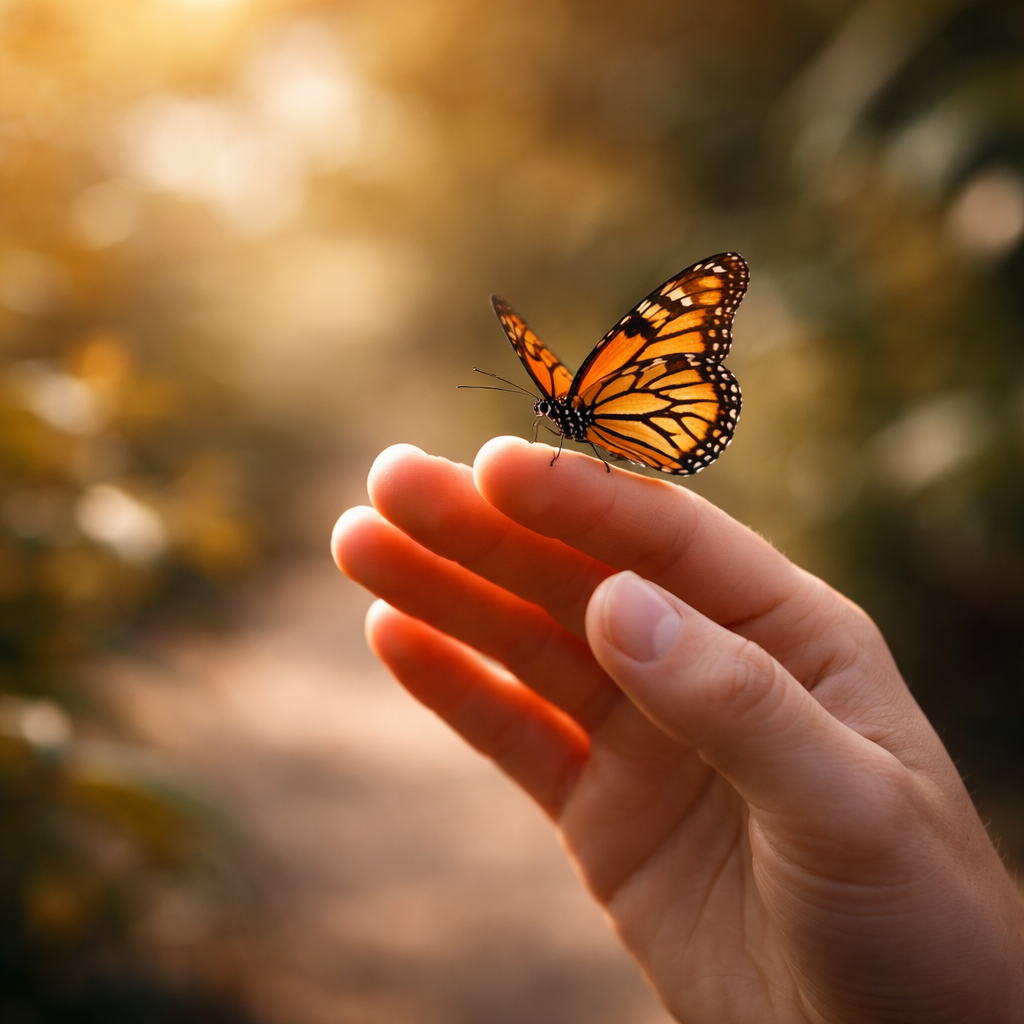
Few moments in nature feel quite as personal as when a butterfly chooses to land on you. The meaning of butterfly landing on you has been explored across cultures, spiritual traditions, and even modern psychology — and while interpretations vary, the experience itself tends to leave people genuinely curious about what it might signify.
Why butterflies land on people in the first place
Before diving into symbolism, it helps to understand the biological reality. Butterflies are drawn to warmth, salt, and certain scents. Human skin naturally emits heat and trace amounts of sodium through sweat, both of which can attract a butterfly that is feeding or resting. So when one lands on your hand or shoulder, there is often a perfectly natural explanation rooted in the butterfly’s own needs rather than any cosmic arrangement.
That said, the rarity and gentleness of the moment is what makes it feel significant. Butterflies are easily startled, and choosing to stay on a person — even briefly — is not something they do casually. This combination of natural behavior and uncommon occurrence is likely why so many people across history have attached deeper meaning to it.
Cultural and spiritual interpretations from around the world
Across vastly different civilizations, butterflies have carried symbolic weight connected to transformation, the soul, and messages from beyond the physical world. Here is how various traditions have understood the encounter:
| Culture / Tradition | Symbolic meaning |
|---|---|
| Ancient Greece | The butterfly represented the human soul (psyche). A butterfly landing on you was seen as a visit from a soul or divine spirit. |
| Native American traditions | Butterflies were considered messengers carrying wishes and prayers to the spirit world. Their presence near a person signaled guidance or comfort. |
| Celtic folklore | Butterflies were associated with the souls of the deceased, particularly loved ones checking in on the living. |
| East Asian symbolism | In Chinese culture, two butterflies together represent love and joy. A single butterfly landing on a person can symbolize good fortune or an incoming positive change. |
| Christian symbolism | The butterfly’s life cycle — egg, caterpillar, chrysalis, butterfly — is widely used as a metaphor for resurrection and spiritual rebirth. |
What is striking is how consistent the theme of transformation and spiritual connection remains, even across cultures with no historical contact. That kind of cross-cultural resonance suggests the butterfly has tapped into something deeply human.
The color of the butterfly and what it may represent
Many people who report meaningful butterfly encounters also pay close attention to the color of the butterfly involved. While color symbolism is not scientifically verified, it is deeply embedded in folklore and spiritual practice:
- White butterfly — often associated with purity, the presence of a deceased loved one, or spiritual clarity
- Yellow butterfly — linked to hope, happiness, and new beginnings in many North American and European traditions
- Orange butterfly — frequently connected to passion, energy, and enthusiasm for life
- Black butterfly — sometimes seen as a symbol of transition, endings, or deep transformation rather than anything negative
- Blue butterfly — associated with luck, wishes coming true, and a sense of peace or emotional healing
It is worth noting that these associations come from cultural and symbolic traditions rather than established science. How you personally respond to the color is ultimately just as valid as any traditional interpretation.
What grief counselors and psychologists observe
Interestingly, butterfly encounters come up frequently in therapeutic settings, particularly among people who are grieving. Many individuals report that a butterfly landing on them shortly after the death of a loved one brought an unexpected sense of comfort or felt like a form of communication.
Grief counselors often describe these moments as “continuing bonds” experiences — instances where bereaved individuals feel a sense of ongoing connection with someone who has died. Whether or not the encounter carries supernatural meaning, its emotional impact is real and can be genuinely healing.
Psychology does not dismiss these experiences. The meaning a person assigns to a butterfly landing on them can serve as a healthy coping mechanism, offering comfort and a sense that life continues in some form beyond physical loss. The subjective significance of such a moment is not something to be explained away.
A butterfly as a personal symbol of change
Separate from spiritual interpretations, many people simply use the butterfly as a personal metaphor for change and growth in their own lives. If you are going through a period of transition — a career shift, a new relationship, a move, or a personal reinvention — a butterfly landing on you can feel like a timely nudge from the universe, or at minimum, a beautiful reminder that transformation is a natural part of living.
This is not about superstition. It is about how humans naturally create meaning from experience. Noticing and reflecting on a butterfly encounter can be a mindful pause in a busy day — a moment that reconnects you with the present.
A simple way to reflect on the encounter
If a butterfly has recently landed on you and you are wondering what to make of it, try asking yourself a few honest questions:
- What was I thinking about just before it happened?
- Am I currently going through any kind of transition or uncertainty?
- Did the moment bring up any specific emotion — calm, joy, sadness, hope?
- Does this remind me of anyone I have lost or someone I care about?
Your answers will likely tell you more about the personal meaning of the moment than any general interpretation ever could.
When the moment stays with you
A butterfly landing on you is one of those small, quiet events that somehow manages to stay in the memory long after it has passed. Whether you interpret it through the lens of science, spirituality, cultural tradition, or personal reflection, the encounter tends to mean something — and that meaning is shaped entirely by who you are and where you are in your life at that moment.
There is no single correct interpretation. What matters is how the experience resonates with you. Some people feel a gentle reassurance. Others feel wonder. A few feel an undeniable connection to someone they have lost. All of these responses are legitimate, and none of them require justification.
The next time a butterfly settles on your hand and stays for a moment longer than expected, you might simply let it be what it is — something rare, something beautiful, and something entirely your own to interpret.