
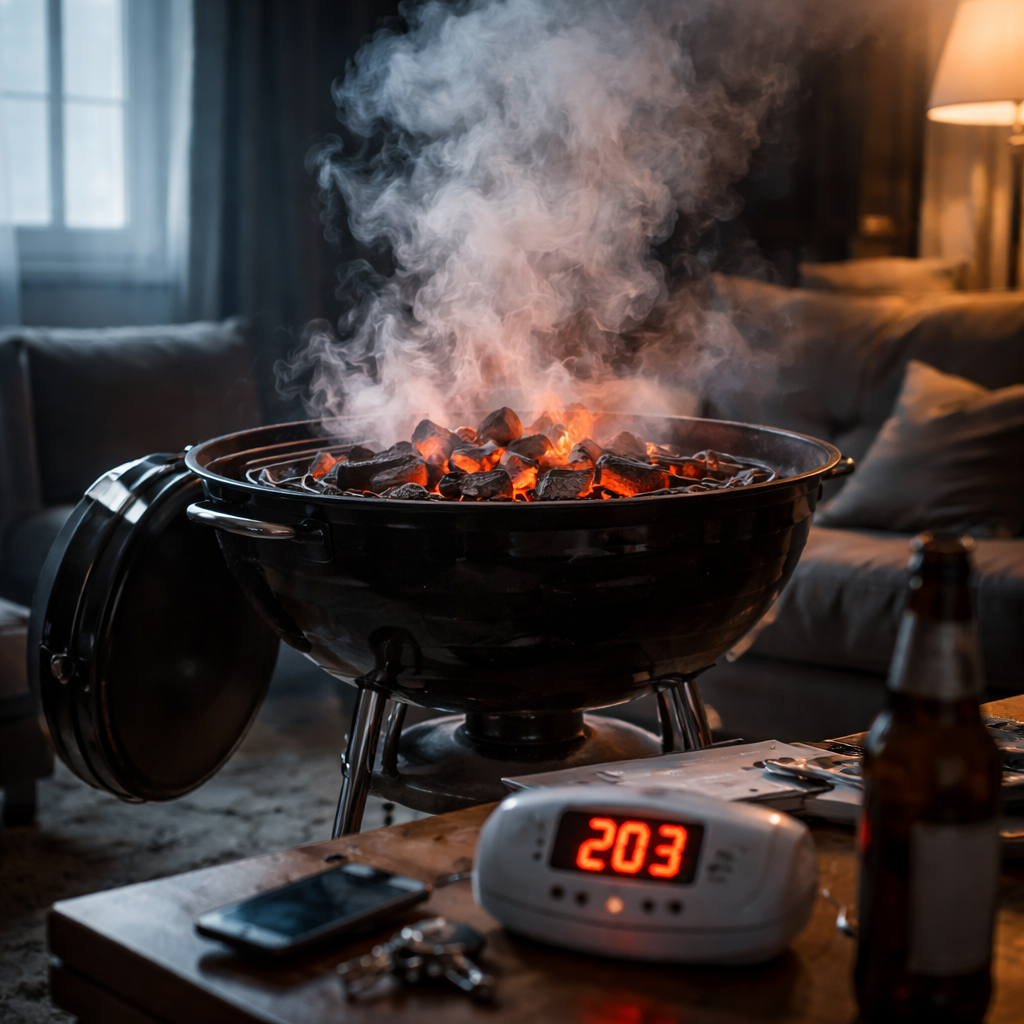
Every year, dozens of people are hospitalized — and some don’t survive — after using a charcoal grill in an enclosed space. The question of whether is it safe to use a charcoal grill indoors has a straightforward answer backed by science, fire safety codes, and emergency medicine: it is not. But understanding exactly why, and what the real risks look like, can make all the difference between a dangerous mistake and a genuinely safe grilling experience.
What actually happens when charcoal burns inside
Charcoal doesn’t just produce heat — it produces carbon monoxide (CO) as a byproduct of incomplete combustion. This colorless, odorless gas is the primary reason indoor charcoal grilling is so dangerous. Unlike smoke from wood or paper, carbon monoxide gives no warning. You cannot smell it, see it, or taste it. It binds to hemoglobin in your blood far more efficiently than oxygen does, which means your body gets starved of oxygen even while you’re breathing normally.
A standard charcoal grill can produce carbon monoxide levels that exceed safe thresholds within minutes in a closed room. Even a garage with the door partially open, a screened porch, or a tent provides nowhere near enough ventilation to disperse the gas safely. The CO builds up, and symptoms can appear before a person even realizes something is wrong.
Recognizing the symptoms of carbon monoxide poisoning
One of the most dangerous aspects of CO exposure is how easily its early symptoms are dismissed. People often assume they’re just tired, have a headache from the heat, or feel nauseous from the food. By the time symptoms become severe, the ability to think clearly or move quickly may already be compromised.
- Mild exposure: headache, slight dizziness, mild nausea
- Moderate exposure: intense headache, confusion, vomiting, rapid heart rate
- Severe exposure: loss of consciousness, seizures, cardiac arrest
Children, elderly individuals, and people with heart or respiratory conditions are at significantly higher risk and may be affected at lower CO concentrations than healthy adults.
According to the Centers for Disease Control and Prevention (CDC), carbon monoxide poisoning accounts for thousands of emergency room visits annually, with a notable portion linked to the improper indoor use of grills and generators.
Common scenarios that put people at risk
It’s rarely recklessness that leads to indoor charcoal grill accidents — more often, it’s a seemingly reasonable decision made under pressure. A sudden rainstorm. A desire to keep cooking going during a power outage. An attempt to stay warm while grilling in cold weather. These situations all share one thing: the temptation to bring the grill inside “just this once.”
| Scenario | Why it feels safe | Why it isn’t |
|---|---|---|
| Grilling in the garage | The door is open, so there’s airflow | CO accumulates faster than it disperses |
| Using a grill on an enclosed porch | Screens allow some air movement | Not sufficient for CO to dissipate safely |
| Grilling after a storm in a tent or camper | Temporary shelter feels like outdoor space | Small enclosed spaces concentrate CO rapidly |
| Keeping a “finished” grill inside to cool | Charcoal looks like it’s done burning | Smoldering charcoal continues to emit CO for hours |
That last point deserves emphasis: a charcoal grill that appears to be cooling down is still actively releasing carbon monoxide. Moving a grill indoors after use — even after the flames are gone — is just as dangerous as using it indoors from the start.
What proper outdoor grilling safety actually looks like
Safe charcoal grilling isn’t complicated, but it does require consistent habits. The key is putting physical distance between the grill and any enclosed space, and maintaining it throughout the entire grilling and cooling process.
Here’s what fire safety organizations and health authorities consistently recommend:
- Place the grill at least 10 feet away from any structure, including walls, fences, and overhangs
- Never use charcoal grills in garages, sheds, campers, tents, or on screened porches
- Allow the grill to cool completely outdoors — never bring it inside to finish cooling
- Install carbon monoxide detectors in your home, particularly near sleeping areas
- Dispose of ash only after it has fully cooled, in a metal container with a lid
A carbon monoxide detector is one of the most affordable safety investments for any household that uses grills, generators, or fuel-burning appliances. Many incidents happen at night, when people are asleep and unable to recognize warning signs.
Alternatives when outdoor grilling isn’t an option
If weather or circumstances genuinely prevent outdoor grilling, there are safe alternatives worth knowing about. Electric grills and stovetop grill pans can replicate some of the grilling experience without producing carbon monoxide. Indoor electric smokers are another option designed specifically for indoor use, with proper ventilation requirements clearly stated by the manufacturer.
What these alternatives share is that they don’t rely on combustion in the same way charcoal does. The characteristic smoky flavor of charcoal grilling comes precisely from the combustion process — and that same process is what makes it incompatible with enclosed spaces. Liquid smoke, smoked salts, and wood chip accessories for electric grills can partially recreate the flavor profile without the risk.
The rule that doesn’t have exceptions
Some safety guidelines have nuance. Charcoal grills indoors do not. There is no ventilation setup, no partial opening of a window, and no “quick use” that makes it acceptable. Emergency responders and poison control specialists are consistent on this point: if the space has walls and a roof, a charcoal grill does not belong there.
The good news is that this is one of those risks that is entirely preventable. Keeping the grill outside, letting it cool outside, and investing in a CO detector are actions that require almost no effort relative to the protection they provide. Grilling should be one of life’s simple pleasures — and with the right habits, it stays that way.