
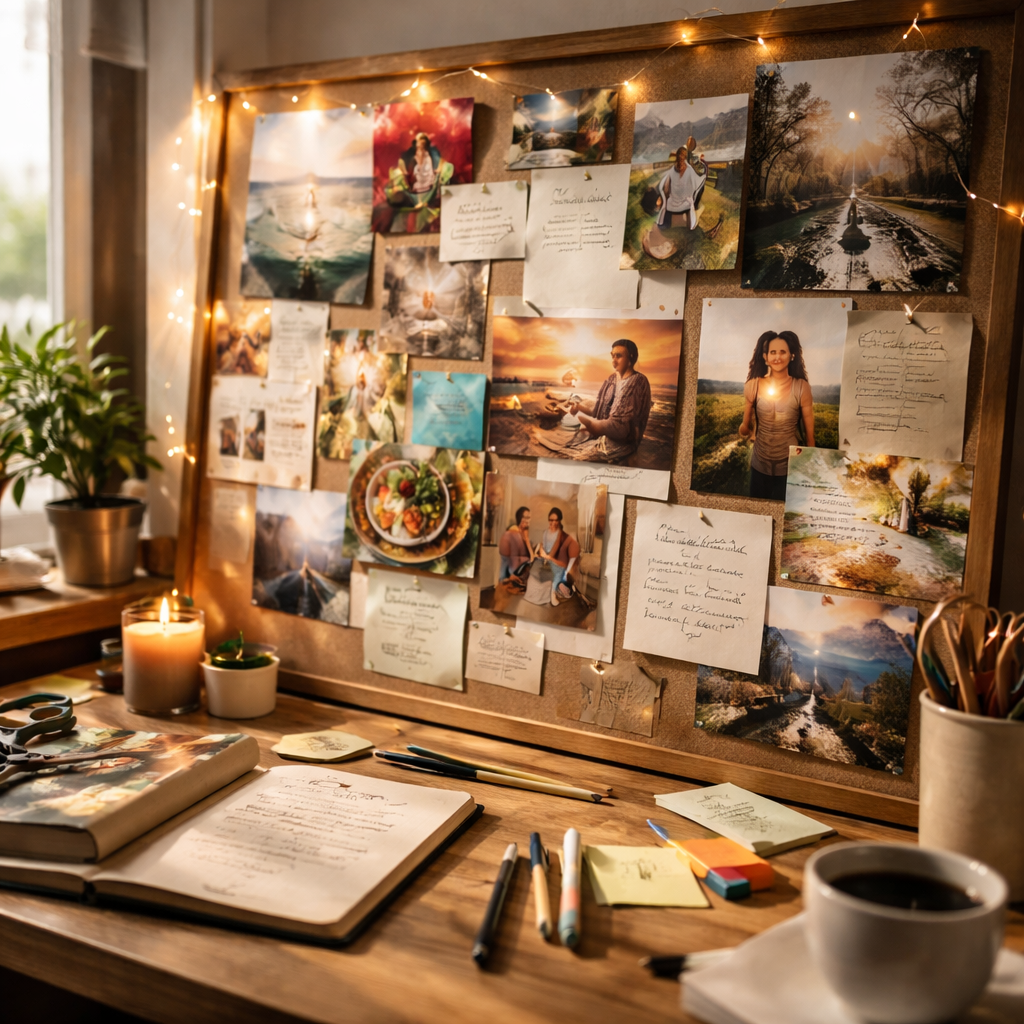
Most people who create ideas for a vision board for the new year make the same mistake: they fill it with generic stock-photo dreams and forget what actually drives them personally. The result? A beautiful collage that gets ignored by February. This guide is about doing it differently — building something that genuinely reflects where you want to go and why.
Why a vision board works — and when it doesn’t
Research in psychology supports the idea that visual cues reinforce goal-directed behavior. When you see images and words connected to your intentions regularly, your brain starts filtering daily experiences through that lens — a process linked to the reticular activating system. But this only works if the images mean something real to you.
A vision board loses its power when it becomes decorative. If you picked an image because it looked nice rather than because it sparked something genuine, it won’t do much for your motivation. The categories below are designed to help you go deeper.
Choosing the right categories for your board
Instead of the usual “career, health, relationships” framework, try thinking about your life in terms of energy. What areas feel depleted? What feels like it’s on the edge of something good? Start there.
- Personal growth — skills you want to develop, books, courses, habits
- Physical wellbeing — movement, rest, nutrition that suits your body
- Relationships — the quality of connections, not just the people
- Work and creative projects — what you want to build or contribute
- Environment — your home, the places you want to be in, atmosphere
- Financial clarity — not just “more money” but what financial security actually looks like for you
- Inner life — values, emotional state, how you want to feel day to day
You don’t have to include all of these. A focused board with three strong areas often outperforms a cluttered one trying to cover everything at once.
Digital vs. physical: which format actually helps you more
Both formats have real advantages, and the right choice depends entirely on your lifestyle.
| Format | Best for | Key advantage |
|---|---|---|
| Physical board | Visual thinkers, tactile learners | Stays visible in your space; harder to ignore |
| Digital board (Canva, Pinterest) | People who travel or work remotely | Easy to update, accessible on any device |
| Hybrid (printed pages + digital backup) | Those who want flexibility and presence | Combines daily visibility with easy editing |
One practical tip: if you go digital, set your board as your phone or desktop wallpaper. Out of sight is genuinely out of mind when it comes to intention-setting tools.
What to actually put on it — specific and unconventional ideas
Forget the luxury car and the tropical beach unless those things genuinely matter to you. Here are some less obvious but highly effective elements to include:
- A word or short phrase that captures how you want to feel — not what you want to have
- A photo of a place that represents a mindset, not just a destination
- A quote from someone whose thinking you respect, written in your own handwriting
- A specific skill or milestone written as a completed statement (“I finished writing my first chapter”)
- An image representing a morning or evening routine you want to build
- Something abstract — a color palette, a texture, an artwork — that reflects the emotional tone of the year you’re designing
“The goal is not to have a beautiful board. The goal is to have a useful one — something that pulls your attention and reminds you what you’re working toward on an ordinary Tuesday morning.”
Making the process itself meaningful
Many people rush through creating their board in an hour and then wonder why it doesn’t resonate. Consider spreading the process over a few days. On the first day, just write — no images yet. Ask yourself: what do I actually want to change, experience, or build? What did the past year teach me that I want to carry forward?
On the second day, gather images and words without curating. Pull anything that catches your eye. Only on the third step do you edit — removing what doesn’t feel right and keeping what does.
Keeping it alive beyond the first week
A vision board is not a set-it-and-forget-it tool. The people who get the most from theirs treat it as a living document. Schedule a monthly check-in — even five minutes — to look at your board and notice what still resonates, what has shifted, and what you’ve already moved toward.
Some elements will naturally fade in relevance as the year progresses. That’s not failure — it’s information. You can update your board mid-year without it meaning anything went wrong. Goals evolve, and your visual anchor should too.
The boards that collect dust are the ones created in a single motivated burst and never revisited. The ones that actually influence behavior are treated more like a compass than a trophy — something you return to when you need direction, not just decoration.