
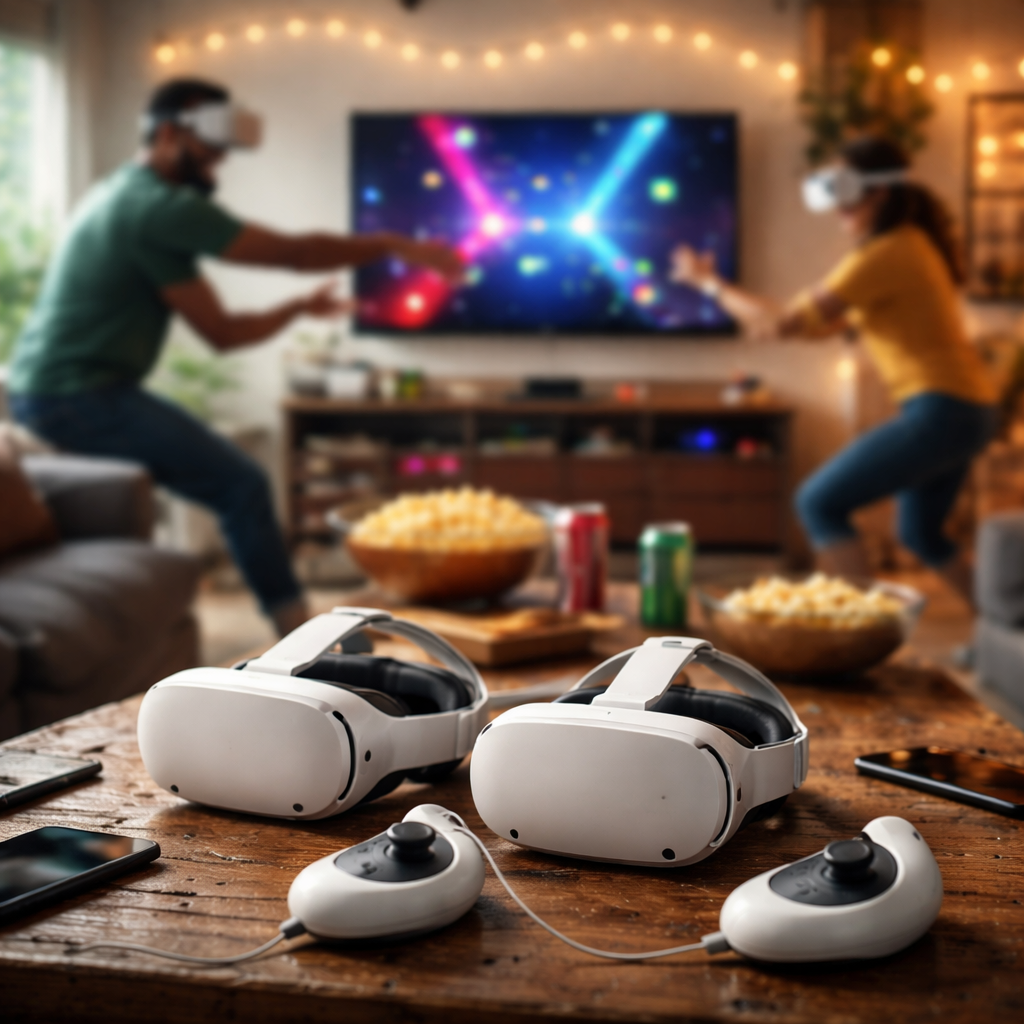
Planning ideas for a virtual reality game night sounds simple until you realize how many moving parts are involved — headsets, compatible platforms, group sizes, motion sickness considerations, and game genres that actually keep everyone engaged. Done right, a VR game night can be genuinely unforgettable. Done poorly, it turns into a tech support session with a side of frustration.
Before you pick a single game, sort out the setup
The most overlooked part of any VR gathering is the physical space. Unlike traditional game nights, virtual reality demands real-world room. Each player needs a clear play area — ideally at least 2×2 meters — to move, swing, dodge, and crouch without knocking over a lamp or elbowing a friend in the face.
Here are the key logistics to sort before the night begins:
- Check how many headsets you actually have available — borrowing or renting extra units is a real option
- Make sure all devices are fully charged and controllers have fresh batteries
- Create a rotation system if headsets are limited, so no one waits more than 15–20 minutes
- Clear furniture from the play zone and mark boundaries with tape on the floor
- Have a designated spotter for first-time players — someone who watches out for physical obstacles
Getting this right upfront means everyone spends the evening actually playing instead of troubleshooting.
Game genres that genuinely work for groups
Not every VR title is built for social play. Single-player story-driven games lose their magic when there’s a room full of people staring at someone exploring a corridor in silence. The sweet spot for a group setting is either competitive multiplayer, cooperative experiences, or games with strong spectator appeal — where watching is almost as fun as playing.
| Genre | Best for | Example titles |
|---|---|---|
| Rhythm / music games | All skill levels, high energy | Beat Saber, Pistol Whip |
| Cooperative puzzle | Teams of 2–4, communication-heavy | Keep Talking and Nobody Explodes |
| Competitive arena | Experienced players, tournaments | Eleven Table Tennis, Echo VR |
| Party / mini-games | Mixed groups, casual crowds | Acron: Attack of the Squirrels |
| Escape rooms | Small groups, problem-solving fans | I Expect You To Die series |
Rhythm games like Beat Saber deserve special mention — they require zero prior VR experience, produce instant reactions from the crowd, and work perfectly as an icebreaker at the start of the evening.
How to structure the evening so energy stays high
A common mistake is treating the night as an open playlist — everyone just picks whatever they want in whatever order. This leads to awkward pacing, long waits, and a gradual decline in enthusiasm. Instead, think of your VR night like a structured event with a clear arc.
Start light, build to competition, end with something memorable. The opening games should be accessible and fun; the middle block is where intensity and skill challenges come in; the finale should be something the whole group does together.
A practical three-block structure:
- Block 1 — Warm-up (30–40 min): Easy rhythm games or casual party titles, everyone gets a turn, no pressure
- Block 2 — Main event (45–60 min): Competitive rounds or team-based challenges with a leaderboard or scoring system
- Block 3 — Finale (20–30 min): A cooperative experience or a group escape room that everyone contributes to
Making it inclusive when not everyone owns a headset
One of the more practical challenges is that VR game nights often mix experienced users with complete beginners — and sometimes people who simply can’t use a headset due to motion sensitivity. The good news is that several VR titles are designed with asymmetric gameplay in mind, where one person plays in VR while others participate through a phone or a regular screen.
Keep Talking and Nobody Explodes is the classic example: the VR player sees a virtual bomb, while everyone else reads a physical or printed manual and guides them through defusing it. No headset required for the majority of players, yet everyone is deeply involved.
Asymmetric VR games are a genuine solution for mixed groups — they eliminate the “I’ll just watch” problem that often sidelines guests who feel excluded from the experience.
A few tips for motion-sensitive guests
- Stick to room-scale games rather than locomotion-heavy titles — movement through a virtual world is the main trigger
- Keep early sessions short — 10 to 15 minutes at a time is enough for someone new to VR
- Make sure the play area is well-ventilated; overheating amplifies discomfort
- Avoid fast-spinning mechanics or rollercoaster-style demos as icebreakers
Adding competitive stakes without it getting too serious
Friendly competition is one of the strongest engagement drivers in any group game setting. For a VR night, this can be as simple as keeping a running score on a whiteboard, or as structured as a mini-tournament bracket where players compete in timed Beat Saber rounds or accuracy challenges in a shooting game.
Small prizes or forfeit-style challenges for the lowest scorer keep the energy light and ensure that losing doesn’t feel discouraging. The goal is to create moments people will reference for weeks — not to find out who’s actually the best at virtual ping pong.
The part most people forget: the experience between rounds
A VR game night isn’t just what happens inside the headset. The time between sessions — while someone else plays — is where the social glue forms. Watching someone flail through Beat Saber or scream during a horror game generates genuine shared moments that become the night’s highlight reel.
Casting the VR view to a TV screen or monitor transforms solo play into a spectator sport. Most standalone headsets support screen mirroring natively, and it’s worth setting this up before guests arrive. The difference in group energy between a mirrored game and a private headset experience is dramatic — laughter, reactions, and live commentary elevate the entire atmosphere.
A VR game night done with attention to pacing, inclusion, and that shared spectator energy stops being just a tech showcase and becomes one of those evenings everyone keeps asking to repeat.