
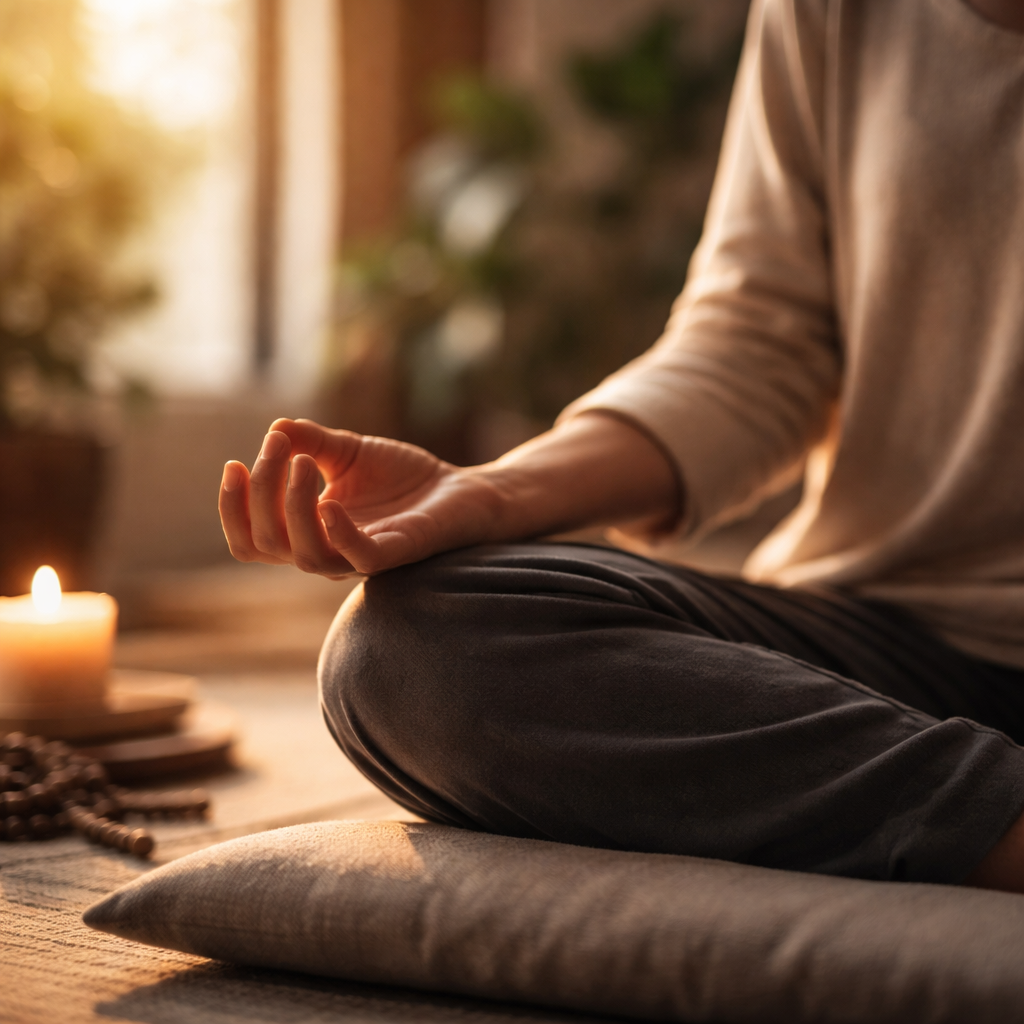
Most people who try to learn how to meditate for beginners make the same mistake: they expect silence, empty thoughts, and some kind of immediate inner peace. In reality, meditation is far messier, more human, and more accessible than any guided app or yoga retreat might suggest. And that gap between expectation and reality is exactly why so many beginners quit after three days.
What meditation actually is — and what it isn’t
Meditation is not about stopping your thoughts. That would be like trying to stop your heart from beating. The mind thinks — that’s its job. What meditation trains is your relationship with those thoughts: the ability to notice them, let them pass, and return your attention to the present moment without judgment.
This distinction matters a lot. When beginners sit down and immediately notice a flood of mental chatter, they conclude they’re “bad at meditating.” But that noticing? That’s the practice. You haven’t failed — you’ve just done exactly what meditation asks of you.
Choosing the right type of practice for where you are right now
There’s no single correct way to meditate, and that’s good news. Different techniques suit different people, moods, and life circumstances. Here are the most well-researched and widely practiced approaches:
- Focused attention meditation — you place your attention on a single anchor, most commonly the breath, and gently return to it whenever the mind wanders.
- Body scan meditation — a slow, deliberate movement of awareness through different parts of the body, often used for stress relief and sleep improvement.
- Loving-kindness meditation (Metta) — a practice of silently directing well-wishes toward yourself and others, shown in research to reduce self-criticism and increase social connection.
- Open monitoring meditation — instead of focusing on one thing, you observe all thoughts, sensations, and sounds as they arise and dissolve, without attaching to any of them.
- Walking meditation — mindful movement where attention is placed on the physical sensations of each step, useful for people who find stillness uncomfortable.
For most beginners, focused attention on the breath is the ideal starting point — it requires no equipment, no special environment, and no previous experience. Once you’ve built a basic habit, exploring other styles becomes much more natural.
A simple starting framework that actually works
Here’s a practical structure you can use from your very first session. Don’t overcomplicate it.
| Step | What to do | Duration |
|---|---|---|
| 1. Set up | Sit comfortably — chair, floor, or cushion. Keep your spine upright but not rigid. | 1–2 min |
| 2. Set a timer | Start with 5–10 minutes. Knowing the session has an end removes the urge to check the clock. | Before starting |
| 3. Close your eyes | Or soften your gaze downward. Both work equally well. | Immediately |
| 4. Breathe naturally | Don’t control the breath — just observe it. Notice the sensation of air entering and leaving. | Throughout |
| 5. Notice and return | When your mind drifts (and it will), gently bring attention back. No frustration needed. | Ongoing |
“You don’t have to be calm to meditate. You have to be willing to sit with whatever is happening.” — a principle shared across many mindfulness traditions
The common obstacles beginners face — and how to move through them
Restlessness, boredom, sleepiness, and a relentless inner monologue — these aren’t signs that meditation isn’t working for you. They’re the standard landscape of the beginner’s experience. Here’s how to handle the most common roadblocks honestly:
You can’t sit still
Try walking meditation or a body scan lying down. Physical restlessness often decreases naturally after the first two weeks of consistent practice, as the nervous system begins to associate the sitting posture with a downshift in alertness.
Your mind won’t stop
This is universally experienced. Research from the University of California has shown that the average untrained mind wanders roughly 47% of the time during waking hours. Meditation doesn’t eliminate this — it trains you to notice it faster and with less distress.
You fall asleep every time
This usually signals that you’re either meditating in a position that’s too relaxed or that you’re running a sleep deficit. Try meditating in the morning before fatigue accumulates, or sit upright without back support to help maintain alertness.
You don’t feel any different
Meditation’s benefits are cumulative and often subtle at first. Most practitioners notice changes not during sessions but in their daily reactions — less irritability, quicker recovery from stress, improved focus. These shifts tend to appear within four to eight weeks of consistent daily practice.
What science says about mindfulness and the brain
It’s worth knowing that the benefits of regular meditation practice aren’t just anecdotal. A landmark study from Harvard Medical School found that participants who meditated for an average of 27 minutes per day over eight weeks showed measurable increases in gray matter density in the hippocampus — an area associated with learning, memory, and emotional regulation. The same study found a reduction in gray matter in the amygdala, which plays a central role in stress and anxiety responses.
Beyond brain structure, consistent mindfulness practice has been linked to lower cortisol levels, improved immune function, and better quality of sleep. These aren’t soft wellness claims — they come from peer-reviewed research across multiple independent institutions.
Building consistency without burning out
The single biggest predictor of whether meditation will actually help you is consistency — not session length, not technique, not how quiet your apartment is. Five minutes every day will outperform sixty minutes once a week every single time.
A few principles that support long-term practice without turning it into another thing on your to-do list:
- Keep early sessions short enough that skipping feels lazier than doing them.
- Track your streak only loosely — missing one day shouldn’t feel like starting over.
- Vary your technique occasionally to prevent stagnation and maintain curiosity.
- Don’t evaluate sessions as good or bad. Every session counts, regardless of how distracted you felt.
There will be weeks when you meditate every day and weeks when you manage two sessions. Both are fine. What matters is returning — not performing.
The practice doesn’t end when the timer does
One thing experienced meditators consistently report is that the real value of a sitting practice shows up off the cushion — in how you respond to a difficult conversation, how quickly you recover from a frustrating moment, how present you are during an ordinary meal. This is sometimes called informal mindfulness: bringing the same quality of attention you cultivate during meditation into everyday activities.
Washing dishes with full attention. Listening without planning your response. Noticing the sensation of walking rather than running through your mental to-do list. These micro-practices reinforce the neural pathways that formal meditation builds — and they require no extra time at all.
Starting a meditation practice doesn’t require a perfect setup, a retreat, or a completely free schedule. It requires a few minutes, a willingness to show up imperfectly, and the understanding that every time you notice your mind has wandered and you bring it back — that moment is the practice working exactly as it should.