
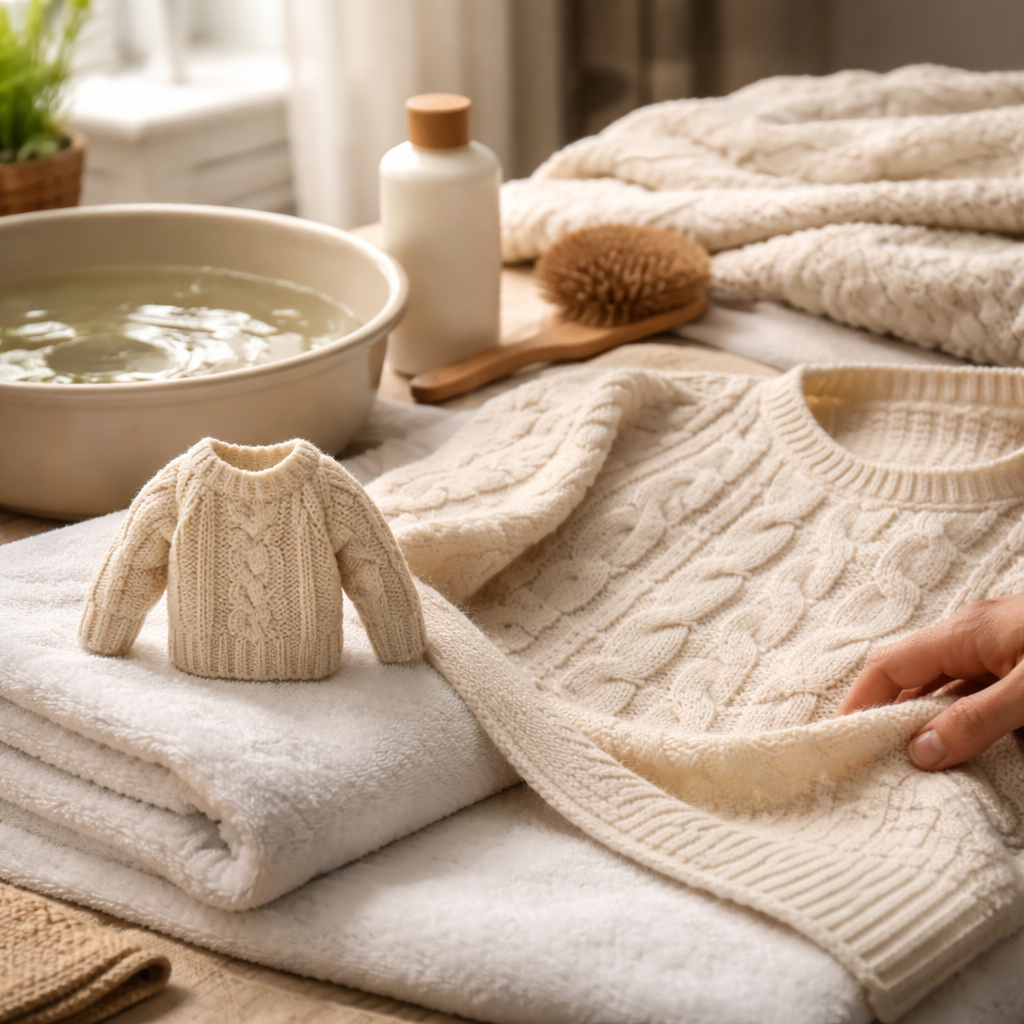
You pull your favorite wool sweater out of the dryer, and it’s now the size of a doll’s shirt — it happens to almost everyone at least once. Knowing how to fix a shrunk wool sweater can save a beloved garment that might otherwise end up in the bin, and the good news is that the process is far more forgiving than most people expect.
Why wool shrinks in the first place
Wool fibers are covered in tiny overlapping scales, similar to roof tiles or fish scales. When exposed to heat, agitation, or rapid temperature changes, those scales lock together and the fibers contract. The result is a denser, smaller fabric that feels almost felted. Understanding this mechanism matters because the method used to reverse shrinkage works directly against it — relaxing those interlocked scales so the fibers can be gently stretched back to their original dimensions.
The good news is that most wool sweaters that have shrunk moderately — not fully felted — can be restored with nothing more than lukewarm water, a mild conditioner, and a little patience.
What you will need before you start
Gathering everything beforehand makes the process smoother and reduces the risk of leaving the sweater sitting too long in water, which can weaken the fibers.
- A clean basin or bathtub large enough to submerge the sweater fully
- Lukewarm water (never hot — heat is what caused the problem)
- A gentle hair conditioner or baby shampoo (choose a sulfate-free formula if possible)
- Two clean, dry towels — ideally thick ones
- A flat surface or drying rack where the sweater can lie undisturbed
Hair conditioner might seem like an unusual choice for laundry, but it works on wool the same way it works on human hair — it softens the protein fibers and reduces the friction between the scales, making them much easier to coax apart.
The step-by-step process for unshrinking wool
This method is sometimes called the “conditioner soak” technique, and it genuinely delivers results when done carefully.
- Fill the basin with lukewarm water and add about one tablespoon of conditioner per liter of water. Swirl gently to mix.
- Submerge the sweater fully and press it down softly. Do not wring or agitate — just let it soak for 20 to 30 minutes.
- Remove the sweater without wringing. Support the entire garment as you lift it so its weight does not pull the fibers.
- Lay the sweater flat on the first dry towel and roll the towel up around it. Press firmly along the roll to absorb excess water. Unroll and transfer the sweater to the second dry towel.
- Now, while the sweater is still damp, begin gently stretching it by hand — section by section, easing the fabric outward toward its original shape. Work on the body, then the sleeves, then the neckline.
- Pin or weight the edges if needed to hold the shape, and allow it to dry completely flat, away from direct sunlight or heat sources.
Patience is doing more work here than any product. Rushing the drying stage — with a hairdryer or a sunny windowsill — risks re-shrinking the sweater all over again.
How much can you realistically restore?
The honest answer depends on the degree of shrinkage and the type of wool. A sweater that has merely tightened up after a single accidental machine wash can often be brought back almost entirely. A garment that has been tumble-dried on high heat repeatedly and has become stiff and dense is much harder — the fibers may have felted irreversibly in places.
| Level of shrinkage | Likely outcome with conditioner soak |
|---|---|
| Mild (slightly tight, shape mostly intact) | Near-full restoration is realistic |
| Moderate (noticeably smaller, some stiffness) | Significant improvement, possibly 80–90% recovery |
| Severe (heavily felted, stiff texture) | Partial improvement only; full recovery unlikely |
If a sweater falls into that third category, it is still worth trying — but it is also worth exploring creative repurposing options if restoration does not succeed.
Common mistakes that make things worse
Even people who know the general idea sometimes undo their progress with a few easy-to-avoid errors.
- Using hot water — this will cause the sweater to shrink further, not relax
- Wringing or twisting the fabric when removing it from the soak
- Stretching too aggressively in one spot instead of working gradually across the whole garment
- Hanging the sweater to dry while damp — gravity will distort the shape, especially in the shoulders and sleeves
- Using a washing machine spin cycle to remove water — the agitation and centrifugal force undo the relaxing effect of the soak
It is also worth noting that not all “wool” garments are the same. A label reading “wool blend” may include synthetic fibers that behave differently. Pure merino, lambswool, or cashmere responds best to the conditioner method, while heavily blended fabrics may need a different approach or may not respond at all.
Keeping wool sweaters safe going forward
Once you have put the effort into restoring a sweater, the last thing you want is to repeat the experience. A few straightforward habits make a significant difference in the long-term care of wool knitwear.
- Always check the care label before washing — many wool garments are hand-wash only or dry-clean only for good reason
- If machine washing is permitted, use a dedicated wool or delicate cycle with cold water and low spin speed
- Use a detergent specifically formulated for wool or delicate fibers — standard detergents can strip the natural lanolin from wool and make it more vulnerable
- Dry flat every time, reshaping the garment while it is still damp
- Store folded rather than hung — hanging places sustained tension on the shoulders and can cause permanent stretching over time
Wool is a durable, resilient natural fiber when treated with a little respect. The care it requires is not complicated — it just differs from the habits most people have built around cotton and synthetic fabrics.
When the sweater matters enough to go further
For a garment with real sentimental or monetary value — a hand-knitted heirloom, a designer merino piece, or a vintage find — it is worth considering professional textile restoration. Dry cleaners who specialize in knitwear often have blocking tools and steam equipment that allow for far more precise reshaping than home methods can achieve. Wet blocking, a technique used widely by knitters, involves pinning a damp garment to exact measurements on a foam mat and allowing it to dry in position. This level of control is difficult to replicate at home but produces consistent results.
Whatever route you take, the key principle stays the same: wool responds to moisture and gentle manipulation. Work with the fiber rather than against it, avoid heat and force at every stage, and you will almost always end up with a sweater that is wearable again — and sometimes better than you expected.