
Most people have encountered the term BMI at some point — at a doctor’s office, on a fitness app, or buried in a health article. But knowing how to calculate body mass index (BMI) yourself, understanding what the result actually means, and recognizing its limitations can make a real difference in how you interpret your own health data.
The formula behind BMI: simple math, real insight
BMI is calculated using just two measurements: your weight and your height. The formula differs slightly depending on which unit system you use.
| Unit system | Formula |
|---|---|
| Metric (kg, cm) | BMI = weight (kg) ÷ height (m)² |
| Imperial (lbs, inches) | BMI = (weight (lbs) ÷ height (inches)²) × 703 |
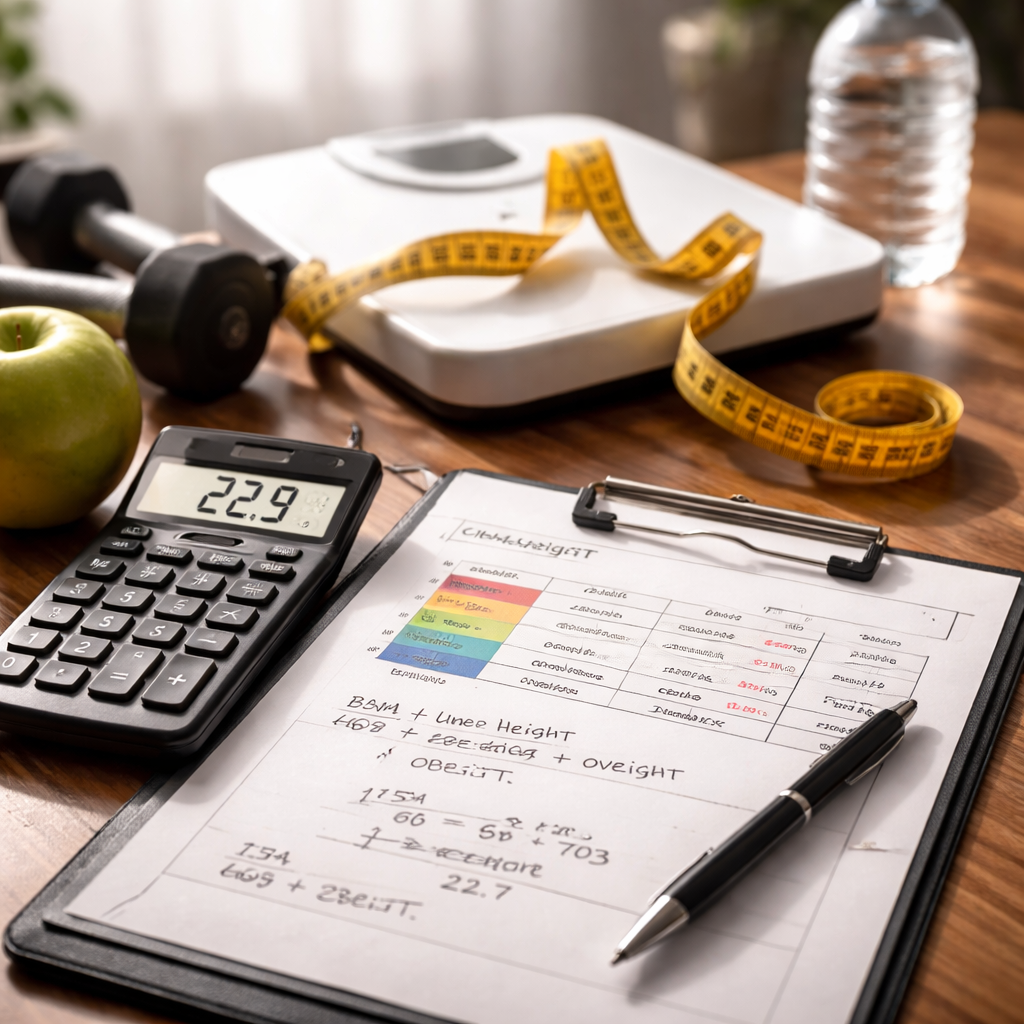
For example, if you weigh 70 kg and your height is 1.75 m, the calculation looks like this: 70 ÷ (1.75 × 1.75) = 70 ÷ 3.0625 ≈ 22.9. That number — 22.9 — is your BMI.
In the imperial system, a person weighing 154 lbs and standing 69 inches tall would calculate: (154 ÷ 69²) × 703 = (154 ÷ 4761) × 703 ≈ 22.7. Both methods yield comparable results when done correctly.
What the numbers actually mean
Once you have your BMI value, interpreting it is straightforward using the standard classification developed by the World Health Organization.
| BMI range | Category |
|---|---|
| Below 18.5 | Underweight |
| 18.5 – 24.9 | Normal weight |
| 25.0 – 29.9 | Overweight |
| 30.0 and above | Obesity |
These ranges apply to adults aged 18 and over. For children and teenagers, BMI is interpreted differently — it’s compared against age- and sex-specific percentiles rather than fixed thresholds.
BMI is a screening tool, not a diagnostic measure. A high or low BMI signals that further evaluation may be worthwhile — it doesn’t confirm the presence or absence of any health condition.
Where BMI works well — and where it falls short
BMI has been widely used in population-level health research for decades precisely because it’s fast, free, and requires no equipment. For large groups, it does a reasonable job of identifying weight-related health trends. But on an individual level, the picture gets more nuanced.
The index doesn’t distinguish between fat mass and muscle mass. A professional athlete with a very high proportion of lean muscle may register as “overweight” despite having low body fat. Conversely, someone with a BMI in the normal range can still carry an unhealthy amount of visceral fat — the type stored around internal organs that carries the greatest health risk.
BMI also doesn’t account for fat distribution. Research consistently shows that where fat is stored matters as much as how much there is. Waist circumference and waist-to-hip ratio are often used alongside BMI to get a more complete picture of metabolic health risk.
- BMI does not reflect bone density or muscle-to-fat ratio
- It doesn’t capture where body fat is distributed
- Results can be less accurate for older adults, who tend to lose muscle mass over time
- Ethnic background can influence how BMI correlates with health risk — some health organizations use adjusted thresholds for certain populations
Practical tips for using BMI meaningfully
Knowing your BMI is a starting point, not an endpoint. Here’s how to use it in a way that’s actually helpful rather than anxiety-inducing.
Think of BMI as one data point in a larger conversation about your health — valuable when combined with other measurements, context, and professional assessment.
- Track BMI over time rather than fixating on a single reading — trends matter more than snapshots
- Pair it with waist circumference: a waist measurement above 88 cm (35 inches) for women or 102 cm (40 inches) for men is associated with increased health risk, regardless of BMI
- Consider body composition testing if you’re physically active — methods like DEXA scans or bioelectrical impedance analysis give more detail
- Always discuss results with a healthcare provider before drawing conclusions about your health
BMI across different life stages
As mentioned earlier, the standard adult BMI ranges don’t apply to everyone equally. For children and adolescents, healthcare providers use BMI-for-age percentile charts. A child at the 85th to 94th percentile is considered at risk of overweight, while the 95th percentile and above falls into the obesity category.
For older adults, some clinicians argue that a slightly higher BMI — in the range of 25 to 27 — may actually be associated with better outcomes, partly because of the role that body reserves play during illness or recovery. This remains an area of ongoing research rather than settled consensus.
Pregnant women are a separate case entirely: BMI is not used to assess weight during pregnancy. Instead, gestational weight gain recommendations are based on pre-pregnancy BMI and monitored throughout the pregnancy separately.
Your number is one piece of a larger picture
BMI has real value when you understand what it can and can’t tell you. Calculating it takes less than a minute, and knowing how to read the result gives you a basic reference point for your weight status. But health is genuinely more complex than any single formula can capture — body fat percentage, cardiovascular fitness, blood markers, sleep quality, and daily activity levels all contribute to how well you feel and function.
Use BMI as an entry point into a broader awareness of your body, not as a verdict. Whether your number falls inside or outside the “normal” range, what matters most is the direction you’re moving in — and the habits you’re building along the way.