
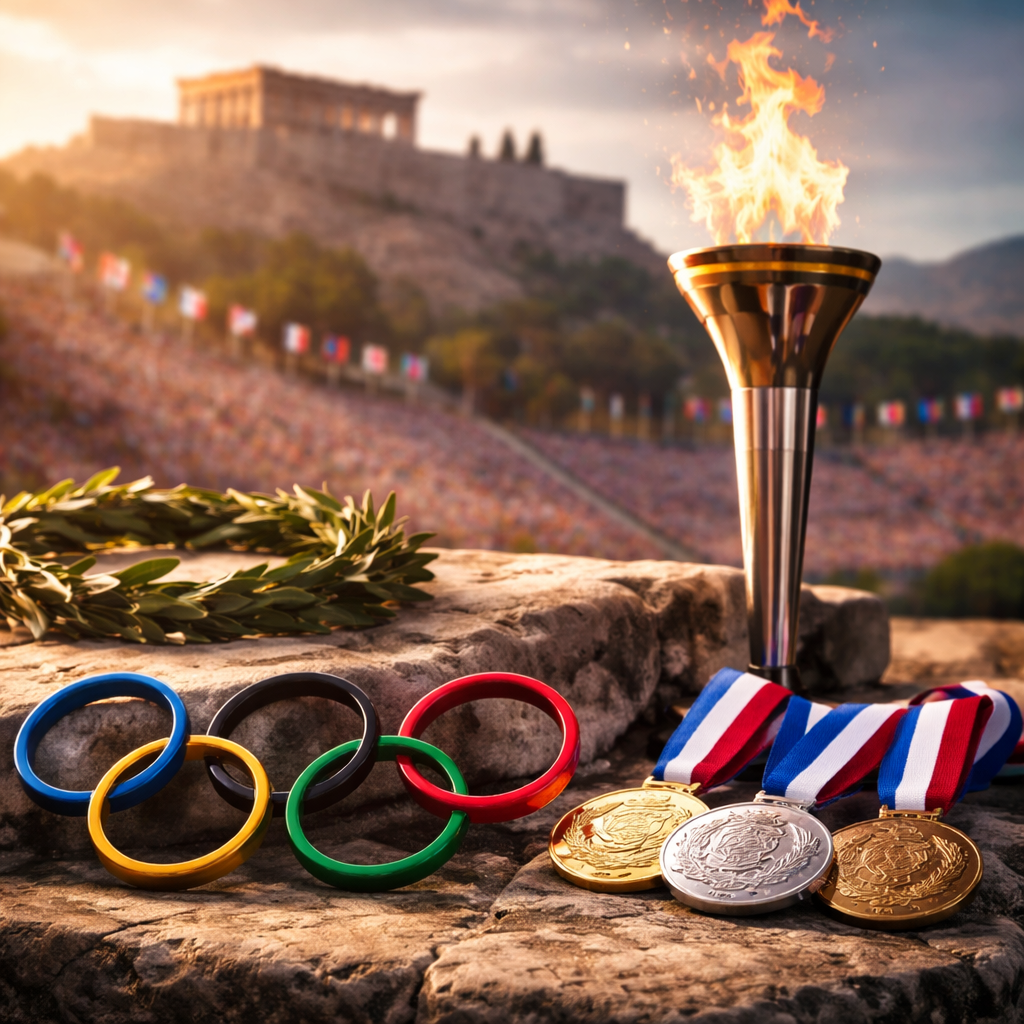
The first Olympic Games in the modern era had just 241 athletes from 14 nations — today that number has grown to over 10,000 competitors from more than 200 countries. These facts about the Olympic Games reveal just how dramatically the world’s largest sporting event has evolved, and how much fascinating history is packed into every edition of the Games.
From Ancient Greece to the Global Stage
The ancient Olympic Games were held at Olympia, Greece, and are believed to have begun as early as 776 BC. They were part of a religious festival honoring Zeus and took place every four years — a cycle the Greeks called an Olympiad. The ancient Games continued for over a thousand years before being abolished by Roman Emperor Theodosius I around 393 AD, who deemed them incompatible with Christian values.
It wasn’t until the late 19th century that French educator Pierre de Coubertin revived the concept. His vision wasn’t just athletic — he believed that international sporting competition could foster peace and cross-cultural understanding. The first modern Olympics took place in Athens in 1896, and the tradition has continued almost uninterrupted ever since. The Games were cancelled only during the two World Wars, in 1916, 1940, and 1944.
Numbers That Put the Scale Into Perspective
It’s one thing to call the Olympics “the world’s biggest sporting event” — it’s another to actually look at the numbers behind it.
| Category | Detail |
|---|---|
| First modern Olympics | Athens, 1896 — 241 athletes, 14 nations |
| Olympic motto | Citius, Altius, Fortius — Communiter (Faster, Higher, Stronger — Together) |
| Olympic rings | Five interlocking rings representing five continents |
| Summer vs. Winter Games | Held in alternating even-numbered years since 1994 |
| Paralympic Games | Held in the same host city, following the main Olympics |
The five-ring symbol, designed by Coubertin himself in 1913, was chosen because at least one of the five colors — blue, yellow, black, green, and red — appears on the flag of every nation in the world. That’s a small design detail with enormous symbolic weight.
Sports That Surprised Everyone
Not every Olympic sport has the long history people assume. Some disciplines that feel like staples of the Summer Games were actually absent for decades, or were only introduced relatively recently. On the flip side, several sports once featured at the Olympics no longer exist in the program at all.
- Tug of war was an Olympic event from 1900 to 1920.
- Solo synchronized swimming appeared at the 1984 and 1988 Games, then was removed.
- Golf and rugby sevens were reintroduced to the Olympics after absences of over 100 years.
- Skateboarding, sport climbing, and surfing are among the newer additions to the Olympic program, reflecting a deliberate effort to attract younger audiences.
- The IOC regularly reviews the sport lineup — no discipline is guaranteed a permanent spot.
This constant evolution keeps the Games relevant across generations. The decision to include urban sports like breaking (breakdancing) sparked debate, but it also showed that the Olympic movement is genuinely trying to adapt rather than simply preserve tradition for its own sake.
The Olympic Torch: A Tradition With a Complicated Past
Many people assume the torch relay is an ancient Greek tradition, but it was actually introduced at the 1936 Berlin Games — organized under the Nazi regime. The relay was conceived partly as a propaganda spectacle, designed to visually connect Adolf Hitler’s Germany to the glory of ancient Greece. That origin doesn’t define the tradition today, but it’s a part of Olympic history that’s worth knowing.
“The Olympic Games are not just athletic competitions — they are a mirror held up to the world, reflecting both its ideals and its contradictions.”
The flame itself is lit in Olympia using a curved mirror and sunlight — no lighters, no matches. It then travels through a relay of torchbearers across the host country before arriving at the opening ceremony stadium. If the flame goes out during the relay, it’s relit from a backup flame that was ignited at the original ceremony in Greece.
Records, Rivalries, and Remarkable Athletes
Olympic history is built on individual stories as much as collective achievement. Some athletes have left marks so significant they reshaped what people believe is physically possible.
Gymnast Larisa Latynina of the Soviet Union held the record for the most Olympic medals ever won — 18 in total — for over 48 years, until Michael Phelps surpassed it. Phelps eventually retired with 28 medals, 23 of them gold. That’s a collection that no other athlete in Olympic history has come close to matching.
On the track, Jesse Owens’ performance at the 1936 Berlin Games remains one of the most politically charged moments in sports history. Winning four gold medals in front of a regime that believed in racial hierarchy, he effectively dismantled its ideology through athletic performance alone.
What Most People Get Wrong About the Olympic Medal
Here’s something that catches people off guard: Olympic gold medals are not made of solid gold. They are required by the International Olympic Committee to be made of at least 92.5% silver, with a gold plating of at least 6 grams. The last time a solid gold medal was awarded was at the 1912 Stockholm Games.
Each host city designs its own medals, which is why they vary so much in appearance from Games to Games. Some editions have produced striking, unconventional designs — Tokyo’s medals, for example, were made from recycled electronics donated by the Japanese public, making them both symbolic and environmentally significant.
The Olympic Charter and the Rules You Didn’t Know Existed
The International Olympic Committee governs the Games through a document called the Olympic Charter. It outlines everything from eligibility requirements to the rules on commercial advertising. Athletes, for instance, are not allowed to use the Olympic podium or any Olympic ceremony for political demonstrations — a rule that has been at the center of controversy multiple times throughout history.
The host city, not the host country, signs the agreement to hold the Games. This is a deliberate structural choice that reflects the IOC’s intention to keep the Olympics tied to a specific place and community, rather than to a national government.
Why the Olympics Still Matter
Beyond the records and the spectacle, the Olympic Games carry weight because they bring together athletes from countries that may have strained political relationships — and they do so under a shared framework of rules, respect, and competition. That doesn’t erase geopolitical tensions, but it creates a rare space where those tensions are temporarily set aside in favor of something else.
The history of the Games is inseparable from world history. Wars, boycotts, political protests, doping scandals, and moments of extraordinary human achievement — it’s all there. Understanding the Olympics means understanding something real about how nations and individuals navigate ambition, identity, and the desire to be recognized on a world stage. And that’s what makes following the Games — edition after edition — genuinely worth your attention.