
Most people picture the North Pole as a frozen, lifeless wasteland — but the facts about the North Pole tell a completely different story. From shifting sea ice to magnetic anomalies and surprisingly rich ecosystems just below the surface, this region is far more dynamic and scientifically fascinating than popular imagination suggests.
There is no land beneath your feet — just ocean
One of the most surprising things about the geographic North Pole is that it sits not on a continent, but on the Arctic Ocean. The ice beneath your hypothetical feet floats on water roughly 4,000 meters deep. Unlike Antarctica, which rests on a solid landmass, the Arctic is essentially a massive frozen sea. This distinction has enormous implications for climate science, wildlife distribution, and geopolitical claims over the region.
Because the ice drifts with ocean currents, any marker placed exactly at 90°N will drift away within hours. Scientists and explorers who reach the Pole must constantly recalibrate their position using GPS.
The magnetic North Pole is not where you think
The geographic North Pole and the magnetic North Pole are two entirely separate points on the planet — and the magnetic one moves. It has been shifting at varying rates for centuries, influenced by the churning of molten iron deep inside Earth’s core. At certain periods, it has moved more than 50 kilometers per year, drifting from northern Canada toward Siberia.
Compasses don’t point to the top of the globe. They follow magnetic field lines, which originate from Earth’s interior and shift over time — making “true north” and “magnetic north” two different destinations.
This difference, known as magnetic declination, matters enormously for navigation — both traditional compass-based and modern aviation routing systems that depend on accurate magnetic reference data.
Six months of daylight, six months of darkness
At the North Pole, the Sun rises once a year — around the spring equinox — and sets once a year around the autumn equinox. This means roughly six continuous months of daylight followed by six months of polar night. During the summer period, the Sun simply circles the horizon rather than rising and setting in the familiar daily pattern.
This extreme photoperiod shapes everything in the Arctic ecosystem, from the feeding patterns of marine mammals to the bloom cycles of phytoplankton under the ice. It also affects human visitors in ways that are easy to underestimate — sleep disruption, altered perception of time, and significant psychological strain during extended polar nights.
What actually lives in the Arctic Ocean
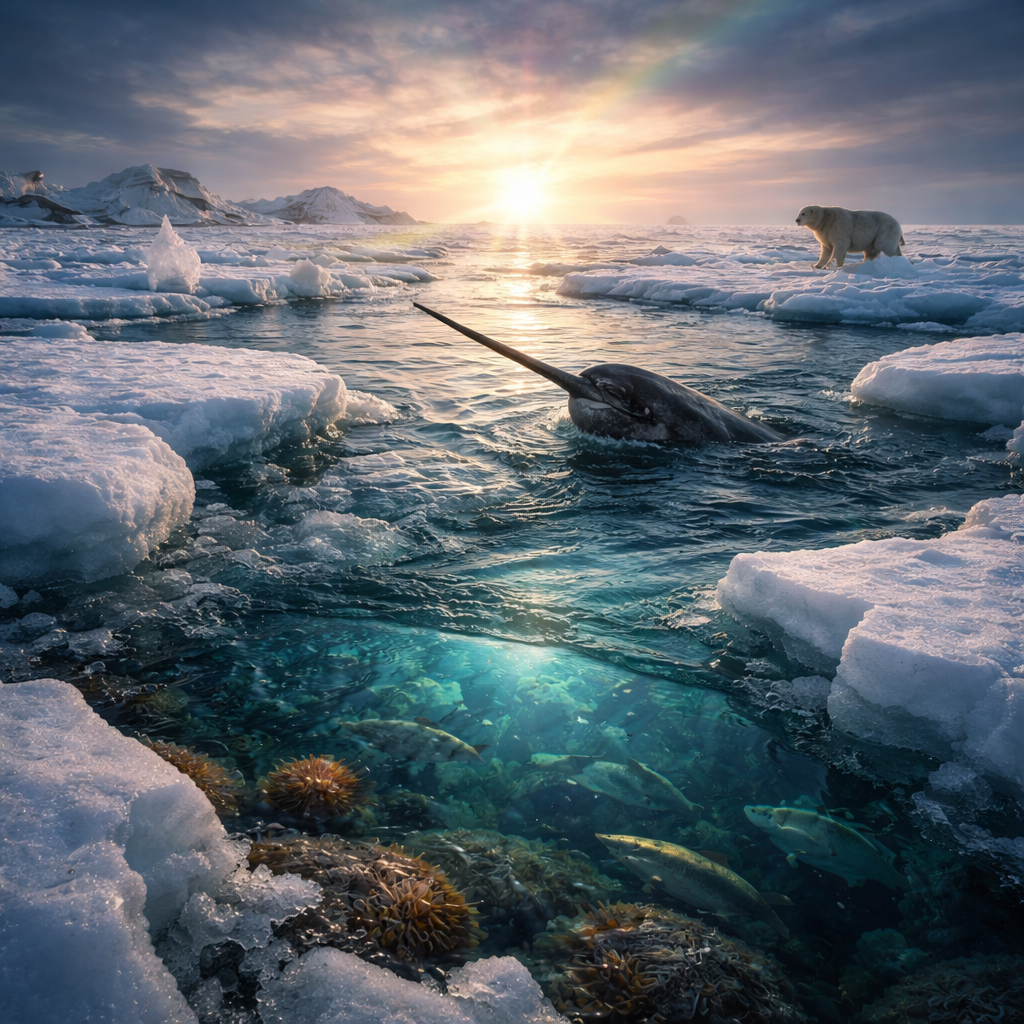
The waters surrounding the North Pole are anything but barren. The Arctic Ocean supports a surprisingly diverse range of life, particularly in its shallower shelf zones. Some of the key species include:
- Polar bears — the world’s largest land carnivores, heavily dependent on sea ice for hunting seals
- Narwhals — sometimes called “unicorns of the sea” for their elongated spiral tusks
- Beluga whales — highly vocal cetaceans that navigate under ice using echolocation
- Arctic cod — a critical link in the food chain between zooplankton and larger predators
- Ringed seals — the primary prey of polar bears and a keystone species in the ecosystem
Despite the extreme cold, microbial life thrives even within sea ice itself. Specialized algae grow in brine channels inside ice sheets, forming the base of a food web that supports the entire Arctic marine environment.
Temperature extremes and what they actually mean
The North Pole is cold — but it is not the coldest place on Earth. That distinction belongs to Antarctica. Average winter temperatures at the geographic North Pole hover around −40°C, while summer temperatures near the surface of the ice can briefly approach 0°C during the melt season.
| Location | Average Winter Temperature | Average Summer Temperature |
|---|---|---|
| Geographic North Pole | −40°C | 0°C (approx.) |
| Antarctic Plateau | −60°C to −70°C | −20°C to −30°C |
| Northern Siberia (comparison) | −30°C to −50°C | +10°C to +15°C |
The Arctic is warming significantly faster than the global average — a phenomenon scientists refer to as Arctic amplification. Sea ice extent and thickness have declined measurably over recent decades, with implications for global ocean circulation, weather patterns far beyond the Arctic, and coastal communities worldwide.
Who has sovereignty over the North Pole?
Technically, no country owns the North Pole or the Arctic Ocean surrounding it. The region is governed by international maritime law under the United Nations Convention on the Law of the Sea (UNCLOS). However, several nations — Russia, Canada, Denmark (via Greenland), Norway, and the United States — have overlapping territorial claims based on the extension of their continental shelves.
Russia famously planted a titanium flag on the seabed beneath the North Pole as a symbolic gesture, though this carried no legal weight. The geopolitical importance of the region is growing as melting ice opens new shipping routes — particularly the Northern Sea Route along Russia’s Arctic coast — and makes previously inaccessible natural resources potentially reachable.
The North Pole has been reached — but not easily
The first confirmed surface expedition to reach the geographic North Pole was led by Norwegian explorer Roald Amundsen and American Lincoln Ellsworth via airship in 1926. Earlier claims — including those by Frederick Cook in 1908 and Robert Peary in 1909 — remain disputed among historians and polar researchers due to inconsistencies in their documented evidence.
Today, reaching the North Pole on foot or by ski remains an extraordinary undertaking. Expeditions face not only brutal temperatures but also the constant movement of the ice, open-water leads that appear without warning, and the complete absence of fixed terrain. Logistically, it is considered one of the most demanding environments on the planet for human travel.
A place that keeps changing — and still matters
The North Pole is not a static symbol at the top of a globe. It is a living, shifting, scientifically vital part of our planet — one that regulates climate systems, hosts unique biodiversity, and sits at the center of international politics. Understanding what this region actually is, rather than what mythology and pop culture suggest, gives us a sharper picture of how Earth functions as a system.
Whether you are drawn to the Arctic out of scientific curiosity, environmental concern, or simply a love of the extraordinary, the deeper you look, the more complex and consequential this seemingly remote corner of the world turns out to be.