
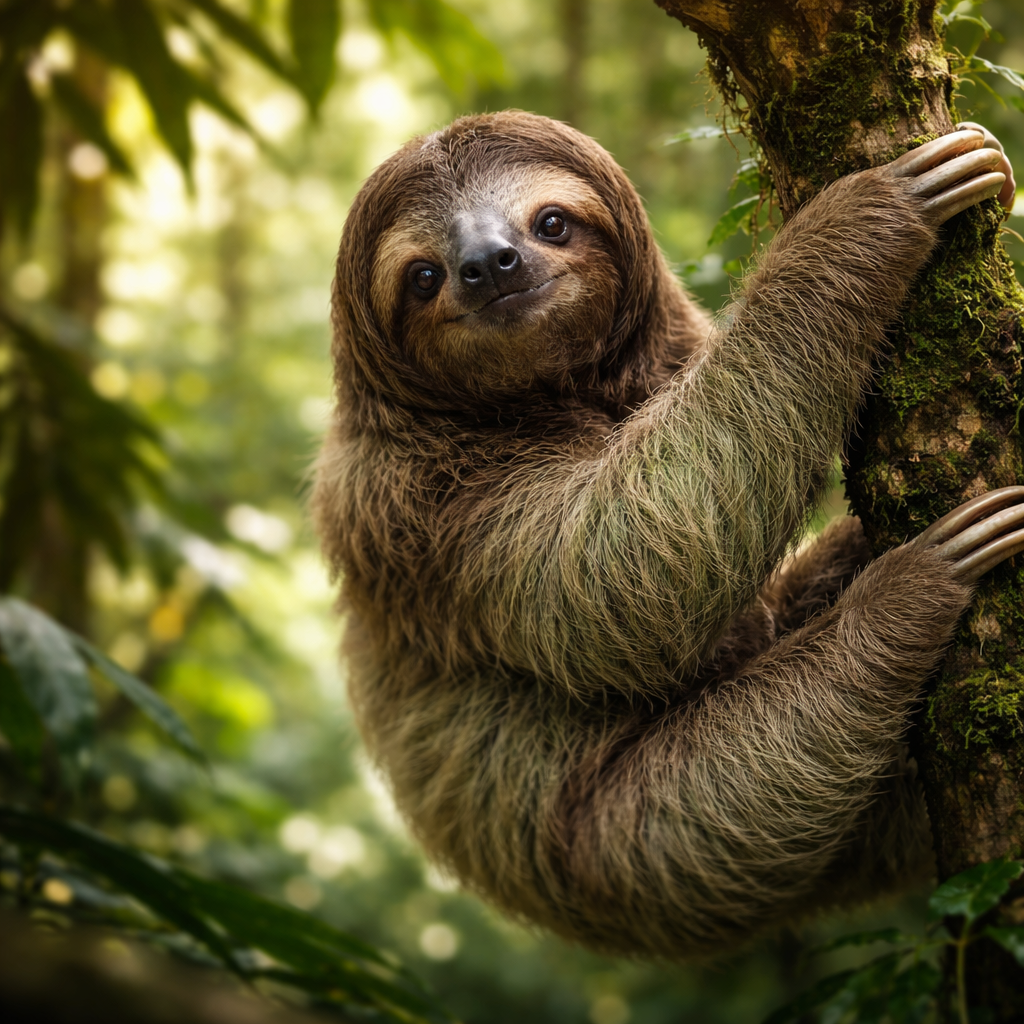
Most people assume that facts about sloths and their speed begin and end with one simple observation — they move slowly. But the reality is far more layered and, frankly, more fascinating than that. Sloths have evolved into one of the most energy-efficient mammals on the planet, and their pace is not a flaw in design — it is the design itself.
Why sloths move the way they do
To understand sloth movement, you have to start with their diet. Sloths feed almost exclusively on leaves, which are low in calories and extremely difficult to digest. Their digestive system can take up to a month to fully process a single meal. With so little energy coming in, sloths have adapted by burning as little as possible going out.
Their muscles are roughly 30% less dense than those of similarly sized mammals. This is not a disadvantage in their environment — it is a survival strategy refined over millions of years. Less muscle means less energy required just to exist. In the canopy of a tropical rainforest, where food is abundant but low in nutritional value, this trade-off makes complete sense.
The actual numbers behind sloth speed
When people ask how fast sloths actually travel, the answers often surprise them — in both directions.
| Situation | Approximate speed |
|---|---|
| Typical movement through trees | 0.03 mph (0.048 km/h) |
| Ground movement | 0.17 mph (0.27 km/h) |
| Swimming | up to 0.15 mph (0.24 km/h) |
| Alarmed or threatened | up to 0.17 mph (0.27 km/h) |
What stands out here is that sloths are actually more capable swimmers than many people realize. They can cross rivers with relative ease, holding their breath for up to 40 minutes by slowing their heart rate. In water, their buoyancy helps compensate for their lack of speed on land.
Two-toed vs. three-toed sloths: not the same animal
A common misconception is that all sloths are essentially identical. In reality, two-toed and three-toed sloths belong to entirely different families and have distinct behavioral patterns.
- Three-toed sloths are almost entirely diurnal, spending their days in slow motion through the upper canopy.
- Two-toed sloths are more nocturnal and slightly more active overall.
- Three-toed sloths tend to stay in one tree for extended periods, sometimes weeks at a time.
- Two-toed sloths have a more varied diet that can include fruit and small insects alongside leaves.
Both species share the same fundamental survival logic — conserve energy, avoid predators through stillness, and blend into the environment. But their daily rhythms and habits differ more than their similar appearances suggest.
Stillness as camouflage
One of the most underappreciated facts about sloth biology is how their slow movement directly serves as camouflage. Predators like harpy eagles and ocelots rely heavily on detecting motion. A sloth that barely moves is a sloth that is nearly invisible in the dense foliage of the rainforest canopy.
Sloths spend up to 90% of their lives hanging upside down. Their claws, not their muscles, do most of the work — allowing them to rest in place with almost no energy expenditure at all.
Green algae that grows in the grooves of their fur adds another layer of disguise, giving their coat a greenish tint that blends with the surrounding vegetation. This relationship between sloth and algae is genuinely symbiotic — the algae gets a moist, sheltered surface to grow on, and the sloth gets better concealment.
Body temperature and metabolism: the full picture
Sloths are mammals, but they behave more like reptiles when it comes to thermoregulation. Their body temperature fluctuates with the ambient temperature of their environment, ranging from around 74°F to 92°F (23°C to 33°C). This variable body temperature is directly linked to their metabolic rate and movement speed — on cooler days, they become even slower.
Their resting heart rate sits at around 40 to 50 beats per minute under normal conditions. When threatened or submerged in water, they can drop this even further. This level of physiological control over energy use is rare among mammals and is a core part of what makes sloths such an effective evolutionary experiment.
What their slow lives actually look like in practice
A sloth spends roughly 15 to 20 hours a day sleeping or resting. The remaining hours are spent in quiet feeding, grooming, or very gradual movement between branches. They do not travel far — their home range can be as small as a few acres of forest.
Despite this sedentary lifestyle, sloths are remarkably long-lived for their size. In the wild, they can live 20 to 30 years. In captivity, some individuals have reached 40 years of age. Their low metabolic rate reduces cellular wear and oxidative stress, which many researchers believe contributes directly to their longevity.
Slow does not mean fragile
It would be easy to walk away from a discussion of sloth speed thinking these animals are somehow disadvantaged. The opposite is closer to the truth. Sloths are one of the most successful mammals in the neotropical rainforest in terms of biomass — meaning there are a lot of them relative to their habitat size.
Their claws are powerful enough to support their entire body weight indefinitely and can deliver a serious defensive blow when needed. Their neck vertebrae, unusually numerous compared to most mammals, allow them to rotate their heads up to 270 degrees — giving them a wide field of vision without needing to move their body.
When you look at sloths through the lens of evolutionary biology rather than human standards of productivity, what you see is a creature that has solved the problem of survival with remarkable elegance. Slow movement, low metabolism, excellent camouflage, and a high-calorie-per-effort ratio all add up to an animal that has been thriving for over 60 million years. That is not a bad track record by any measure.