
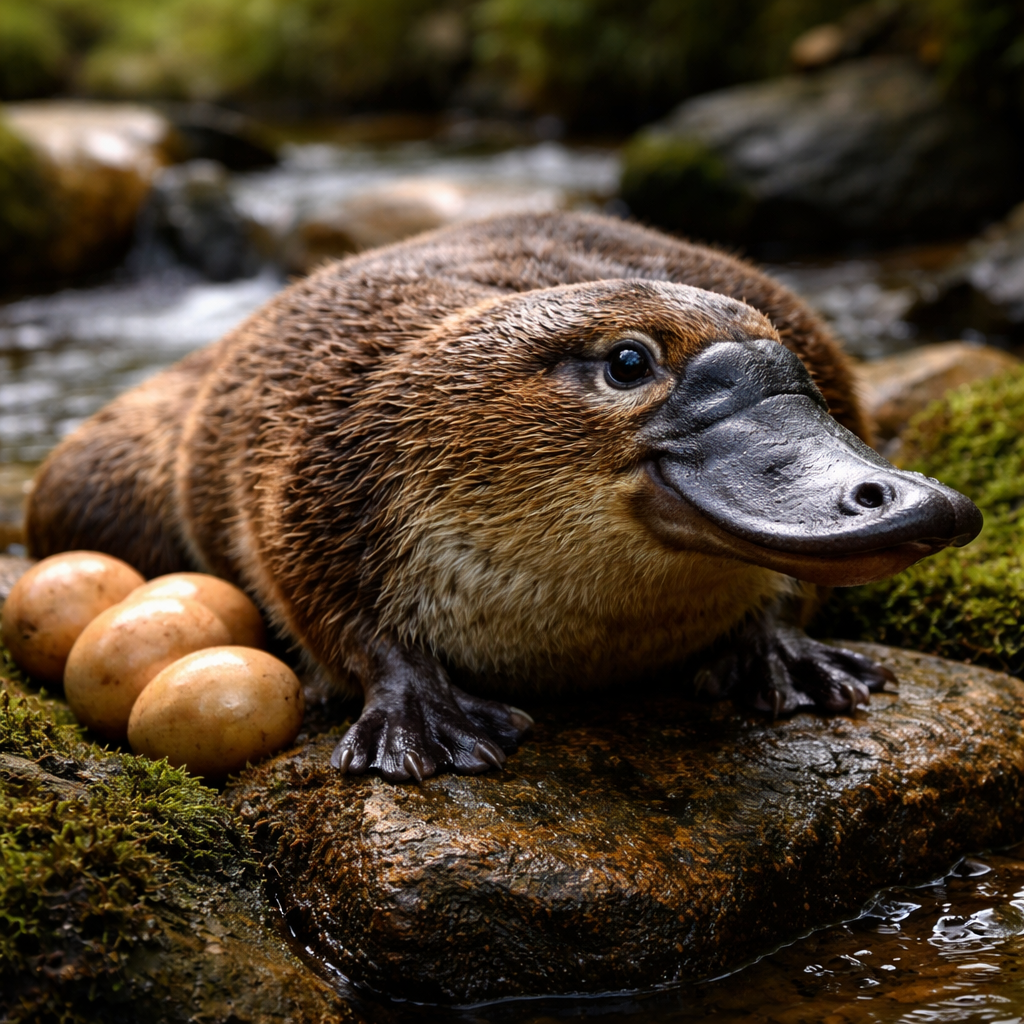
Most people can name a handful of facts about platypuses — they lay eggs and have a duck-like bill — but that barely scratches the surface of how genuinely strange this animal is. The platypus sits in a category of its own, and the more you dig into its biology, the more it reads like something a novelist invented on a dare.
A mammal that lays eggs — and means it
The platypus belongs to a group called monotremes, the only mammals on Earth that reproduce by laying eggs rather than giving birth to live young. The only other living monotremes are echidnas, which makes this club remarkably small. A female platypus typically lays one to three leathery eggs and incubates them by curling around them for about ten days.
Once the young hatch, they are tiny and helpless, and the mother feeds them milk — but not through nipples. Platypuses have no nipples at all. Instead, milk seeps through patches of skin on the mother’s abdomen, and the young lap it up. It sounds impractical, yet the species has survived for millions of years this way.
The bill is not just for show
That distinctive bill is packed with around 40,000 electroreceptors, allowing the platypus to detect the tiny electrical fields generated by the muscle movements of prey. This ability is called electroreception, and it is so precise that the animal can hunt with its eyes, ears, and nose all closed underwater, relying entirely on electric signals.
The platypus essentially has a sixth sense. While we navigate the world through sight and sound, it reads the invisible electrical language of living things moving through water.
The bill is also covered in sensitive mechanoreceptors that detect pressure changes in water, helping the platypus track movement with remarkable accuracy. When it dives, it stores sensory data and processes it between dives rather than continuously, which is a fascinating quirk of its nervous system.
Venomous — but only the males
Here is something that surprises most people: male platypuses are venomous. On the hind legs of adult males, there are spurs connected to venom glands. The venom is not lethal to humans, but it causes severe and long-lasting pain that is reportedly resistant to standard painkillers. Interestingly, the venom production increases significantly during the mating season, which strongly suggests it is used in competition between males rather than purely for defense.
Female platypuses are born with the spur structures too, but they disappear before adulthood. Scientists are actively studying platypus venom because it contains unique compounds — including a version of a hormone linked to insulin regulation — that could have medical applications in the future.
Quick biology overview
| Feature | Detail |
|---|---|
| Classification | Monotreme mammal (Ornithorhynchus anatinus) |
| Habitat | Eastern Australia and Tasmania |
| Diet | Insects, larvae, worms, freshwater crustaceans |
| Lifespan (wild) | Up to 11–17 years |
| Body length | 38–60 cm including tail |
| Reproduction | Lays 1–3 eggs per season |
| Venomous | Yes — males only, via hind leg spurs |
Sleeping habits that puzzled scientists
Research into platypus sleep revealed something unexpected. The platypus experiences REM sleep — the stage associated with dreaming in humans — but unlike most mammals, it combines REM activity with another sleep state simultaneously. It displays some of the highest amounts of REM sleep recorded in any animal, which has challenged long-held theories about why REM sleep evolved and what it is actually for.
Some researchers believe this points to the platypus representing an ancient evolutionary stage of sleep development, essentially a living window into how sleep patterns may have looked before mammals diverged into different lineages.
The genome is a biological patchwork
When scientists sequenced the platypus genome, they found it genuinely defies easy categorization. It contains genetic elements shared with reptiles, birds, and mammals — sometimes all present in the same chromosome. The sex determination system alone is extraordinary: platypuses have ten sex chromosomes rather than the two found in most mammals.
- Males have five X and five Y chromosomes
- These ten chromosomes form a chain during cell division
- Some of their sex chromosomes share more similarity with bird sex chromosomes than with human ones
- The genome also contains genes related to venom production found in reptiles
This genetic complexity makes the platypus invaluable to evolutionary biology, because it helps researchers trace where mammalian traits originated and how they developed over hundreds of millions of years.
Conservation status and threats
The platypus is listed as a vulnerable species. Its population has declined significantly due to habitat loss, water pollution, prolonged drought, and the effects of land clearing along riverbanks where it lives and burrows. Climate change has affected the river systems it depends on, reducing both water quality and the availability of prey.
Illegal fishing nets and traps placed in rivers pose a direct drowning risk, as platypuses need to surface regularly to breathe. Conservation organizations in Australia are working on habitat restoration projects, improved water management policies, and community education programs to reduce human impact on platypus populations.
Why the platypus keeps rewriting what we think we know
Every decade or so, a new study on the platypus overturns some assumption biologists held about mammals, evolution, or neuroscience. It has done this with sleep research, reproductive biology, genetics, and sensory systems. The animal is not a curiosity at the edge of the natural world — it is a central data point that helps science understand how life on Earth actually assembled itself over deep time.
There is something genuinely grounding about the platypus: it is a reminder that nature does not follow the clean categories we build for it. When a mammal lays eggs, hunts with electricity, dreams in ways we cannot fully explain, and carries a genome that blends three different vertebrate lineages, the only reasonable response is to keep asking questions.