
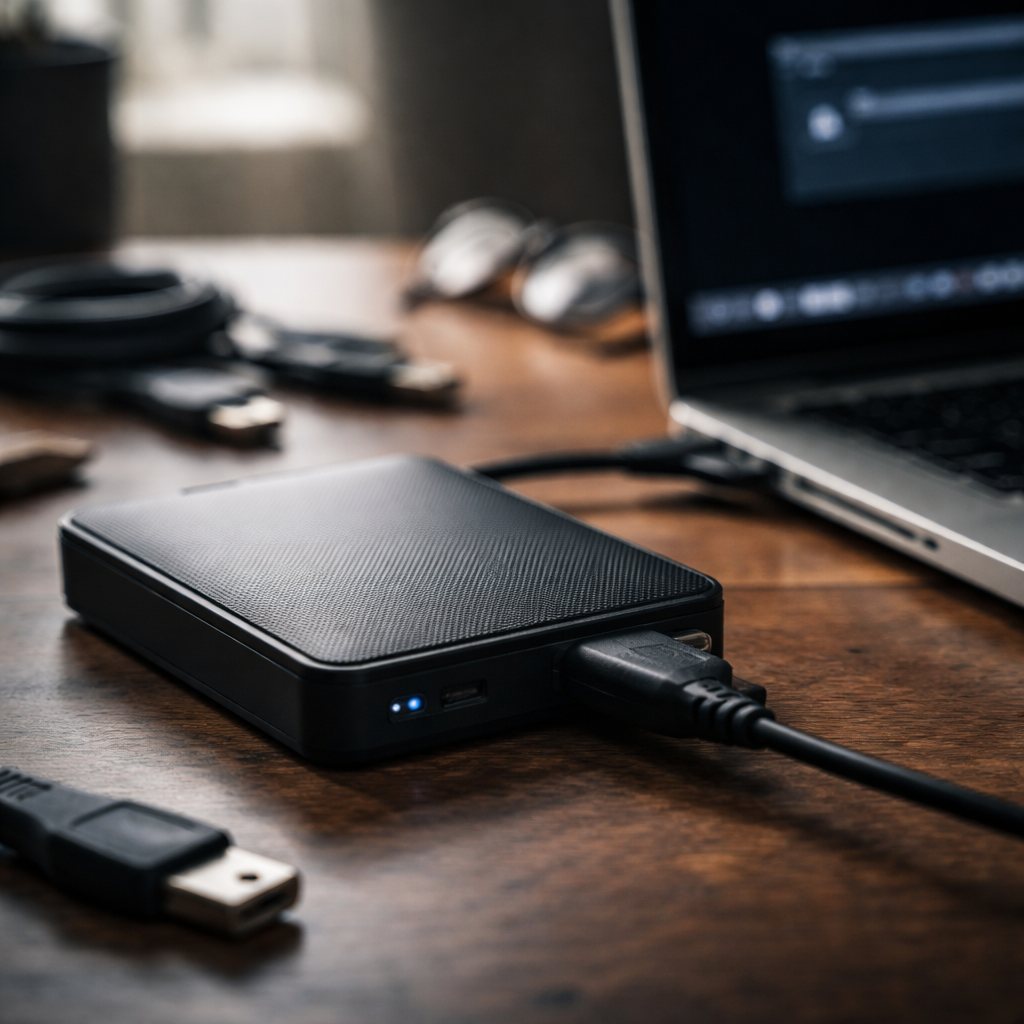
You plug in your external hard drive, hear the familiar click, and… nothing happens. No notification, no new drive appearing in the file explorer, just silence. If your external hard drive not working is the problem you’re staring at right now, you’re not alone — and in most cases, this is fixable without losing a single file.
Before you panic or reach for your wallet to buy a replacement, it’s worth understanding what’s actually going on. External drives fail for a surprisingly wide range of reasons — some are hardware-related, others are purely software or driver conflicts. Knowing the difference can save you hours of frustration.
Start with the basics before assuming the worst
It sounds obvious, but a huge percentage of drive issues come down to physical connection problems. Try a different USB cable — cables degrade over time and are often the real culprit. Then try a different USB port on your computer. If you’re using a USB hub, bypass it entirely and connect directly to the machine. These three steps alone resolve a significant number of cases.
Also check whether the drive shows any signs of power. Most portable drives are bus-powered, meaning they draw electricity through the USB connection itself. If the drive doesn’t spin up or show any indicator light, the port may not be supplying enough power — this is especially common on older laptops.
A drive that isn’t recognized isn’t necessarily dead. It’s often just not being seen correctly by the operating system — and that’s a very different problem with a very different solution.
Check Disk Management and Device Manager on Windows
If the drive isn’t showing up in File Explorer but your computer does register that something was plugged in, the issue is likely at the software level. Open Disk Management by right-clicking the Start button and selecting it from the menu. Here you may find your drive listed but without an assigned drive letter — which is why it’s invisible in Explorer.
Right-click on the drive partition and choose “Change Drive Letter and Paths,” then assign a letter manually. That often brings the drive back immediately.
If the drive appears in Device Manager with a yellow warning triangle, you’re looking at a driver issue. In that case:
- Right-click the device and select “Uninstall device”
- Disconnect the drive and restart your computer
- Reconnect the drive and let Windows reinstall the driver automatically
- If that doesn’t help, visit the drive manufacturer’s website and download the latest driver manually
What Mac users should check first
On macOS, open Disk Utility and see whether the drive appears in the left-hand sidebar. If it does but is greyed out or shows as unreadable, try clicking “Mount” or running “First Aid” on the volume. First Aid scans for filesystem errors and can repair minor corruption automatically.
If the drive doesn’t appear at all, check System Information under the USB or Thunderbolt section to confirm whether the hardware is being detected at all. This tells you immediately whether you’re dealing with a hardware or software problem.
When the drive makes noise — and what it means
There’s a big difference between the sounds a failing drive can make. A repeated clicking sound — often called the “click of death” — typically means the read/write heads are failing to locate the magnetic platters correctly. This is a serious mechanical issue. A grinding or scraping noise points to physical damage inside the enclosure.
If you hear either of these sounds, stop using the drive immediately. Continued use can make data recovery harder or impossible. At this point, professional data recovery services are the safer path — though they can be expensive, ranging from a few hundred to over a thousand dollars depending on the damage.
| Sound or symptom | Likely cause | What to do |
|---|---|---|
| No sound, not detected | Connection or power issue | Try different cable, port, or computer |
| Detected but inaccessible | Filesystem error or missing drive letter | Use Disk Management or Disk Utility |
| Clicking noise | Head failure (mechanical) | Stop using — contact data recovery service |
| Drive shows but files missing | Partition corruption or accidental format | Try recovery software like Recuva or TestDisk |
| Slow transfer speeds | Bad sectors or USB 2.0 bottleneck | Run CHKDSK or check interface version |
Recovering files when the drive is still partially readable
If the drive mounts but you can see that files are missing or folders look corrupted, data recovery software can often pull content back from damaged or reformatted drives. Tools like Recuva (Windows), Disk Drill (cross-platform), and TestDisk (free and open-source) are widely used and genuinely effective for logical data loss.
The key rule when using any recovery software: never write new data to the damaged drive while attempting recovery. Every new file written can overwrite the data you’re trying to retrieve. If possible, create a sector-by-sector clone of the drive first using a tool like ddrescue, then run recovery on the clone.
Preventing this from happening again
Once your drive is working again — or once you’ve replaced it — a few habits can dramatically reduce the risk of this happening in the future. External drives are more vulnerable than internal ones simply because they get moved around, unplugged suddenly, and used on different devices.
- Always eject the drive safely before unplugging — abrupt disconnections can corrupt the filesystem
- Avoid moving a spinning hard drive while it’s active — SSDs are more tolerant, but traditional HDDs are not
- Don’t rely on a single external drive as your only backup — follow the 3-2-1 rule: three copies, on two different media, with one stored offsite or in the cloud
- Check drive health periodically using tools like CrystalDiskInfo (Windows) or DriveDx (Mac), which read S.M.A.R.T. data and can warn you before failure happens
Most external drives give warning signs before they fully fail — slower performance, occasional disconnects, or strange sounds. Catching these early gives you time to back up your data rather than scrambling to recover it.
When it’s time to let go and move on
Not every drive can be saved, and that’s simply the reality of mechanical and electronic hardware. If you’ve worked through every software fix, tried multiple computers, and the drive still won’t respond — and professional recovery isn’t worth the cost for what’s stored on it — then replacing the drive is the right call.
Solid-state external drives have become far more affordable in recent years and offer a meaningful improvement in durability over traditional spinning drives. They’re less sensitive to drops, handle temperature changes better, and tend to fail more gracefully — often giving more warning time before complete failure. If you’re replacing a drive that gets heavy daily use, an SSD is worth the extra investment.
Whatever path you take — whether you fix it yourself, use recovery software, or hand it off to professionals — the experience of a drive failure is a reminder that no storage device is permanent. Treat your external drive as a convenience, not a vault, and your data will always be safer for it.